
The Hidden Faces of Water Injustice in South African Communities: How Water Scarcity Silently Shapes Lives, Health and Human Dignity
- Posted by ukzn-admin
- Categories News
- Date March 31, 2026
When citizens talk about water scarcity in their communities, it is easy to think in terms of numbers – litres per household, rainfall averages, or drought severity indices. However, behind every data point lies a human story. Water scarcity is not simply an environmental issue; it is a profound social and human rights challenge that determines who thrives and who is left behind.
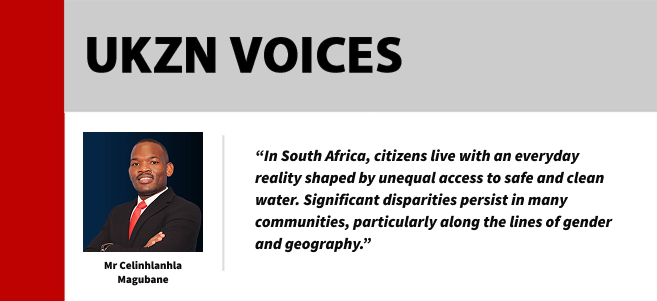
In South Africa, citizens live with an everyday reality shaped by unequal access to safe and clean water. Significant disparities persist in many communities, particularly along the lines of gender and geography. Rural women often face elevated risks of physical injury, harassment or violence when travelling to distant water points or using shared sanitation facilities. These experiences represent some of the hidden faces of water injustice in South African communities, which the Government of the Republic of South Africa has a constitutional duty to address.
The Human Right’s perspective with regards to access to water
The Constitution of the Republic of South Africa provides in section 27(1)(b) that everyone has the right to have access to sufficient food and water. Importantly, section 27(2) requires the state to take reasonable legislative and other measures, within its available resources, to achieve the progressive realisation of this right. Access to water is therefore a human rights issue, and the Government has a positive obligation to ensure that citizens can access this essential resource.
This principle was reinforced by the Constitutional Court in Mkontwana v Nelson Mandela Metropolitan Municipality 2005 (2) BCLR 150 (CC), where the Court noted that one of the five key objectives of local government is to ensure the provision of services to communities in a sustainable manner. This includes the provision of water supply. Municipalities therefore play a crucial role in service delivery at the local sphere of government and bear the responsibility for ensuring access to water. They must develop plans for water provision that take into account effective service delivery, particularly in informal settlements and disadvantaged communities.
Furthermore, human rights exist within an intrinsically interconnected and mutually reinforcing framework in South Africa’s Constitution. The right of access to water cannot be viewed in isolation, as it is closely linked to other rights, including the rights to life, dignity, health, adequate housing and food. Consequently, inadequate access to water generates a wide range of social, economic and health-related challenges.
The Constitutional Court in Mazibuko and Others v City of Johannesburg and Others 2010 (4) SA 1 (CC) also emphasised that, across cultures and throughout history, water has been recognised as fundamental to human existence. The Court noted that water is synonymous with life itself: without it, no organic matter can grow or be sustained. Human beings require water for drinking, cooking, washing and cultivating food, and without it survival is impossible. It is therefore unsurprising that the Constitution expressly guarantees the right of access to water, recognising its essential role in securing human dignity and wellbeing.
To give effect to the right to water, the Constitution is supported by the Water Services Act 108 of 1997. The purpose of this Act is to regulate the provision of basic water supply and sanitation services. The Act recognises that access to basic water supply is necessary to ensure sufficient water and to maintain an environment that is not harmful to the health and wellbeing of people and animals.
International law perspective on the rights to water
The obligation to ensure access to water does not rest solely on the South African government in terms of domestic law. South Africa is also bound by several international instruments it has ratified, which impose a duty on the government to guarantee access to water for all citizens.
South Africa has committed to the 2030 Agenda for Sustainable Development adopted by the United Nations in 2015. Central to this commitment is Sustainable Development Goal 6, which calls on governments to ensure the sustainable management of water and sanitation and to achieve universal access to safe and affordable drinking water by 2030.
Furthermore, on 30 July 2019 the African Commission on Human and Peoples’ Rights adopted guidelines on the right to water in Africa. These guidelines require governments to pursue integrated water strategies aimed at realising the right to water and other related human rights, including the rights to life and the survival and development of children.
In 2010, the United Nations General Assembly also recognised the right to safe and clean drinking water as a human right through Resolution 64/292. This resolution affirms that access to safe drinking water is essential for the full enjoyment of life and all other human rights. The right is also derived from Article 11(1) of the International Covenant on Economic, Social and Cultural Rights.
Conclusion
The right to water is firmly established within international human rights law and South Africa’s constitutional framework. This underscores the central importance of water for life, dignity, and socio-economic development. South Africa’s Constitution, together with its supporting legislation and jurisprudence, imposes a clear obligation on the government to progressively realise equitable access to water for all citizens. However, the practical implementation of these constitutional obligations continues to reveal deep structural inequalities.
Although water is a naturally occurring resource, access to it in South Africa remains profoundly unequal. Industries and wealthy households benefit from consistent and reliable piped water, while indigent communities – particularly women in rural areas – often spend long hours collecting water from distant and inadequate sources. This inequity highlights the gap between South Africa’s constitutional and international commitments regarding the right to water and the lived realities of many communities.
*Celinhlanhla Magubane lectures Administrative Law, Jurisprudence (Legal Philosophy), and Street Law at the School of Law. His research interests are in Human Rights (Constitutional law), Administrative Law and Jurisprudence.
*The views and opinions expressed in this article are those of the author and do not necessarily reflect the official policy or position of the University of KwaZulu-Natal.

Previous post


