
International Voice Expert Shares Insights on Vocal Health with UKZN Students
- Posted by ukzn-admin
- Categories News
- Date March 27, 2026
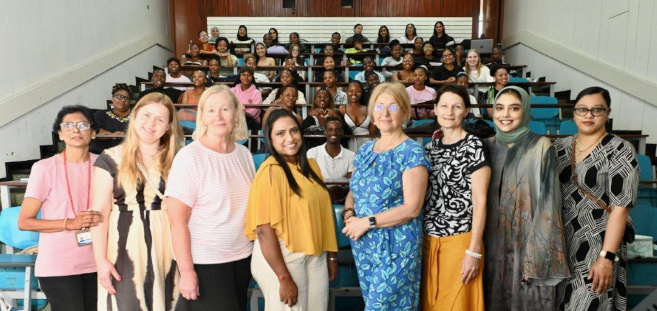
Speech-Language Therapy students at the University of KwaZulu-Natal (UKZN) recently gained valuable insights into vocal health and voice ergonomics during a guest lecture by internationally recognised voice researcher Professor Baiba Trinite from the Liepaja Academy at Riga Technical University in Latvia.
Hosted by Dr Angela James of the School of Arts in the College of Humanities and Dr Urisha Naidoo of the College of Health Sciences, the lecture formed part of UKZN’s efforts to expose students to global research and best practices in speech-language therapy.
Trinite, a specialist in voice research and occupational voice disorders, introduced students to the concept of voice ergonomics – the study of how working environments and behaviours affect vocal health.
“Voice ergonomics is about awareness of work-related risk factors for voice disorders and learning how to improve voice production and speech intelligibility in different work environments,” she said. “The goal is to prevent occupational voice disorders before they develop.”
She noted that about one-third of the global workforce depended on their voice as a primary tool of communication, making vocal health an important consideration in many professions.
Trinite explained the distinction between professional voice users, such as actors and singers who receive formal vocal training, and occupational voice users, including teachers, coaches, customer service workers and clergy, who rely heavily on their voices but often receive little training on how to care for them.
“Occupational voice users are expected to use their voices intensively, yet many have never been taught how to protect them,” she said. “This makes them particularly vulnerable to voice disorders.”
Teachers, she explained, are among the groups most affected by voice-related challenges because of the demanding vocal environment of classrooms. Background noise, poor acoustics and long hours of speaking can significantly increase vocal strain.
Drawing on research conducted in Latvian schools, Trinite explained that classroom noise often originated from multiple sources, including outdoor traffic, corridors, nearby classrooms and equipment such as data projectors.
“The noise in classrooms has a cumulative effect,” she said. “When background noise increases, speakers naturally raise their voices. This is known as the Lombard effect, where we increase vocal loudness in response to noise.”
Studies presented during the lecture showed that average background noise levels in classrooms can reach around 57 decibels during lessons and increase to more than 70 decibels during lunch breaks, requiring teachers to raise their voices to remain audible.
Trinite also discussed the role of reverberation, the persistence of sound after it is produced, in shaping how voices carry in a room. Research suggests that the optimal reverberation time for speech in classrooms is about 0.7 seconds, allowing speech to remain clear without excessive vocal effort.
However, studies conducted in Latvian schools found that reverberation times can vary significantly, sometimes reaching levels that place additional strain on teachers’ voices.
Interestingly, relatively small environmental adjustments can significantly improve classroom acoustics. In one example, simply installing window blinds reduced reverberation time dramatically, demonstrating that effective solutions do not always require major financial investment.
“Sometimes we do not need big budgets to improve acoustic conditions,” she said. “Small adjustments can make classrooms much more comfortable for teachers’ voices.”
The lecture also highlighted the role of indoor air quality in vocal health. Dusty environments, often associated with chalkboards or poorly ventilated classrooms, can irritate the vocal tract and increase the risk of voice problems.
In addition to environmental factors, Trinite emphasised the importance of posture and body awareness when speaking. Poor posture, including excessive neck extension or shoulder tension, can place unnecessary strain on the vocal mechanism.
“Your body is the house of your voice,” she explained. “If the body is uncomfortable or tense, the voice cannot function optimally.”
She encouraged students to pay attention to their posture, particularly when working with children, where therapists may unintentionally adopt awkward speaking positions.
Trinite also highlighted the importance of healthy vocal habits, such as reducing speaking distance instead of raising one’s voice, allowing periods of vocal rest during the day, and staying well hydrated.
“If you have a break, give your voice a break as well,” she advised. “Come closer to the people you are speaking to instead of raising your voice. Every additional metre of distance increases vocal loudness.”
The lecture left a strong impression on students, many of whom described it as both educational and inspiring.
Third-year Speech-Language Therapy student Ms Namisa Nzama said the session broadened her understanding of the importance of vocal care within the profession.
“I found the lecture very informative,” she said. “It made me realise how important it is for speech-language therapists to protect their own voices while also helping others care for theirs. As future professionals who work with communication and voice every day, we need to lead by example.”
Fourth-year student Ms Asanda Ntshangase said the lecture was both engaging and reassuring, particularly as she prepares to enter professional practice.
“I found the lecture very calming,” she said. “It reminded us that taking care of our voices is part of taking care of ourselves as professionals, especially when we are working in environments where we have to speak for long periods.”
Fellow student Ms Sbahle Ncube said the session left her feeling optimistic about the future of the field and the role young professionals can play in promoting vocal health.
“I really enjoyed the lecture and it made me feel very excited about the future,” she said.
“Learning about voice ergonomics showed me how much impact speech therapists can have, not only with patients but also in workplaces and schools.”
Trinite also highlighted the importance of vocal training. Research involving choir conductors – who typically receive formal voice training – found that extended periods of speaking did not significantly affect their vocal parameters.
“This shows that when people are trained to use their voices correctly, even prolonged speaking does not necessarily damage the voice,” she said.
For this reason, she encouraged future speech-language therapists to prioritise vocal training and awareness as part of their professional preparation.
Trinite also urged students to see themselves as advocates for vocal health in the workplaces they will enter.
“You should be the role model,” she told students. “Speech-language therapists should be ambassadors of voice ergonomics in schools and healthcare settings.”
She outlined several foundations for healthy voice use, including vocal mindfulness, breathing exercises, stretching, voice warm-ups, hydration and maintaining a positive mindset.
Even short vocal warm-ups lasting just a few minutes, she noted, can help prepare the voice for extended speaking.
To reinforce these principles, Trinite gave students a creative assignment to design a voice ergonomics awareness flyer using landmarks from their own cities or countries to illustrate key messages about vocal health.
The project forms part of broader international initiatives to promote professional voice development programmes, which Trinite and her collaborators are sharing with academic and clinical communities worldwide.
Her visit to UKZN, together with colleagues Professor Gundega Tomele and Ms Zane Tumševica, also opened opportunities for future collaboration in voice research and speech-language therapy education between the institutions.
For UKZN students preparing for careers in speech-language therapy, the lecture offered both scientific insight and practical guidance on protecting one of the most essential tools of their profession – the human voice.
Words: Nombuso Dlamini
Photograph: Albert Hirasen


