
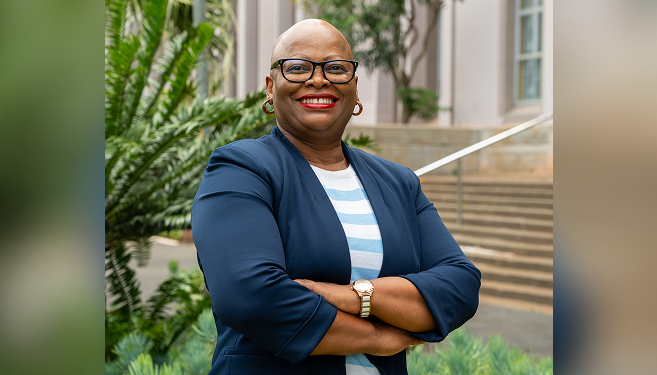
Professor Nobuhle Hlongwa: Decades of Dedication to IsiZulu Scholarship
- Posted by ukzn-admin
- Categories News
- Date March 31, 2026
The journey of seasoned IsiZulu Professor Nobuhle Hlongwa in academia has been long.
Today, she is the Head and Dean of the School of Arts at the University of KwaZulu-Natal (UKZN) and a champion of isiZulu.
After arriving as a starry-eyed student at the University of Durban-Westville (now UKZN Westville campus), Hlongwa landed a temporary lecturing job in 1998 to relieve another lecturer. Relating her journey, she said: “My journey in academia is long, starting with arriving as an inexperienced lecturer. It really has been long, although there are ups and downs but if you remain resolute, there is no stopping you from succeeding. I started as a junior lecturer, relieving someone for six months.”
As fate would have it, soon there was a vacancy for a contract worker. Her colleagues in the department encouraged her to apply. While still battling with impostor syndrome, she applied nonetheless, and got a three-year contract. At the end of that contract, she was appointed as a junior lecturer in the Department of isiZulu.
Hlongwa says academia is demanding. “We (academics) are expected to research in our fields. As someone in the isiZulu discipline, I progressed through publishing journal articles, books and attending national as well as international conferences,” she added.
Her work as an isiZulu specialist has opened her eyes, taken her on travels around the world and made her meet academics from other countries. She has been to countries such as France, England, the USA, Canada, Spain, Romania, China, Bulgaria, Norway, Zimbabwe, Italy and others. “There are few countries I have not visited because of isiZulu,” she said, citing a trip to China in 2024, where she met a Beijing professor of isiZulu who speaks isiZulu fluently.
Hlongwa has risen through the academic ranks. “From junior lecturer, I was promoted to senior lecturer, later associate professor. I am now a full professor of isiZulu.”
She holds a UPGDE from UKZN, a Bachelor of Arts, a BA Honours, a master’s, and a DLitt from the former UDW (University of Durban Westville). She is a C2 rated social scientist by the National Research Foundation, a winner of multiple academic awards. She is the author of the book “Ukuhlelwa Kolimi” (Language Planning) and co-author of a recently published book “Ubuciko Bokwethiwa Kwamagama” (Onomastics). In addition, Hlongwa has supervised several MA and PhD students to completion, and examined a number of MA and PhD theses for different universities.
Hlongwa is now the Dean and Head of the School of Arts in the College of Humanities at UKZN. “In a nutshell, the Dean provides strategic direction for the school that has seven new disciplines namely: African Languages; Cultural Studies, Media, and Fine Arts; History; Language and Literature; Music, Drama & Performance; Philosophy; Theology and Religion” she explained.
For her scholarship, she has received a string of accolades including the Mellon Merit Award for Younger Scholars in Humanities, Development and Social Sciences in 2008/09, a Merit Award in 2007 for excellence in University Service and Community Involvement, a Bilingualism/Multilingualism award in the College of Humanities in 2012 and in 2018 she was among the top 10 Most Published Women Researchers in the College of Humanities. She has co-guest edited 10 special issues of Alternation Journal. The latest one is written entirely in isiZulu with abstracts available in isiZulu and English. Hlongwa was honoured by the Academy for Multilingualism at the University of the Free State in 2025 for her outstanding commitment and significant contribution to the advancement and promotion of isiZulu in South African Higher Education and beyond.
Hlongwa is the Chairperson of KwaZulu-Natal Geographical Names Committee and represents the province in the South African Geographical Names Council. Hlongwa is also the Chairperson of the Community of Practice for the teaching and learning of African Languages (CoPAL) which forms part of the devolved governance structure of Universities of South Africa (USAf). She is a member of the Higher Education Quality Committee (HEQC) and Accreditation Committee, both of which are subcommittees of the Council on Higher Education (CHE). Her work at USAf has been an eye-opener about the lack of understanding basic human rights when it comes to language matters in Higher Education. She encourages Africans to emulate the example of the Afrikaners in relation to matters that pertain to language development and preservation whether you are referring to isiZulu, isiXhosa, Sesotho or even KiSwahili which is a lingua franca of Africa.
As the world celebrated International Mother Tongue on 21 February, which was declared by UNESCO, Hlongwa called on Black South Africans to take the issue of their mother tongues seriously. “Since 2026 is the fifth year of the International Decade of Indigenous Languages, we advocate for our mother tongues, our indigenous languages to be catered for, not just in institutions of higher learning but also in all spheres of life. When we talk about Parliament, the law, health and all fields including banking, our languages must be catered for. UNESCO made this declaration because Africa is the only continent where education is not conducted in indigenous languages, but in colonial languages.”
Hlongwa said this was as a result of colonisation. “Remember Africa was colonised and divided up, where colonisers said ‘give me Senegal’, ‘give me South Africa’ and ‘give me Zimbabwe’. Although our leaders have made efforts to liberate Africa, they still fail to address the language question. Indigenous African languages must take their rightful place in Africa. In institutions of higher learning, we still fight the language wars to ensure that they become languages of teaching and research, but it is difficult because of resistance.
“We need to intensify this fight. One of the ways to intensify it is the bold decision taken by the Department of Basic Education of introducing Mother Tongue-Based Bilingual Education (MTBBE). Here we are saying we must include the mother tongue as part and parcel of teaching, learning and assessment. This is based on research they conducted, which shows that learners whose first language is English or Afrikaans perform better than those who are second or third language speakers of English in schools,” she added.
Hlongwa said it is imperative that social media is harnessed in initiatives to deepen isiZulu. “We always emphasise that our languages must not be left behind in social media platforms. I must use isiZulu, isiXhosa and Sesotho so that our languages are not left behind. We encourage people to take pride in their languages. Now, with the advent of artificial intelligence, we are saying that our languages must be included in the digital spaces.”
Words: Langa Khanyile
Photograph: Supplied

Previous post


