
Rural Women Transform Their Lives Through Small-Scale Farming
- Posted by ukzn-admin
- Categories News
- Date September 2, 2026
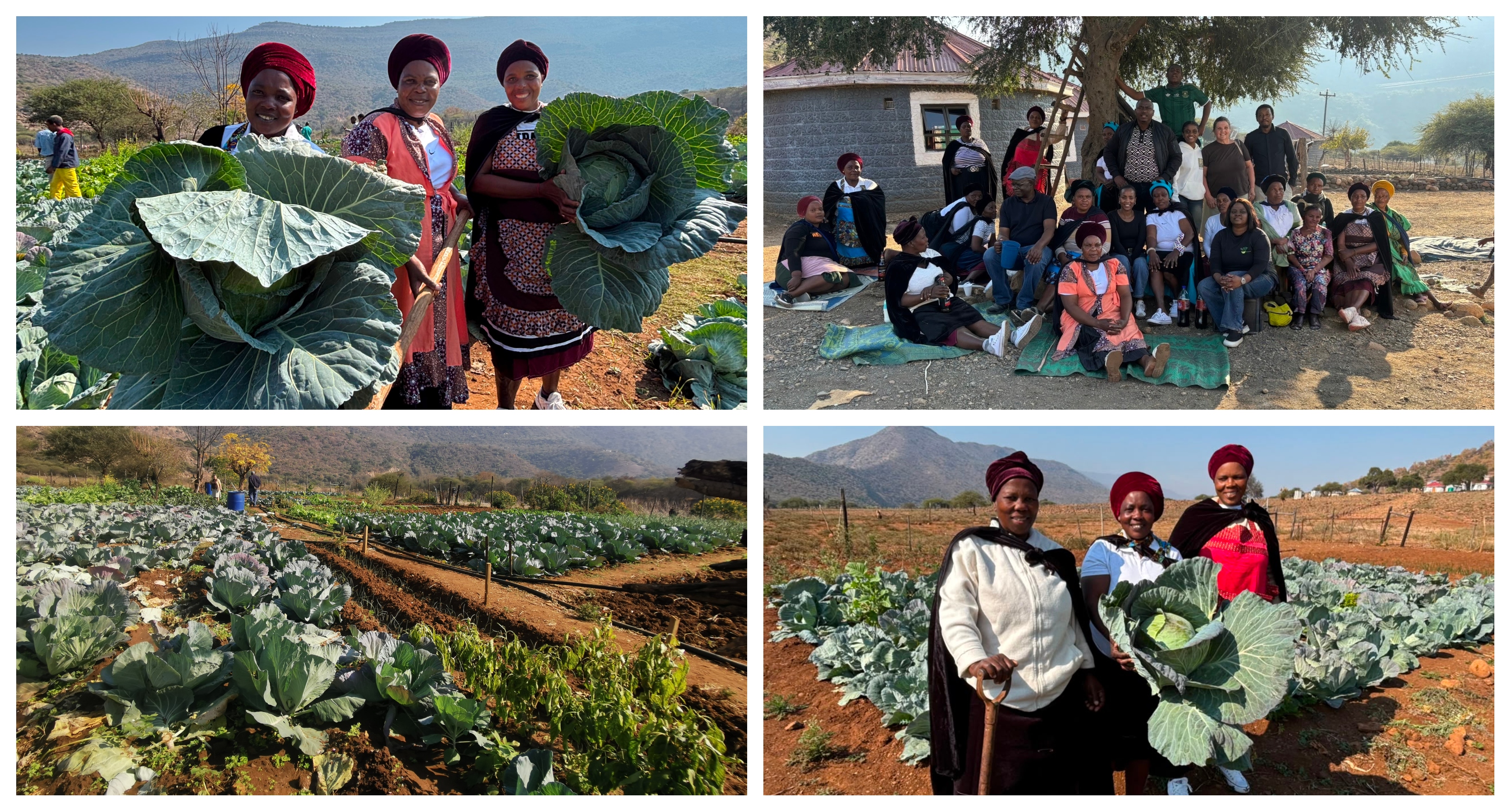
Eighteen years ago, beneath the shade of a tree in the remote and barren landscape of rural Msinga in KwaZulu-Natal (KZN) a handful of people gathered around a simple idea: to plant a garden that could help feed their families.
At the time, the area offered little more than dry fields and limited opportunities. Roads were poor, unemployment was rife and many households depended solely on men who had left for the cities in search of work. For the women who remained behind, daily life revolved only around fetching water, preparing meals, caring for children and waiting for their husbands to return home with an income.
Today, that same community tells a different story.
What began as a single community garden has blossomed into a thriving network of small holder farming across Msinga, Bergville, and Swayimane. Roads have been developed where none existed before and more and more rural entrepreneurs have emerged.
At the heart of this transformation is the Farmers Support Group (FSG), a non-profit organisation and community engagement unit of the University of KwaZulu-Natal (UKZN). For nearly two decades, FSG has equipped women with agricultural knowledge, business skills and the tools to become economically independent.
FSG’s interventions have changed what is possible for women in rural communities.
The story began in 2008 when FSG established its first gardens in Fabeni within Msinga, at the height of the HIV/AIDS epidemic. Local hospital authorities approached the organisation to assist women living with HIV by ensuring they had access to nutritious food.
FSG made a deliberate decision to expand the intervention beyond those directly affected. “We decided not to have an intervention just for the affected women but for the whole community,” said FSG Director Professor Maxwell Mudhara. “That way there would be no stigmatisation and everyone would benefit.”
Mudhara reflected on those early days. “I remember one of the first visits when there was nothing. We were sitting under a tree with a small group of community members and I said: ‘We have to start a garden in this area’. We then identified this land that belonged to a member of the community and asked for her family’s permission to build a garden there.”
There were no gardens in the area and many residents believed the land could no longer sustain agriculture.
“The locals said they had forgotten how to plant,” Mudhara recalled. “They used to have fields that eroded and with stones covering the area. They had written off the land and thought they could no longer do agriculture. But they started. And now there’s a road where there was no road.”
Many of the women now sell their surplus produce to supermarkets and vendors. Crops including cabbages, spinach, tomatoes, potatoes, beetroot, sweet potatoes and carrots have become a source of sustainable income, enabling families to pay school fees, improve their homes and invest in their children’s futures.
At a recent gathering in the area of Gudwini in Msinga, farmers celebrated their successes and reflected on the challenges that remain. Under the theme ‘Smallholder Farmers Market Participation – From Subsistence to Commercial Farming’, the Msinga Food and Nutrition Fair’ brought together farmer groups from Bergville, Swayimane and Msinga.
Farmers gathered beneath a large marquee as the programme opened with prayer and song before community garden leaders, the local ward councillor, traditional leaders and members of FSG addressed the audience.
The event included a visit to one of the flagship gardens in Gudwini, where neat rows of emerald cabbages stretched across the fields. Between them, patches of spinach and beetroot. Farmers moved through the garden with curiosity and enthusiasm, exchanging ideas and discussing everything from irrigation techniques to market opportunities.
For many, the visit was an opportunity to learn from one another.
Leading the Gudwini farmers, Ma Ntombizekhaya Ngubane, who has been part of the initiative since its inception, spoke about the years of hard work, support from UKZN, local leaders and fellow farmers.
“Initially, we were just farming for our households,” she said. “Through FSG’s guidance, we realised we could sell our produce. Now we are building houses and buying stoves. Our quality of life has improved. We are now selling our produce to local Spar stores, pension pay points, and tuckshops.”
Her daughter-in-law, Ms Ntombizenhlanhla Nxele echoed this sentiment, describing how the garden had given her a newfound sense of independence.
“I don’t have to wait for my husband if I need to buy something,” she said. “I can go and buy it myself.”
In Swayimane, where sweet potatoes, maize and amadumbe (taro) dominate the fields, farmer, Ma Eunice Gasa drew laughter and applause with her candid reflections.
“I can make R7 000 in one day selling maize,” she said. “Sometimes while I’m preparing one order, my phone is ringing with two or three more from Greytown.”
Using a crutch for support, Gasa who is a pensioner, spoke passionately about the importance of adapting and embracing technology.
“I have graduates at home,” she said with a smile. “I told them to teach me how to use social media.”
Today, she markets her produce using WhatsApp and earns additional income from avocado trees on her property. “I’m now a farm manager. I employ people,” she said proudly. “Don’t wait for your husbands to give you money. You’ve got to work for yourself.”
Her words reflect a significant shift taking place across rural KZN, where economic empowerment is reshaping traditional gender roles.
Former Induna, Bab Zamokwakhe Shelembe, who led the community when the gardens were first established in Fabeni, recalled how he travelled a long distance on foot to seek permission from the tribal council to use the land.
“Farming is the backbone of our community,” he said. “It allows us to sustain ourselves no matter what challenges arise.”
Beyond the financial gains, many farmers say the gardens have created a sense of community. “Our relationship is now bigger than farming,” Ma Ngubane explained. “The gardens have become a place where we meet and support one another.”
Mudhara addressed the farmers saying, “What we are trying to do is to go on a journey to uplift people’s lives. When we started on this journey our main focus was food. Now it’s not just about food. We want you to have enough money for medicine, lights, and other things to improve the quality of your livelihoods. Our way of thinking has to change to: how do we achieve a higher standard of living?”
He thanked the farmers for the energy they put into the farming saying their commitment gives FSG confidence when seeking resources and support.
“We are looking at agriculture as a basis for creating employment. We have a big responsibility to ensure that we create employment and also that whatever is produced can be put into the value chain.”
Mudhara also encouraged farmers to remain vigilant in the face of climate change and possible El Niño weather patterns.
“Climate change is a reality we need to prepare for,” he said. “We must be wise about what we plant and when we plant it. We also need to think about diversifying our activities so communities remain resilient.”
Over the years, FSG has provided guidance on best agricultural practices informed by the work of UKZN’s School of Agriculture and Science, as well as training in cooperative development, market access, pricing and business management.
Each area is supported by a dedicated FSG facilitator. In Gudwini, facilitator Mr Musa Mbatha has witnessed the evolution of the gardens first-hand.
“They started by carrying water in buckets,” he explained. “We introduced pumps, then irrigation systems with pipes that use water more efficiently. We helped them move from subsistence farming to commercial production.”
FSG has also assisted with fencing and gates to protect crops and encouraged farmers to buy inputs collectively, reducing costs through bulk purchases.
One of the programme’s most encouraging outcomes has been the transfer of knowledge between generations. “The younger generation is learning from the older community members,” said FSG facilitator Ms Khethiwe Mncwabe. “This secures the future of the gardens. They (the youth) won’t simply say, ‘Gogo (Grandmother) used to plant there.’ They will continue the work.”
In a nation searching for solutions to poverty, unemployment and food insecurity, these rural women have shown that the seeds of change are planted one garden at a time.
Sometimes, it begins with a conversation under a tree.
The article originally appeared in The Mercury, The National and Isolezwe Ngempelasonto.
Words and photograph: Sejal Desai

You may also like

Transforming Education Systems for Inclusive Futures

Postgraduate Open Days Inspire Future Researchers and Leaders
