
Public Shaming Is Not Law Enforcement
- Posted by ukzn-admin
- Categories News
- Date June 19, 2026
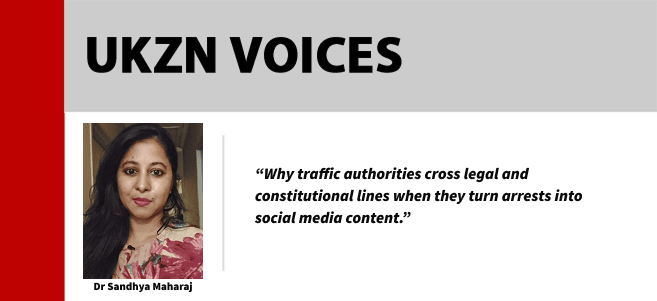
Why traffic authorities cross legal and constitutional lines when they turn arrests into social media content.
In 2025, South Africa recorded 11 418 road fatalities. This staggering statistic paints a bleak picture for the country, with travelling on the country’s roads seemingly becoming a life-or-death situation.
In light of the persistently high death toll, the Department of Transport has embarked on an unconventional method to tackle the scourge of drunken driving. This involves placing footage of motorists who are suspected of driving under the influence of alcohol across various social media platforms.
Videos and livestreams of motorists at police roadblocks have gone viral, a form of public awareness which doubles as entertainment through humiliation. During a recent Facebook Live stream, motorists were filmed being breathalysed and subsequently arrested. The faces of motorists were barely blurred; however, vehicle licence plates, clothing and locations often make individuals easily identifiable. Ultimately, the actions of the Department of Transport risk infringing on the human rights of motorists.
While road safety is a pressing concern, the methods used to educate and ultimately deter criminality have come under scrutiny. When the state moves from lawful enforcement into public shaming, entrenched constitutional values are undermined. A core principle of criminal law is that protection afforded to an arrested individual attaches at the point of arrest. Guilt or innocence is only for a court to determine and not for the court of public opinion. Therefore, the state’s power over that individual must be exercised with restraint and reverence for dignity, a foundational value of South Africa’s post-1994 constitutional order.
Furthermore, Section 69 of the South African Police Service (SAPS) Act 68 of 1995 prohibits any person from publishing a photograph or sketch of a suspect or person in custody without the written authorisation of the National or Provincial Commissioner. ‘Photograph’ is defined broadly to include any visually perceptible image or depiction. While the section speaks specifically of photographs and sketches, the same protective rationale applies to video footage that depicts identifiable individuals in custody. The prohibition binds not only SAPS members but any person or entity publishing such material. Its purpose is to safeguard the integrity of investigations and preserve the rights and dignity of those not yet convicted.
The prohibition is triggered once someone is a suspect, a threshold clearly met at a roadblock arrest. Indirect identification remains identification, and it falls foul of the law. Section 69 is not a technicality to be circumvented by partial concealment; it demands substantive compliance.
These posts also raise serious constitutional concerns. Section 35 of the Constitution affords arrested persons fundamental rights, including the presumption of innocence, which primarily governs the trial process. When read in conjunction with the right to dignity (section 10) and privacy (section 14), it reinforces a broader principle: the state must not prejudge or humiliate individuals before a court has handed down a verdict. Broadcasting footage of an arrest to thousands of followers, accompanied by commentary on behaviour or excuses, risks doing exactly that, turning vulnerable moments into a public spectacle.
The constitutional right to dignity is not earned through good behaviour nor is it forfeited through unlawful conduct. It belongs to every individual simply by virtue of their shared humanity. Even when a person is arrested, they do not surrender this fundamental right. On the contrary, the state bears a positive constitutional duty to respect and protect the dignity of arrested persons, rather than exploit their vulnerability for public spectacle or social media engagement. The power to arrest and prosecute must never become a licence to humiliate.
The Protection of Personal Information Act (POPIA) adds another layer. Images of individuals, their vehicles, and contextual details constitute personal information. POPIA contains a law enforcement exclusion (section 6), but this is not unlimited. It applies to the prevention, detection, investigation or prosecution of offences only to the extent that adequate safeguards exist in other legislation.
In cases supported by evidence in the form of breathalyser or blood test readings, charges are unlikely to be struck out solely due to social media exposure. However, the defence may raise allegations of abuse of process. The greater risk arises if charges are withdrawn or the accused is acquitted: the Department would then have publicly shamed an innocent person. Affected individuals would have strong grounds for civil claims based on unlawful publication under the SAPS Act, violations of constitutional rights, and breaches of POPIA.
None of this is to suggest that traffic enforcement should be weak or invisible. South Africa’s road death statistics demand firm and effective law enforcement. However, effective policing and constitutional compliance are not competing goals. If the state wishes to harness the shock factor of real enforcement footage, it must do so responsibly by ensuring that all material is carefully edited to protect the identity of motorists. This will uphold the dignity and due process rights of arrested individuals. Tools such as carefully edited footage of roadblocks that do not identify individuals, as well as hard-hitting educational material on the dangers of drunk driving, can effectively convey the seriousness of the crisis while remaining firmly within legal and ethical boundaries.
There is also a deeper point worth making. The notion that humiliation serves as an effective deterrent rests on shaky ground. Shaming campaigns may generate social media engagement and a fleeting sense of public satisfaction, but there is little evidence that they produce lasting behavioural change. What they do produce is harm to the individuals exposed and erosion of the integrity of a justice system, built on the shoulders of constitutionality. A state that reaches for humiliation as a governance tool signals, perhaps unwittingly, that rights are conditional and that the presumption of innocence is merely a courtroom formality.
That signal is corrosive, and it ought to be resisted. Public safety does not require public shaming – and the law does not permit it.
Dr Sandhya Maharaj is a lecturer in the School of Law, Discipline of Public Law, at the University of KwaZulu-Natal. Her research focuses on criminal justice and capacity-based criminal defences, examining issues of criminal responsibility, mental functioning, and the role of psychological and psychiatric evidence in determining criminal liability under conditions of emotional and psychological stress.
*The views and opinions expressed in this article are those of the author and do not necessarily reflect the official policy or position of the University of KwaZulu-Natal.

Next post


