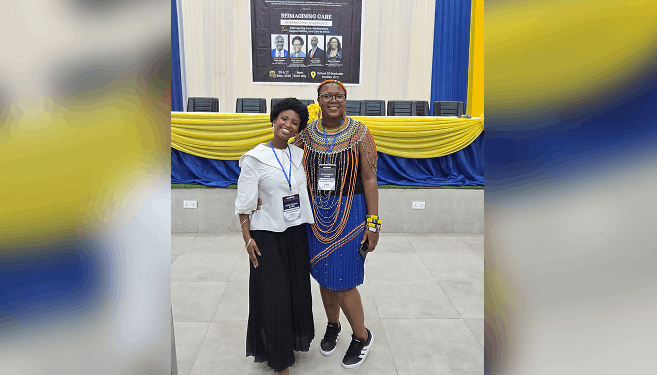
Health Law expert, Ms Nomfundo Mthembu recently represented the University of KwaZulu-Natal (UKZN) School of Law at the Reimagining Care International Conference hosted by the University of Cape Coast (UCC) in Ghana. Held under the theme ‘Reimagining Care: Relationships, Responsibilities, and Care in Africa,’ the two-day conference took place from 26 to 27 May 2026 at the School of Graduate Studies at UCC.
The conference convened scholars, healthcare practitioners, researchers, and policymakers from across the continent to engage in interdisciplinary dialogue on strengthening health systems and advancing patient-centred care within African contexts.
At the conference, Mthembu presented a paper titled ‘Sustaining Care Without Technology: Medical Officers as Advocates for Fertility Preservation for Cancer Patients in Rural Settings’.
Her presentation examined the pressing need for equitable access to fertility preservation services and Assisted Reproductive Technologies (ARTs) for cancer patients, particularly in rural and resource-constrained settings where such services remain limited or unavailable.
The presentation highlighted the reproductive health implications of cancer treatment, particularly the risk of treatment-induced infertility, and foregrounded the ethical and professional responsibilities of medical officers in initiating timely discussions on fertility preservation.
Mthembu emphasised the importance of early counselling, patient autonomy, and continuity of care, even in contexts where advanced technological interventions are not readily accessible.
Her contribution further advanced critical discourse on the ethical, legal, and structural dimensions of fertility preservation and ART access in Africa, drawing attention to persistent inequalities between urban and rural healthcare systems and their implications for reproductive justice on the continent.
The conference also served as a vital platform for interdisciplinary academic exchange, where scholars collectively interrogated how emerging technologies, health systems design, and socio-legal frameworks intersect in shaping care delivery. Such engagements remain essential to advancing evidence-informed policy development, particularly in African contexts where policies must respond to diverse structural realities and lived experiences.
Mthembu’s participation was supported through funding from the National Research Foundation (NRF).
Reflecting on her experience, she said: “The travel was funded by the NRF Black Academics Advancement Programme, and I am deeply grateful that as an emerging scholar, I am able to meaningfully participate in these dialogues.”
She added: “This underscores the growing importance of African-led scholarship in shaping global and continental discourses on health, law, and emerging technologies, particularly in ensuring that policy development is grounded in locally produced evidence and contextual realities.”
Her participation reflects the School of Law’s commitment to advancing rigorous interdisciplinary scholarship at the intersection of law, health, and social justice, while contributing meaningfully to African-centred academic dialogue and evidence-informed policy development.
Words: NdabaOnline
Photograph: Supplied