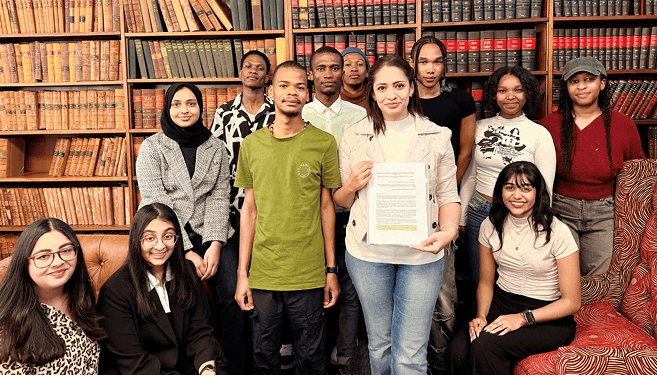
As part of efforts to enhance student learning experiences, Dr Sheetal Soni, senior lecturer and Head of Research and Higher Degrees at the University of KwaZulu-Natal (UKZN) School of Law, co-ordinated a research project during the first semester involving a group of third- and fourth-year Law students.
The students assisted in preparing a formal submission to the United Nations (UN) Committee on Economic, Social and Cultural Rights (CESCR), which monitors implementation of the International Covenant on Economic, Social and Cultural Rights (ICESCR) by its State parties. The Covenant enshrines economic, social and cultural rights such as the rights to adequate food, adequate housing, education, health, social security, water and sanitation, and work.
The submission responded to a call for input on the application of the ICESCR in situations of armed conflict and will contribute to the development of a forthcoming General Comment by the Committee.
“The project was designed not only as a research initiative, but also as a mentorship and skills development opportunity, allowing students to contribute to a live international legal process,” explained Soni.
Students worked on a series of structured research briefs covering thematic areas related to the protection of economic, social and cultural rights during armed conflict. Topics included healthcare, food, water, education, housing, occupation, and accountability. They were introduced to advanced international legal research methods, engaged extensively with international legal sources and scholarly literature, and received detailed feedback throughout the process.
The research findings were consolidated into a high-level submission, which Soni formally submitted to the UN Committee on 15 May 2026. The submission reiterates that minimum core obligations relating to food, water, healthcare, and shelter must continue to be protected during armed conflict, and highlights significant doctrinal gaps in the interaction between international humanitarian law and human rights law, particularly regarding accountability, occupation, and the protection of civilians’ essential conditions for survival. A particularly novel aspect of the submission was its argument that international humanitarian law should not merely coexist with socio-economic rights protections, but be interpreted through them, ensuring that military necessity can never justify deprivation of civilians’ essential conditions for survival.
While Soni has previously submitted work to United Nations committees, this marked the first time she involved students directly in the process. The initiative aligns closely with UKZN’s objective of creating meaningful student experiences through engagement with contemporary global challenges.
“The project offered students valuable insight into the role legal research can play in shaping international policy and legal interpretation,” said Soni. “Notably, the students volunteered to participate and undertook the research in addition to the demands of their formal studies.”
Soni commended the students for their thought-provoking contributions, dedication and professionalism throughout the project, noting that they played a critical role in shaping the final submission. “We worked very much as a team, and the students’ names appear on the written submission, together with mine,” she said.
Reflecting on her experience, final-year Law student Ms Attikah Manga said: “The idea of contributing to a submission to the UN Committee on Economic, Social and Cultural Rights was incredibly exciting and slightly intimidating. However, working on the ICESCR submission under the guidance of Dr Soni turned out to be an enlightening experience, particularly in the context of advocating for human rights. This opportunity allowed me to contribute to something that could have an international impact.”
Another final-year Law student, Ms Kiandra Singh, described the project as a rewarding learning experience. Commenting on the brief development stage, she said: “This phase required a high level of critical thinking, particularly in identifying gaps within international law and considering how these could be addressed during situations of armed conflict.”
Students who participated in the project expressed gratitude to Soni for the enriching experience, noting that it significantly strengthened their legal research and writing skills, which they hope to apply in their future postgraduate studies and professional careers.
Words: NdabaOnline
Photograph: Warren Freedman