Invest in South Africa’s Young People – President Ramaphosa
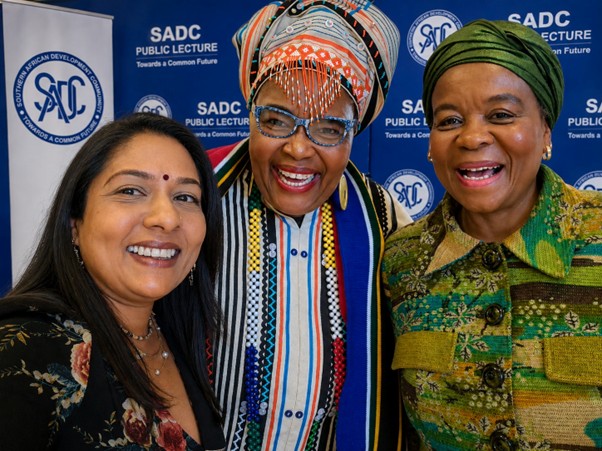
President Ramaphosa called for stronger investment in young people when he delivered the Southern African Development Community (SADC) Public Lecture on the Westville campus of the University of KwaZulu-Natal (UKZN), ahead of the 46th Summit of SADC Heads of State and Government.
The summit was held under the theme: ‘Resilient, Sustainable and Inclusive Industrialisation through Infrastructure Development, Agricultural and Critical Minerals Transformation in Pursuit of a Just World.’
The lecture placed young people, human capital development, regional integration and economic opportunity firmly within the conversation about Southern Africa’s future. President Ramaphosa emphasised that the region’s young and growing population is one of its greatest strategic assets and highlighted the critical role of schools, universities, Technical and Vocational Education and Training (TVET) colleges and research institutions in developing the skills required for the future economy.
For Dr Andrisha Beharry-Ramraj of UKZN’s School of Commerce (Discipline of Management), the message had particular relevance for Higher Education. “Universities must prepare graduates not only to enter the world of work, but also to recognise opportunities, solve problems and create value within their communities and economies.”
“Entrepreneurship education, therefore, should not be viewed as an optional addition to a university qualification, but as an important component of preparing graduates for an increasingly complex and changing economic environment. This aligns strongly with UKZN’s Strategic Plan, which identifies Excellent and High-Impact Research, Innovation and Entrepreneurship as one of the University’s five strategic goals. The plan also seeks to produce graduates with the knowledge, skills and networks to build meaningful and agile careers that can be sustained and adapted throughout their lives.”
The lecture also highlighted a fundamental challenge facing the region: economic growth must translate into opportunities for its people. President Ramaphosa identified youth unemployment as one of the major obstacles to achieving SADC Vision 2050 and called for stronger investment in young people. This places universities in a particularly important position.
According to Beharry-Ramraj, entrepreneurship education gives students the opportunity to move from being passive recipients of knowledge to becoming active problem-solvers, innovators and potential job creators. It can develop confidence, resilience, creativity, opportunity recognition, financial awareness and the ability to transform ideas into sustainable initiatives.
The lecture made it clear that importantly, entrepreneurship at university level should extend beyond the traditional idea of starting a business. “It encompasses innovation, social entrepreneurship, the creative economy, technology, research, commercialisation and community-based solutions.
A university student developing an agricultural technology solution, creating a digital platform, commercialising research, developing a creative enterprise or establishing a social initiative is engaging in entrepreneurial activity. This broader understanding is particularly important for South Africa and the SADC region, where young people need diverse pathways into economic participation.
UKZN’s institutional strategy recognises this responsibility. Its vision is to be a South African university that is “academically excellent, innovative in research, entrepreneurial, and critically engaged with society”, while its strategic framework explicitly connects research, innovation and entrepreneurship with addressing major societal, economic and environmental challenges.
Beharry-Ramraj said: “The real measure of entrepreneurship education is not simply how many students start businesses, but how effectively we develop graduates who can identify opportunities, innovate and contribute solutions to the challenges facing society.”
The public lecture provided more than an opportunity to hear a national leader speak about regional development. It created a timely space for the University community to reflect on what Higher Education can do to help translate SADC’s long-term vision into tangible outcomes.
Universities are uniquely positioned at the intersection of knowledge, research, young people, industry, and communities. They can develop entrepreneurial ecosystems in which students are exposed to mentors, industry partners, innovation hubs, research opportunities and real-world challenges.
For Beharry-Ramraj, this is where the connection between the SADC agenda and entrepreneurship education becomes particularly powerful. “If we want to build a resilient, sustainable and inclusive Southern Africa, we have to invest in the capabilities of our young people and give them the confidence and skills to participate in shaping the economy, rather than simply waiting for opportunities to be created for them,” she said.
The lecture consequently reinforced an important message for UKZN and the broader Higher Education sector: education must ultimately translate into impact. As the region works towards industrialisation, technological advancement, agricultural transformation, infrastructure development and greater economic integration, universities have a responsibility to ensure that their graduates are equipped to participate in and contribute to these developments.
Beharry-Ramraj concluded that the future of the SADC will depend not only on educated citizens, but on a generation of innovators, entrepreneurs, researchers, leaders and problem-solvers.
For UKZN, nurturing these capabilities is not separate from its Institutional mission; it is central to its commitment to academic excellence, innovation, entrepreneurship and meaningful engagement with society.
Words: Andrisha Beharry
Photograph: Supplied