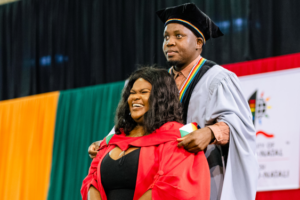
Visible Yet Invisible: Albinism in Higher Education
UKZN staff member Dr Rovashni Chetty’s novel research on the unseen struggles of students with albinism in South Africa’s universities earned her a PhD in Community Development.
“Visible Yet Invisible: Community Development Perspectives to Understanding the ‘Lived’ Experiences of Persons with Albinism at Institutions of Higher Education in KwaZulu-Natal, South Africa” explores the complex and often overlooked challenges faced by this marginalised group.
‘Albinism is a genetic condition characterised by a deficiency or absence of melanin pigment, which impacts normal pigmentation. Persons with albinism occupy a paradoxical position – they are simultaneously “visible” and “invisible”. While they are visible because of the physical manifestation of the condition, when confronted with discrimination, labelling, and alienation, they often withdraw from the broader community, making themselves “invisible”. This extends to the education sector, where students with albinism experience various social, environmental, cultural, and institutional barriers,’ said Chetty.
‘This research was both a personal and an academic endeavour for me. While South Africa has made significant strides towards a more inclusive education model, my two decades of experience in Higher Education revealed that persons with disabilities face persistent challenges. Discrimination, logistical hurdles, and social marginalisation continue to hinder their educational journey. As a sociologist at UKZN, my interest in the topic was sparked by my daily encounters with students with albinism, and the desire to make a meaningful difference in their lives.’
Despite a growing body of scholarship on albinism, Chetty notes that significant gaps remain in understanding their “lived” experiences and challenges, particularly in Higher Education settings. Most research has focused on violence against persons with albinism – a theme often sensationalised by the global media. According to Chetty, there is a noticeable void in the literature, particularly within the African context, regarding how albinism impacts access to education.
The study found that the challenges faced by students with albinism do not necessarily stem from their physical traits. Rather, their limited access to educational opportunities is more closely linked to broader issues such as poverty, discrimination, stigma, social exclusion, and human rights abuses.
‘There are significant gaps in existing interventions and policies, with current frameworks and support systems falling short of achieving their intended outcomes for students with albinism. We need urgent reforms, including clearer legal definitions, amendments to national legislation, and improved institutional support systems,’ Chetty commented.
Her findings were integrated to inform the development of a multi-sectoral framework to address the challenges that students with albinism face, and a framework that specifically addresses access to Higher Education for persons with albinism. Chetty recommends that the frameworks be adopted and implemented across all sectors that cater to the needs of persons with albinism.
Supervisor Dr Hema Hargovan, praised the research as ‘innovative and ground-breaking’, noting its potential to impact global and regional scholarship on albinism, ‘The study adopts a multidisciplinary approach, intersecting community development, social work, education, criminology, sociology, criminal justice, and human rights. It provides valuable insights and recommendations that can inform policy reform, enhance educational practices, and promote inclusivity for students with albinism.’
Words: Rakshika Sibran
Photograph: Sethu Dlamini