Students are moving at digital speed. The question for Higher Education Institutions is whether they can keep up, or if they are destined to be like a cartoon cat chasing an elusive mouse.
This was the striking analogy used by Professor Nyna Amin, Interim Director of the University Teaching and Learning Office at the University of KwaZulu-Natal, who opened a two-day Instructional and Learning Design Symposium. The event brought together academics, support staff, students, and instructional designers to reimagine the future of university teaching.
Under the theme ‘From Design to Impact: Driving Curriculum Digital Transformation in Higher Education’, the symposium addressed a pressing reality: transformation in higher education must go beyond mere digitalisation to tackle deeper systemic issues in the design of learning, teaching, and assessment.
Amin’s Speedy Gonzales metaphor resonated throughout the event. She described how universities often fall into the “Sylvester trap”: ‘technology first’, where complexity is mistaken for effectiveness; the ‘solo pursuit problem’, where academics reinvent pedagogical wheels in isolation; and the ‘performance versus purpose confusion’, where busyness is mistaken for achievement.
“Students are moving at digital speed and possess contextual intelligence about learning,” Amin explained. “The work of our digital content editors and instructional designers is helping to propel academics into the 21st century, creating learning environments where natural velocity becomes an asset rather than a challenge.”
The symposium showcased the Digital Curriculum Transformation (DCT) Project, an initiative enabling instructional designers to collaborate with academic staff and Deans of Teaching and Learning on high-impact modules identified through institutional data and consultations. Structured around five Instructional Design Learning Sprints, the project advances key goals in UKZN’s Strategic Plan for teaching excellence and student experience.
Keynote speaker Professor André Vosloo, Academic Leader for Teaching and Learning at UKZN’s former School of Life Sciences, drew on an equally compelling analogy: building architecture. Just as great buildings must be both functional and beautiful, he argued, so must learning design balance purpose with aesthetic appeal.
“This is what our learning experience should strive for – to be both attractive and inviting, while delivering its purpose,” Vosloo said, outlining three foundational design principles: Universal Design for Learning as the master plan, Backward Design as the blueprint, and Instructional Design as the engineering team responsible for execution.
He emphasised that learning is maximised when these principles work in synergy, incorporating user-centric approaches, media-rich and hands-on learning, gamification, microlearning techniques, and continuous feedback to enhance the student experience.
The symposium moved from conceptual frameworks to concrete examples through a panel discussion that provided a reflective overview of UKZN’s digital transformation journey. Panellists highlighted key successes while engaging critically with ongoing challenges, including issues of fragmentation, and outlined strategic directions to sustain this work across the institution.
Academic presentations from colleagues who collaborated with instructional designers throughout the year showcased innovative teaching practices developed through these partnerships. Student presenters offered their own perspectives, reflecting on how digital transformation has reshaped their learning experiences.
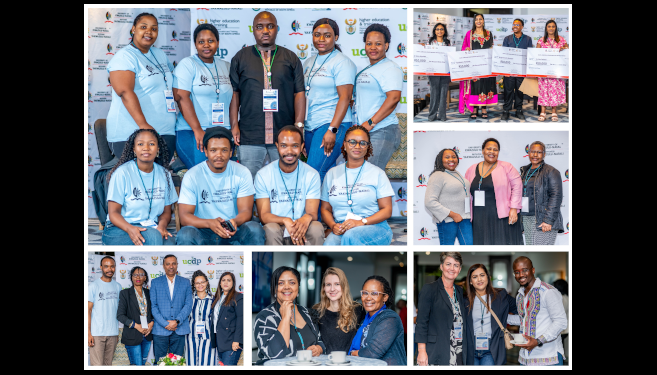
The symposium culminated in the recognition of Digital Curriculum Transformation Portfolio Award winners, each receiving institutional cheques of R10 000 for their outstanding submissions, along with certificates and a raffle draw.
In closing remarks that elevated the symposium’s significance beyond institutional boundaries, instructional designer Mr Mukondeleli Mulaudzi issued a powerful call to action: “Africa’s moment has come, not to imitate or compete, but to restore balance to a world in disarray. Through education rooted in harmony of Earth, Water, Fire, Air, and Ether, we can cultivate leaders who think deeply, act wisely, and create holistically.”
His vision of classrooms as spaces of renewal, teachers as elemental masters, and students as seekers of balance framed digital curriculum transformation not merely as technological adaptation, but as a profound opportunity to contribute to a new civilisation grounded in harmony, wisdom, and purpose.
Words: Ndabaonline
Photographs: Andile Ndlovu