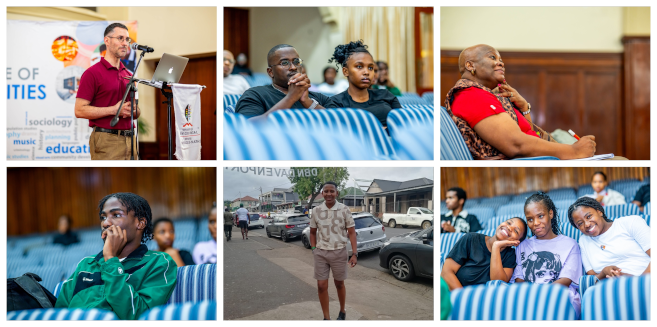
At a recent University of KwaZulu-Natal (UKZN) gathering Mr Warren Bessey, a seasoned composer, producer, and creative visionary shared his profound reflections on music, culture, and creativity.
With over 35 years of professional experience, he has immersed himself deeply in the world of composition, producing works that bridge history, storytelling, and emotion.
He began by expressing heartfelt gratitude for his time in South Africa, explaining that Zulu culture had helped shape him into a better person.
“I am sincerely grateful that my experiences with Zulu culture have made me a significantly better individual,” he reflected.
“Had I continued to live in Canada or elsewhere, I might not possess the same values or understanding. It is crucial to cherish ideals, people, and respect for others, regardless of who they are.”
Describing his journey, he introduced himself as a composer, producer, desktop publisher, writer, humourist, activist, translator, and communication specialist. Despite his many roles, he identifies most deeply as a composer, one capable of playing every instrument in an orchestra, even if imperfectly.
He explained that his decades-long commitment to daily composition had given him an extraordinary depth of knowledge. Over the years, he has composed for diverse purposes – from advertising campaigns and national brands to pieces inspired by social causes, such as music for spinal injury awareness. Each composition, he explained, follows the structure of life itself: a beginning, middle, and end.
Drawing inspiration from a book titled The Japanese Conspiracy, he described a creative process he calls “reverse engineering” – beginning with the end in mind. “When composing, I start with the ending. I know the destination before I begin. That way, everything that comes before aligns with the truth of the story.”
He shared how this method guided his symphonic work King Shaka, emphasising the importance of cultural and historical accuracy.
“When writing about King Shaka, I must ensure the ending resonates with truth because if I misrepresent him, I’ll have many people who don’t like me. That’s why the ending must be real, powerful, and authentic.”
One of his most striking insights came from an unlikely source – a Siberian punk band, which he says, “made me realise that creativity doesn’t need to be confined by expectations like rhyme or complexity. What matters is truth and feeling.”
This revelation influenced how he writes lyrics for his symphonies – focusing on meaning rather than rhyme and content over convention. Unlike many composers, he says he doesn’t just hear music, he sees it.
“I see music multidimensionally – from left to right, top to bottom, and even far away. When you experience one of my symphonic works, you don’t just hear it; you visualise it. The music moves toward you, surrounds you – it’s alive.”
Reflecting on his early career in South Africa, he recalled arriving in 1987, working at the Playhouse Theatre as a sound engineer before establishing his own company. His experience in radio taught him one of the most vital lessons in composition – retention.
“One of the worst things about music is when it goes on and on beyond its ‘sell-by date’. Retention is critical. Like a billboard on a highway – if it’s cluttered, no one remembers it. Music must be concise and memorable.”
Turning to Shaka iLembe, he spoke passionately about the visual storytelling behind the music. He described scenes surrounding the birth of the twins: the music, he said, mirrored the tension of that moment – the birth of a child surrounded by love, yet threatened by tradition.
He also spoke about Nandi, who was deeply mourned, as well as Mkabayi, a powerful “survivor in a cutthroat environment” where her decisions were often questioned because she was a woman. “Yet, when she spoke, monarchs, emperors, and commoners alike listened in silence. Her presence was quiet but commanding – like a marsh, inviting yet dangerous to those who underestimated her.”
Through his reflections, the composer revealed that music is not just an art form, it’s a philosophy of life. It’s about structure, truth, and vision; about seeing beyond sound to capture history, culture, and spirit.
Watch the full clip here.
Words: Sinoyolo Mahlasela
Photographs: Supplied