UKZN Workshop Explores Ways to Advance Multilingual Pedagogies
Promoting functional multilingualism, as outlined in UKZN’s Language Policy, was the central focus of a two-day workshop hosted by the University’s Language Planning and Development Office (ULPDO).
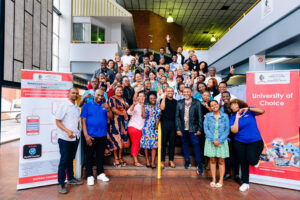
The workshop, titled Inter-institutional Multilingual Pedagogies Fostering Collaborations and Partnerships, was attended by representatives of government departments, municipalities, students and lecturers from across universities as well as legislators and language inspectors.
Dean and Head of the School of Arts Professor Nobuhle Hlongwa said in her welcome address that the aim of the workshop was to discuss how to advance indigenous languages, particularly in the classrooms. ‘As universities we already have language policies and language implementation plans -we have worked together on various projects and are committed to future inter-institutional collaborations which are an extension of the work we are doing in language promotion.’
Executive Director of the South African Centre for Digital Language Resources (SADiLAR) at the North-West University Professor Langa Khumalo commented on the collaborative work between the two institutions in advancing isiZulu as language of teaching and learning.
Khumalo highlighted SADiLAR as a research infrastructure focused on the Humanities and mandated to develop resources to advance South Africa’s 12 official languages. Listing Digital Humanities, Digitisation, and Higher Education Support as the three main programmes, Khumalo said Digital Humanities aimed to enhance research capacity in the social sciences through the ESCALATOR project, which provides digital training and promotes innovative methods using digital data. The digitisation programme, he said, involved the development of language resources such as corpora, terminology and term banks; while the Higher Education Support programme included access to free spell checkers, a multilingual academic writing support tool – Write It, and an Open Educational
Resource Term Bank – LwimiLinks.
Deputy Dean of Teaching and Learning at the University of the Western Cape Professor Mantoa Motinyane delivered a paper on language and technology. She explored how AI could be used to promote multilingualism and improve African languages through the use of automated transcription and translation, speech recognition, interactive learning tools, and personalised learning paths.
Motinyane implored the audience to feed and correct AI indigenous languages in order to advance them and shared two projects she spearheads. These include AI in Collaborative Research Stuttering and AI in Collaborative Research – Cognitive Ageing, that address the speech disorder of stuttering through the development of an AI and speech pathology video game titled, Stutter Stars and the challenges faced by aging multilinguals.
Senior lecturer at the Cape Peninsula University of Technology Dr Kevin Ncube, presented a paper on Translanguaging. He reviewed the role of translanguaging between diverse cultures. The epitome of Nelson Mandela’s words: “If you talk to a man in a language he understands, that goes to his head, but if you talk to him in his own language, that goes to his heart”. Ncube shared the ways in which he had centred isiXhosa as a language of teaching and learning when evaluating Classical Conditioning and Psychodynamic Theories in Marketing and the difference that had made in his students’ lives.
Associate Professor in Education at the Nelson Mandela University Ms Nokhanyo Mdzanga delved into the topic of African Knowledge Systems (AKS) in fostering inclusivity in education. Mdzanga examined whether the current curriculum recognised and valued diversity, if learning was done in co-existence, and teacher training was inclusive of varying pedagogies. Mdzanga noted the role played by intersectionality and marginalisation when evaluating AKS and offered the Technology, Organisation and Environment Framework, and the Critical Mass Theory as frameworks of interrogation.
Director of the Language Directorate at North-West University Dr Keaoboka Seshoka delivered a talk on Language Policy in Higher Education. She discussed the planning and implementation of language policy in Higher Education and implored institutions to move from complying to being practical
about execution. Stressing the importance of strengthening implementation through effective monitoring and evaluation strategies, she said language audits and impact assessments informed institutions on what must be improved and how because ‘whatever is not monitored will eventually die’.
Sharing her experience in moving indigenous languages forward, Seshoka emphasised the importance of digitalisation languages, breaking down silos, prioritising the development of languages over financial gain, involving students in policy implementation, and assuring stakeholders that the goal was to build on established languages like English and Afrikaans by incorporating indigenous languages.
In her vote of thanks, lecturer in the School of Arts at the University of KwaZulu-Natal, Dr Muhle Sibisi acknowledged the ULPDO for hosting a cross-cutting multidisciplinary workshop on multilingual pedagogies in the digital era. Sibisi thanked the office for encouraging work in language promotion and implored the audience to avoid the digital death of indigenous languages by using and feeding digital AI tools.
Sibisi also thanked SADiLAR for all the resources they offer and mentioned how the ESCALATOR project, in particular, was well designed and inclusive. She expressed gratitude to the facilitators for their enriching presentations, the programme director, Dr Sanele Nsele of the School of Education, the stakeholders, and everyone in attendance.
Said Sibisi, ‘Indigenous languages are keys to unlocking the epistemes of various disciplines and transferring our knowledge systems. Working together as critical masses we can be a force to reckon with by placing our languages in the global and digital space.’
Words: Hlengiwe Khwela
Photograph: Sethu Dlamini