UKZN Awards Celebrate Collaborative and Innovative Research in 2022/2023
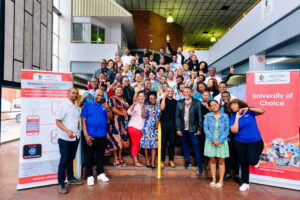
Excellence was rewarded during UKZN’s annual research awards dinner on 29 November at Durban’s Coastlands Hotel in Musgrave where the Top 30 researchers at UKZN were honoured and recognised as were the Vice- Chancellor’s Award recipients, the most cited researchers and researchers raising substantial research funding.
The keynote address by Dr Robert Stephen, a master specialist at Eskom and the engineer responsible for the smart grid strategy for Eskom, was delivered on his behalf by Professor Leigh Jarvis, acting Director of the High Voltage Direct Current (HVDC) Centre.
Jarvis, referred to Stephen as ‘the jedi knight of electrical engineering’ while presenting the address titled: “Engineering and the Power of Blue Sky Thinking” in which Stephen – who holds a PhD in overhead line design –explored the three pillars of engineering research: blue sky, applied and translational.
Stephen focused on blue sky research, which is the pursuit of knowledge for its own sake – ‘a fearless exploration of unchartered scientific territories,’ he said. ‘Blue sky research doesn’t always promise immediate results but it often leads to the most profound breakthroughs. Without it, we wouldn’t have the Theory of Relativity, which underpins technologies like GPS that we find on our
cellphones.’
He singled out an inspiring example close to home – UKZN’s line-inspection robot. ‘Initially, this was dismissed as an impractical idea but it exemplifies blue sky thinking. It’s an audacious attempt to automate the inspection of transmission lines. Today, this robot is a tangible game-changing tool which has also been adapted to applying specialised coating to transmission lines which allows more power to be transmitted via the line.’
Stephen highlighted that applied research took discoveries of blue sky efforts and turned them into practical solutions, while the translation research phase converted ideas into marketable technology. ‘This is the final step in the research journey where ideas become solutions and transform industries,’ he said.
On the critical role of blue sky thinking, he said: ‘While applied and translation research often get the spotlight, it is blue sky research that lays the foundation for which meaningful innovation is taken.
‘Blue sky research dares to ask the questions no-one else is asking. It ventures into unexplored territories where answers could redefine our understanding of science and engineering. Blue sky research is like planting a forest – it may take years or even decades to bear fruit but when it does, the results are transformative.’
Despite its importance, blue sky research faces significant challenges. ‘It’s often seen as a blackhole for funds and criticised for a lack of immediate outcomes. But we must change this narrative. Blue sky research is not about instant gratification – it is about laying the groundwork for a better future,’ he said.
Preserving research facilities, rigorous peer-review and securing funding were of critical importance.‘Blue sky is not a luxury – it is a necessity. To build a brighter future, we must increase funding and public support for theoretical research.’
Stephen, who also holds an MBA, underlined fostering multi-disciplinary collaboration and integrating diverse perspectives to solve complex challenges.
‘Let us not forget that every major technological leap began with a single question – a question that dared to defy convention. Blue sky research is a spark that ignites innovation – it drives us to explore, to dream and to create a better tomorrow. Let us commit to supporting this vital work to ensure that the next generation of engineers and scientists inherits a legacy of discovery and progress.’
Dean of Research at the University Professor Neil Koorbanally emphasised the importance of impactful and collaborative research. ‘Our research at UKZN has been at the forefront of the world’s problems, offering possible solutions in the areas of food security, water resources and energy to name a few. Many of the researchers in these fields were in the list of our top researchers. UKZN is proud to have world experts in these areas,’ said Koorbanally.
‘I congratulate all our Top 30 researchers, top young researchers and the Vice-Chancellor’s Award recipients. Keep up the momentum and the great research.’
For the research awards for 2022 and 2023, click here.
Additionally, the Senior Awards Committee has conferred three Vice-Chancellor’s Research Awards: two for 2023 and one for 2024. The recipients of the 2023 Vice-Chancellor’s Research Award are Professor David Lokhat and Professor Bongani Nkambule, while the 2024 recipient is Dr Rubeshan Perumal. Each award carries a value of R250 000, which is allocated toward research-related expenses, further supporting their academic endeavours.
Words: Raylene Captain-Hasthibeer
Photographs: Albert Hirasen