
UKZN Workshop Empowers Early Career Researchers to Build Strong Research Identities
- Posted by ukzn-admin
- Categories News
- Date July 9, 2026
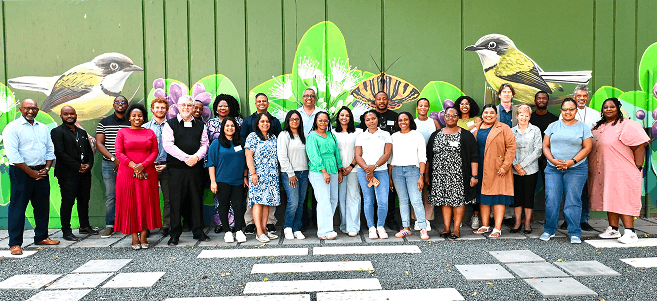
The University of KwaZulu-Natal’s (UKZN) Research Office recently hosted a five-day Early Career Researcher (ECR) workshop themed ‘Establishing Your Research Identity’, aimed at equipping emerging academics with the knowledge, skills and strategies needed to navigate the research landscape and build successful academic careers.
Facilitated by Professor Gregory Blatch, an internationally recognised researcher and Higher Education leader with more than 30 years of experience, the workshop explored both the internal and external research environment. Discussions focused on Discipline, School, College and cross-institutional structures, as well as local, national, regional and international research networks.
A Fellow of the Royal Society of South Africa and a member of the Academy of Science of South Africa, Blatch has held several senior leadership positions at universities in Australia, South Africa and the United Arab Emirates. His internationally recognised research in cellular stress biology has resulted in more than 130 peer-reviewed publications and the supervision of over 50 postgraduate students.
The programme addressed key questions around understanding the research landscape, accessing knowledge and resources and identifying strategies for successfully establishing a research career.
Opening the workshop, Professor Anil Chuturgoon emphasised the importance of developing a clear research identity as academics transition from emerging to established researchers.
“Becoming an independent, established researcher involves a number of formative steps, including developing a clear understanding of who you are as a researcher, defining the nature and scope of your research interests, identifying your research field, and learning how to navigate within it,” said Chuturgoon.
Blatch highlighted the value of a structured ‘Road Map for Year One’ designed to help researchers build a strong foundation for their academic careers.
“The four pillars of the Road Map – Building Strategic Knowledge, Forging a Scholarly Identity, Developing Relationships and Harnessing Resources – cover the essential actions that every emerging researcher must master,” he said.
Chuturgoon noted that the workshop was designed to help participants better understand the factors that influence research success and equip them to create personalised road maps for their professional development.
The programme combined presentations, group discussions, panel engagements and networking opportunities. Sessions focused on the Four Pillars framework, career planning, research publishing strategies and the development of individual research road maps.
One of the panellists, Professor Bhekumuzi Khoza, highlighted the significance of the ECR workshop series in preparing academics for long-term career growth and promotion.
“This series of Early Career Researcher workshops is very important because it provides ECRs with the key frameworks that define a well-established researcher who is promotable,” said Khoza.
He explained that these frameworks encompass five critical areas of academic development: qualifications and experience; teaching and learning; research and innovation; academic citizenship and community engagement; and leadership and university administration.
Khoza encouraged emerging researchers to complete their doctoral studies, articulate their teaching philosophies, critically reflect on the quality and impact of their research outputs, contribute meaningfully to their academic communities, and actively pursue leadership opportunities.
“Academics can strengthen their teaching portfolios and advance their careers by participating in workshops that support each of these areas. Initiatives such as teaching portfolio development workshops and the ECR series help academics become well-established scholars who are promotable and eligible for academic awards,” he said.
The workshop concluded with participants reflecting on the commitments outlined in their personal Year One Road Maps, followed by a networking session aimed at fostering collaboration and professional connections.
During the reflection session, Dr Aubrey Sosibo shared his research development roadmap, highlighting strengths gained through his doctoral studies, including systematic evidence synthesis, scoping methodologies and a strong commitment to evidence-based research. His research interests focus on lifestyle medicine and the prevention and management of non-communicable diseases, particularly diabetes.
Sosibo also reflected on the challenges of establishing an independent research identity, integrating basic science and public health approaches, and expanding collaborative networks. He committed to strengthening interdisciplinary partnerships, pursuing research funding opportunities, developing a comprehensive teaching portfolio and leveraging institutional resources to advance his academic career.
Dr Andile Faya described the workshop as an enriching experience that provided valuable insights into building a strong research identity, developing a specialised research niche, securing grants, publishing scholarly work, postgraduate supervision, and fostering collaborations.
During the programme, Faya presented a poster on his current research focusing on nano-formulations targeting various cancers and shared his career growth map, which outlined his research strengths, challenges, mitigation strategies, and strategic milestones for the next three years.
“I was privileged to present my work before the facilitator, Professor Gregory Blatch, as well as the Deputy Vice-Chancellor, University Dean of Research, and College Dean of Research. Their guidance on research growth, career road-mapping, and accessing key infrastructure, funding opportunities, and other resources was invaluable for advancing our careers,” said Faya.
By providing a structured framework for research development and career planning, the workshop reinforced UKZN’s commitment to nurturing the next generation of scholars and supporting early career researchers in establishing strong, sustainable and impactful research identities.
Words: Nombuso Dlamini
Photograph: Albert Hirasen

Previous post


