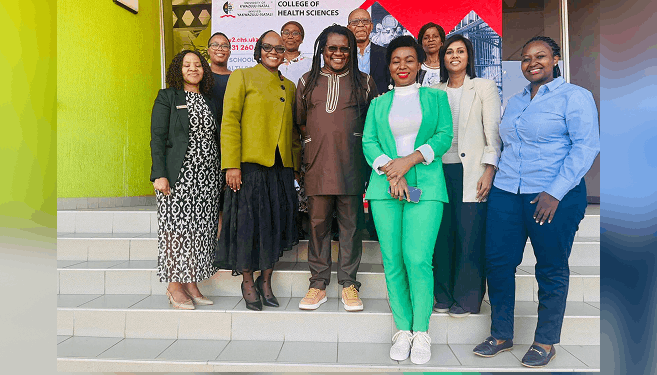
The Discipline of Physiotherapy at the University of KwaZulu-Natal (UKZN) hosted an insightful ‘Ethics and Law in Healthcare’ workshop aimed at strengthening the professional development of Department of Health physiotherapists and rehabilitation professionals.
The programme featured discussions on the Protection of Personal Information Act (POPIA), Promotion of Access to Information Act (PAIA), social media and clinical practice, informed consent, medical law, ethics in clinical research, as well as disability and rehabilitation ethics. Participants also engaged in scenario role-plays, case-based learning, and ethical dilemma discussions.
Former Health Professions Council of South Africa (HPCSA) President, Professor Desmond Mathye, presented on ethical and legal compliance in healthcare practice, focusing on Ethical Rule 27A as a practical framework for preventing professional misconduct. He emphasised that healthcare ethics is rooted in the Constitution and supported by legislation such as the National Health Act, POPIA, PAIA, and HPCSA ethical guidelines.
Mathye highlighted the importance of maintaining patient confidentiality, obtaining informed consent, communicating effectively, and keeping accurate patient records. He cautioned healthcare practitioners against the misuse of social media, warning that even anonymised patient posts could compromise confidentiality. “If it is not recorded, it is hard to prove,” he noted, while stressing the legal importance of proper clinical documentation.
Professor Sylvester Chima delivered a presentation on South Africa’s medical law framework and informed consent in clinical practice. He explained that informed consent is both an ethical obligation and legal requirement grounded in constitutional rights such as dignity, privacy, bodily integrity, and access to healthcare.
Chima emphasised that informed consent should be viewed as an ongoing conversation rather than a once-off signature on a form. Drawing on research conducted among rehabilitation therapists in KwaZulu-Natal, he highlighted challenges such as language barriers, heavy workloads, and inconsistent documentation practices. He encouraged practitioners to strengthen patient-centred communication and uphold ethical and legal standards in rehabilitation care.
Dean of Research at UKZN, Professor Bongani Nkambule, addressed ethics in clinical research, encouraging healthcare professionals to become active contributors to evidence-based practice through postgraduate study and research. He stressed that clinicians working directly with patients are best positioned to identify healthcare gaps and develop contextually relevant solutions.
Nkambule also warned about growing ethical concerns linked to artificial intelligence (AI), including data falsification, plagiarism, and manipulated research findings. He urged practitioners to critically evaluate evidence before applying it in clinical practice and underscored the importance of accountability, transparency, and reproducibility in ethical research.
In a presentation on disability rights and rehabilitation ethics, UKZN’s Physiotherapy lecturer, Dr Nsikelelo Pefile challenged healthcare professionals to reflect critically on how rehabilitation services are delivered to people with disabilities. He advocated for patient-centred rehabilitation practices that uphold autonomy, dignity, and inclusion.
Pefile stressed the importance of involving patients in rehabilitation goal setting, guided by the principle: ‘Nothing for us without us’. He also highlighted systemic barriers in the public healthcare sector, including resource constraints and limited access to workplace rehabilitation support, warning that these challenges contribute to cycles of poverty among people with disabilities.
Head of Physiotherapy, Professor Verusia Chetty, said: “The workshop is a valuable platform for healthcare professionals to reflect on ethical decision-making, lawful clinical practice, and patient-centred care in today’s evolving healthcare environment. We are proud of our partnership with the Department of Health physiotherapists.”
Participants praised the workshop for its practical relevance and engaging discussions. Mr Bandile Gazu described the workshop as “very insightful,” while Ms Philile Ngubo said it was “informative and more of a revival.”
Mr Iviwe Gabisa added: “The workshop allowed me as a healthcare professional to amalgamate ethics and legislation in being able to provide safe and legal services for the patients I attend to in my community.”
Words and photograph: Nombuso Dlamini