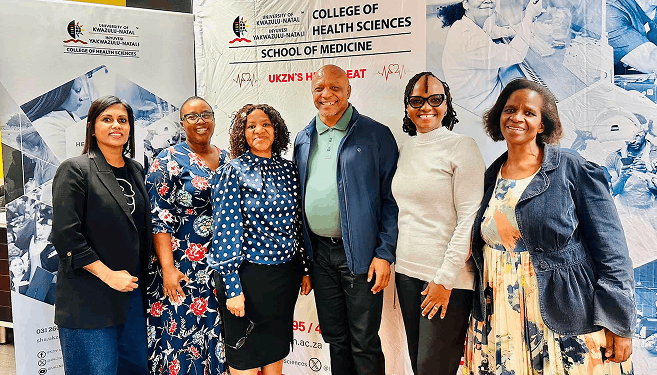
The University of KwaZulu-Natal’s (UKZN) Discipline of Physiotherapy recently hosted a comprehensive two-day Neurological Rehabilitation Workshop aimed at strengthening the knowledge and clinical competencies of healthcare professionals involved in the management of paediatric and adult neurological conditions.
The programme attracted neurologists, neurosurgeons, physiotherapists and rehabilitation specialists from UKZN, its partner – the KwaZulu-Natal Department of Health (KZN DoH) – and private practice to share the latest evidence-based approaches to neurological rehabilitation.
Through expert presentations, interactive discussions and hands-on practical sessions, delegates explored multidisciplinary strategies for managing conditions including stroke, traumatic brain injury, spinal cord injury and spina bifida.
The workshop also underscored the importance of family-centred care, functional goal setting, collaborative multidisciplinary practice and the pivotal role of physiotherapy in improving patient outcomes and quality of life for individuals living with neurological conditions.
It was highlighted that treating paediatric neurology was a scarce skill amongst healthcare providers, and that made it a critical component of the workshop.
This workshop was part of a series being hosted by the University in collaboration with KZN DoH for the greater benefit of patients spread across the province’s township and rural peripheries by equipping the healthcare providers to manage large patient populations that have limited access to especially specialised healthcare.
Acting Deputy Director Disability and Rehabilitation for KZN DoH, Mr Jacob Mbhele, said DoH colleagues had also benefited immensely from the preceding Ethics and Medical Law as well as Medico-legal Report Writing, workshops.
Mbhele said continuing professional development (CPD) and short-course development for DoH healthcare workers were essential in addressing the needs of the province. This made partnering with UKZN a clear mandate as the University upholds its name as a ‘reputable service provider – an accredited, authentic brand to work with’.
Mbhele commended the University’s ongoing research endeavours, highlighting that the UKZN-DoH partnership also benefited patients when students did their community service rotations across the KZN’s health districts.
Mbhele said his own passion for the areas of disability and rehabilitation stemmed from making people understand that functional ability, in terms of the human body, can be improved if you have a skilled person providing guidance. “In rural areas, you find when a person suffers a stroke there are myths and stigmas that ought to be dispelled in order for them to receive an appropriate intervention. The population must find people out there in the community who know how to provide care in the home setting.”
Mbhele lobbied for holistic healing, aligning it to the country’s economy, “as full recovery means that people can get back to work and be able to provide for their families.”
“As a developing country we struggle to manage chronic illness which often lead to disability, thereby hindering the patient’s career and overall quality of life,” said compassionate UKZN alumnus and Ceza Hospital Physiotherapist in Zululand, Mr Sikhumbuzo Dube, who lobbies for healthy living, raising health awareness and prays the province sees a reduced number of motor vehicle accidents, which often hinder health and progress to the economy.
Biokinetics, Exercise and Leisure Sciences (BELS) senior lecturer, Dr Levin Chetty, said it was important to have a multidisciplinary approach to patient care “because we are moving away from the biomedical to the bio-psycho-social model of treatment.” He emphasised that this was necessary because there is no one-size-fits-all model for the diversity of patients that they treat.
Professor Verusia Chetty, who heads UKZN’s Physiotherapy, added: “This partnership with the KZN Department of Health lies at the heart of what we are trying to achieve – decentralising specialised care so that it reaches patients wherever they are, not only those close to tertiary hospitals. By upskilling healthcare providers who work daily in our townships and rural districts, we are building sustainable local capacity that will long outlast any single workshop. Ultimately, this is about improving the quality of life of patients who have historically had the least access to specialised rehabilitation care.”
Words and photograph: Lunga Memela