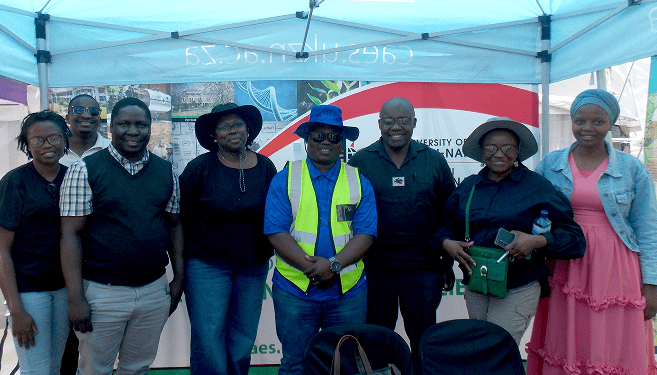
The University of KwaZulu-Natal’s (UKZN) research into transforming waste into a resource featured prominently during Deputy Minister of Water and Sanitation (DWS) Sello Seitlholo’s visit to the Darvill Wastewater Treatment Works (WWTW) in Pietermaritzburg to launch the Department’s Sanitation Month under the theme: ‘Towards a Circular Economy’.
At a briefing session with officials from national and provincial DWS offices as well as uMngeni-uThukela Water (UUW) representatives, provincial DWS Director Ms Angela Masefield emphasised the importance of recognising waste as a resource and the role of wastewater treatment in supplying nutrients for agriculture while easing pressure on freshwater systems. Masefield highlighted Darvill as a positive model of public-private collaboration enabling innovation and knowledge generation through partnerships with universities.
During the public stakeholder session, the Deputy Mayor of Msunduzi, Mr Mxolisi Mkhize, and the uMgungundlovu Deputy Mayor Councillor Sibongile Dlamini-Mabaso, welcomed guests to the region, which faces unique development pressures.
Seitlholo described Darvill as an example of what can be achieved when a wastewater facility is designed for more than linear waste disposal. With over 40% of South Africa’s wastewater works currently dysfunctional, he warned of a national crisis of untreated sewage and stressed the urgency of transitioning to circular systems. He highlighted the economic importance of the uMngeni catchment area, which supports 70% of KwaZulu-Natal’s economy, and called for greater public awareness to protect sewage infrastructure and conserve water.
During the interaction, Professor Alfred Odindo of the Discipline of Agricultural Plant Sciences at UKZN, who serves as a principal investigator on the international Rural-Urban Nexus: Establishing a Nutrient Loop to Improve City Region Food System Resilience (RUNRES), described how co-composting and resource recovery can strengthen food system resilience and advance South Africa’s green economy. Odindo emphasised a circular economy approach in which faecal sludge and organic waste are treated not as waste but as valuable nutrient sources. Human excreta, he noted, contains essential nutrients for plant growth, with the waste from just 80 people capable of fertilising a hectare of land.
Over the past decade, UKZN has collaborated with municipalities and stakeholders to map organic waste streams and develop an innovative platform that combines organic green waste and treated sludge. In Msunduzi, where 55 000 tons of organic green waste is produced annually, the team’s work diverted 10 000 – 15 000 tons from landfill each year, extending its lifespan. Their quality-assured co-compost has been successfully used at the Bishopstowe Agroecology Living Laboratory, where farmers and young people are trained to integrate these resources into agricultural systems and add value through agro-processing.
Odindo also highlighted the team’s work with Julukandoda Primary School, where a decentralised wastewater treatment system and urine-diversion toilets for the 900 learners are linked to agriculture. Co-compost, biochar, and urine, collected and treated according to World Health Organization guidelines, were used to establish a potato crop at the school. This was done as part of a study to evaluate the efficacy of human-excreta-derived fertiliser and phosphorus recovery on crop production, providing an opportunity to observe social-technical transitions integrating innovative sanitation technologies with changes in user behaviour. This aids the understanding of how to change mindsets on human-excreta use in agriculture, recognising that changes often emerge from smaller ‘niche’ innovations that gradually challenge and replace the existing dominant thinking.
Odindo concluded by emphasising the need for strong stakeholder engagement across the sanitation, agriculture, water and health sectors. Developing crop value chains, business models and financial frameworks for circular sanitation interventions, he said, was essential to ‘move this agenda forward’.
Said Masefield: “Here we have a technology and partnerships that are really valuable and in line with the policies and ideologies of the department, where we want to ensure that our waste disposal is as sustainable as possible.”
Seitlholo said water knew no boundaries… “if we don’t start classifying pollution of our water sources as a crisis, it will be too late. UKZN is doing remarkable research that will assist us in making sure we are able to deal with this issue at a high level.”
A tour of Darvill and the neighbouring DuziTurf operation showcased nutrient recovery for fertiliser, methane-to-energy processes, and water purification. Project manager Mr Lindelani Sibiya noted UUW’s ambition to establish the site as South Africa’s wastewater research hub.
The South African Local Government Association in KwaZulu-Natal praised the collaborative model, with Seitlholo concluding that informed decision-making and deliberate municipal adoption of circular economy principles were essential for the long-term sustainability of sanitation.
Words and photograph: Christine Cuénod