While the global economy is projected to grow by 3.3% in 2026, South Africa’s projected growth is 1.6% which is less than half of the global average. South Africa’s growth projection is insufficient to address the triple challenge of unemployment, inequality and poverty. Our growth projections, closely linked to those of the advanced economies, are far below those of our peers. This is despite the fact that our economic problems are not aligned with those of advanced economies.
We are way below the average when compared to emerging and developing economies, with a projection of 4.2%, and sub-Saharan Africa, with a projection of 4.6%. China and India (South Africa’s partners in BRICS) have projected growth rates of 4.5% and 6.4%, respectively. Nigeria has a projection of 4.4%. In the wake of geopolitical tensions, emerging countries appear to be resilient. South Africa urgently needs economic reforms which would help reduce vulnerability to external shocks and position itself to benefit from emerging global growth centres.
Notable economic milestones in South Africa include the country’s removal from grey-listing, which South Africa hopes will attract investors and create higher-than- expected net VAT, corporate income tax, and dividends tax collections. The gross tax revenue of R21.3 billion, more than the estimated, led Minister Godongwana to withdraw the R20 billion tax increase proposal taking pressure off the country’s fiscus. The minister lauded the current SARS Commissioner for the achievement.
More can still be achieved as the country strengthens its attack against illicit trade.
Rather than increasing VAT, improving efficiencies in the country’s fiscus has produced good results, but again more still needs to be done.
Two important items noted by the Minister were:
- about 35 000 grants were identified as incorrect or fraudulent
- a ghost worker audit flagged more than 4 323 high-risk cases on the government payroll system
As well as helping fund recovery, it would instil much-needed confidence in South Africans if perpetrators and fraudsters could be brought to book.
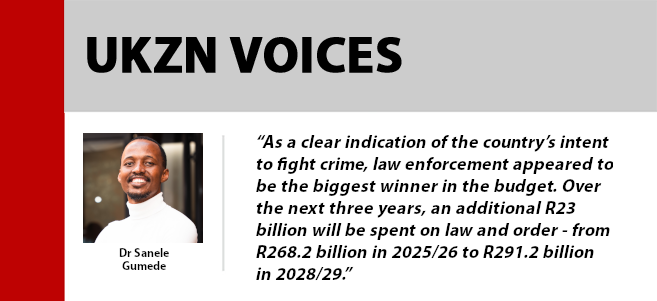
As a clear indication of the country’s intent to fight crime, law enforcement appeared to be the biggest winner in the budget. Over the next three years, an additional R23 billion will be spent on law and order – from R268.2 billion in 2025/26 to R291.2 billion in 2028/29.
A total of 738 people will be hired for positions at the Border Management Authority while R1 billion is earmarked for the SA Police Services and R3.7 billion for the South African National Defence Force.
Godongwana also said the Treasury was open to extend funding for commissions of inquiry should the need arise – another indication of the government’s intent to root out corruption in the country.
Increases in fuel levies – by 21c/l on petrol and 23c/l on diesel – will produce additional revenue.
As expected, there were the usual increases in in alcohol and tobacco duties which provide further significant contributions to the country’s revenue.
The President is expected to soon announce the date of South Africa’s local government elections. A trade-off appears evident as the minister has decided to cut the Home Affairs budget to fund the elections.
Overall, the minister’s budget tabled highlighted much-needed structural reforms to our economy, which the country hopes will result in sustainable growth.
* Dr Sanele Gumede is an economist and a senior lecturer in the School of Commerce at the University of KwaZulu-Natal, and a founding member of the University’s Macroeconomics Research Unit.
*The views and opinions expressed in this article are those of the author and do not necessarily reflect the official policy or position of the University of KwaZulu-Natal.