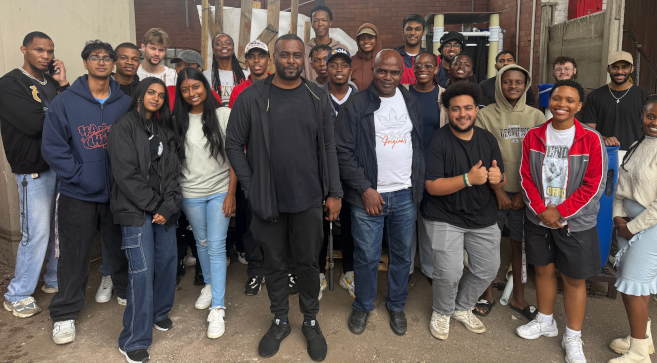
Under the leadership of third year co-ordinator Dr Viloshin Govender, a University of KwaZulu-Natal (UKZN) senior lecturer in the School of Architecture, a studio project was conceived to explore architecture’s role in social responsibility.
The project aimed to redefine how design can contribute to sustainable urban environments through small-scale, high-impact interventions.
The task of students – to design an informal urinal for informal economies – perhaps appears modest in scale, but its implications were profound, addressing some of the most persistent and overlooked urban challenges: sanitation, dignity and access in marginalised urban spaces.
Situated within the realities of informal trading environments, the project challenged students to confront the everyday conditions experienced by those who live and work on the margins of formal city systems. Rather than treating sanitation as a purely technical problem, students approached it as a social, spatial, environmental, and ethical issue, recognising that access to safe, dignified sanitation is inseparable from human rights, public health, and urban justice.
Through collaboration with Asiye Etafuleni, a community-based organisation working directly with informal traders and vulnerable urban communities, students engaged with real users, real constraints and real urban complexity. This partnership transformed the project from an abstract design exercise into a participatory, community-informed process, grounding architectural thinking in lived experience. Students were required to listen, observe, test ideas, and respond to social realities rather than impose preconceived solutions.
The informal urinal became a micro-infrastructure project with macro-urban impact. Proposals addressed water efficiency, low-cost construction, durability, ease of maintenance, safety, accessibility and cultural sensitivity. Importantly, designs were not treated as isolated objects but rather as urban interfaces, integrated into pedestrian flows, trading networks and public space systems. Students explored how a single piece of infrastructure could support public health, improve environmental conditions, enhance safety, and restore dignity in everyday urban life.
The project demonstrated how architects can operate meaningfully within informal economies, working with, not against, informality. It challenged dominant top-down planning models and instead promoted bottom-up, adaptive, and community-responsive design thinking. Students learned that sustainability is not only about materials and energy performance, but also about social inclusion, economic resilience and spatial justice.
Ultimately, the project reframed sustainability as an ethical practice. By designing for sanitation in marginalised urban contexts, students contributed to a broader vision of sustainable cities -cities that are not only efficient and resilient, but equitable, humane, and inclusive.
The work shows that even the smallest architectural interventions, when grounded in empathy, collaboration, and critical urban thinking, can play a transformative role in shaping more just and sustainable urban environments.
Words: Melissa Mungroo
Photograph: Supplied