
The 2026 State of the Nation Address: Key Issues and Direction
- Posted by ukzn-admin
- Categories News
- Date March 2, 2026
In the South African context, the State of the Nation Address (SONA) is delivered annually by the President. The address reflects on the state of the country, outlines key challenges and sets out broad government plans in response. SONA also marks the official opening of Parliament and provides an opportunity for the President to address national, continental and international socio-economic and political developments.
The cost of this year’s SONA was R7 million, and it remains one of the most significant parliamentary events of the year. In terms of constitutional and parliamentary rules, the President may call a joint sitting of the National Assembly and the National Council of Provinces for special business, including SONA.
Preparation of the address is consultative and involves Government of National Unity (GNU) partners, researchers, advisers, technocrats, civil society, labour and business. The Presidency directs the process, incorporating the Medium-Term Development Plan 2024–2029 and the priorities of the seventh administration: inclusive economic growth, job creation, poverty reduction, lowering the cost of living, and building an ethical and capable state.
President Cyril Ramaphosa delivered the 2026 SONA in a manner that drew attention to the role of the Government of National Unity (GNU) as a collaborative arrangement among political parties. The address suggested that smaller political parties can contribute to shaping public policy in South Africa.
The President highlighted positive economic indicators while also outlining persistent structural challenges facing the country.
There has been a slight increase in economic growth; the rand–dollar exchange rate has stabilised; infrastructure investment has exceeded R3 trillion over three years; inflation is at its lowest level in 20 years; credit ratings have improved; mining exploration has attracted renewed interest; and load shedding has largely ended. The prioritised sectors of the economy include renewable energy, logistics, agriculture and the green economy, with future emphasis on green manufacturing, digital infrastructure and critical minerals.
Despite this progress, unemployment and poverty remain significant constraints. South Africa also hosted the G20 Summit last year, reinforcing its role in global socio-economic and political engagement.
The President acknowledged the emergence of a new global order, requiring South Africa to adapt politically and economically. He emphasised that the country will continue to engage continentally and internationally without compromising its constitutional values and sovereignty.
Organised crime was identified as a serious threat to democracy and development. Proposed interventions include increased recruitment of police officers, strengthened intelligence capacity and, where necessary, deployment of the armed forces. Concerns were also raised regarding leadership challenges within the South African Police Service (SAPS), as referenced by the Madlanga Commission of Inquiry.
Anti-corruption reforms and strengthened whistleblower protection were also proposed, with particular emphasis on financial compensation. Addressing these issues will require strong political and administrative will, effective implementation of legislation and successful prosecutions. Babita Deokaran, a prominent whistleblower, was killed on 23 August 2021.
Water governance, which featured prominently in the 2026 SONA, has become a national crisis. Deteriorating infrastructure and poor maintenance have resulted in widespread water outages. A National Water Crisis Committee, chaired by the President, has been established.
Intervention in eThekwini Municipality was noted; however, challenges remain, including water outages and inflated municipal billing. The possibility of criminal charges against municipalities for delivery failures was also raised. At local level, communities continue to experience challenges related to unresponsive administration and weak accountability.
The assertion that “local government is the hands and feet of government” and that municipal failure affects national performance was reinforced in the 2026 SONA. Municipal challenges were attributed to governance weaknesses, with proposals including strengthened oversight and professionalisation of the public sector based on meritocracy.
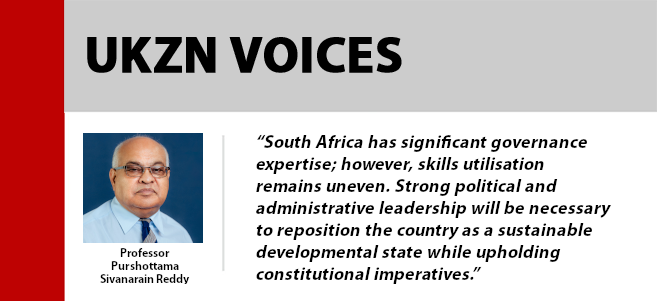
South Africa has significant governance expertise; however, skills utilisation remains uneven. Strong political and administrative leadership will be necessary to reposition the country as a sustainable developmental state while upholding constitutional imperatives.
The 2026 SONA addressed a range of key issues and adopted an optimistic tone. Many South Africans have been awaiting tangible progress over the past 12 months. However, effective implementation remains the critical test.
Several non-governmental organisations (NGOs) have expressed concern that previous addresses were strong on commitments but lacked clear, funded implementation plans. Questions have also been raised about the absence of detailed timelines and firm budget allocations to address urgent social and economic challenges.
Purshottama Sivanarain Reddy is a professor and Public Governance Specialist in the Graduate School of Business and Leadership, University of KwaZulu-Natal.
*The views and opinions expressed in this article are those of the author and do not necessarily reflect the official policy or position of the University of KwaZulu-Natal.


