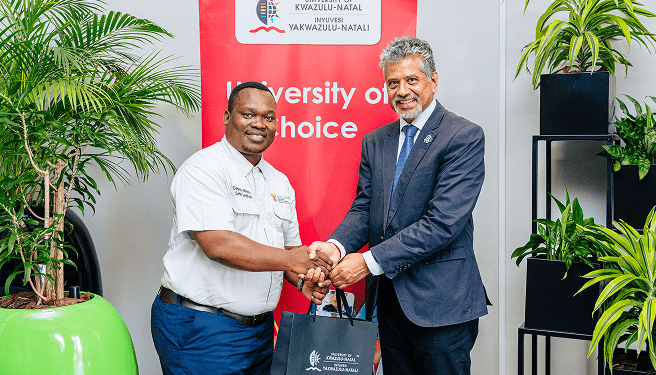
University of KwaZulu-Natal (UKZN) hosted a two-day World Toilet Day celebration on its Howard College campus in Durban, highlighting the University’s commitment to innovative, sustainable sanitation solutions.
Welcoming guests, Acting Deputy Vice-Chancellor (DVC) of Research and Innovation Professor Anil Chuturgoon emphasised the importance of partnerships in advancing sanitation technologies that can transform communities.
“At UKZN, we recognise that advancing sanitation solutions requires not only cutting-edge technology but also strong collaboration with providers, communities, government and research experts,” said Chuturgoon. “By broadening our support for these vital partners, we aim to accelerate the development, implementation and scaling of effective sanitation technologies that can transform lives locally and beyond.”
The event was led by Deputy Minister of Water and Sanitation, Mr Sello Seitlholo, and attended by UKZN academics as well as community representatives and industry partners.
Speaking on behalf of the Vice-Chancellor and Principal Professor Nana Poku, Chuturgoon noted that the celebration aligned closely with UKZN’s strategic vision. “Access to safe and sustainable sanitation is a cornerstone of public health, dignity and community development. Our Strategic Plan emphasises advancing knowledge that addresses local and global challenges, including sustainable water and sanitation solutions,” said Chuturgoon. He added that UKZN continued striving to integrate research, teaching, and community engagement to create meaningful impact.
Seitlholo highlighted the urgent need for collaboration between government, academia, the private sector and communities in addressing South Africa’s sanitation challenges.
He emphasised that everyone deserved dignity, and stressed the importance of exploring waterless and water-efficient sanitation solutions, particularly in the context of increasing water scarcity. “The best way to get South Africa to work is by getting municipalities to work together and engage stakeholders, including academics and communities,” he said, acknowledging contributions from the Water Research Commission, UKZN, and various partners committed to people-centred innovation.
An innovative sanitation project in the Ekuthuleni (Shallcross) area took centre stage as part of the Sanitation Month campaign. Officials inspected the Aquonic wastewater treatment system, a compact modular technology that converts black and grey water into reusable water for flushing and irrigation. The project forms part of the Water Efficient Sanitation Solutions (WESS) initiative, being tested across multiple sites in the country.
The Ekuthuleni informal settlement – home to 50 households relying on a communal ablution block – is one of the key testing grounds for these technologies. This year’s World Toilet Day theme: ‘Sanitation in a Changing World’, underscores the urgency of adapting sanitation systems to environmental and social shifts.
Seitlholo also visited the KwaMashu Wastewater Treatment Plant, where advanced sludge treatment technology, including latrine dehydration and pasteurisation systems, is being implemented to enhance hygiene and sustainability.
According to the eThekwini Municipality, newly-installed eco-friendly toilets – such as eco twin leach pits, easy flush toilets, and potable wastewater treatment units – are off-grid, requiring only two litres of grey water for flushing. Rainwater can also be used, making them both cost-effective and water efficient.
Chairperson of the eThekwini Municipality Trading Services Committee Mr Mduduzi Nkosi, noted that the city recently hosted a delegation from another African country interested in benchmarking these sanitation innovations. He said the Municipality planned to expand the programme to schools and informal settlements across the region.
Communities in areas including Dassenhoek, Tshelimnyama, Verulam, Zwelisha, Buffelsdraai, Umlazi, and Imfume have already reported positive experiences. Women have welcomed the improved hygiene and safety provided by the new systems.
“We are proud that other countries want to benchmark our sanitation projects,” said Nkosi. “These systems operate off-grid and reduce maintenance needs. Communities have looked after the infrastructure and helped prevent vandalism,” Nkosi added.
Words: Nombuso Dlamini
Photograph: Sethu Dlamini