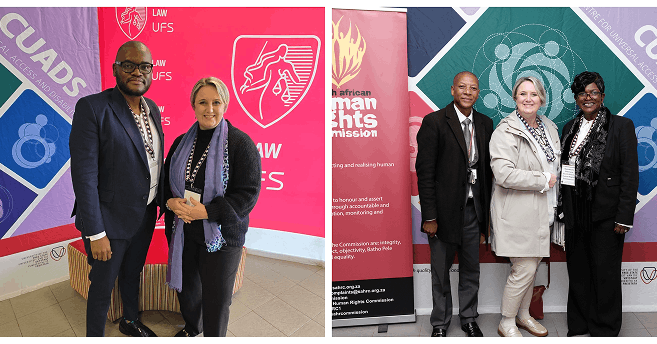
The University of KwaZulu-Natal’s (UKZN) School of Law was strongly represented at the third International Conference on Disability Rights hosted by the University of the Free State recently.
Organised by the Faculty of Law in partnership with the Centre for Universal Access and Disability Support (CUADS), the South African Human Rights Commission (SAHRC), the National Council of and for Persons with Disabilities and other partners, the conference explored accessibility as a universal design principle that benefits society as a whole. Discussions were framed by the United Nations Convention on the Rights of Persons with Disabilities (CRPD), the African Disability Rights Protocol and the Sustainable Development Goals.
The School’s delegation comprised Professor Willene Holness, Honorary Research Fellow Dr Lindani Nxumalo and doctoral candidates Ms Leone Nezi and Mr Tanaka Dhumbura, whose research addressed legal and policy challenges affecting persons with disabilities.
Nezi presented findings from her doctoral research on the barriers Deaf women who survive intimate partner sexual violence face in accessing sexual and reproductive health services. Her study developed a conceptual framework demonstrating how systemic ableism and audism within healthcare and legal systems continue to impede access to justice and essential services.
Dhumbura examined the exclusion of children with disabilities from humanitarian action, climate response and disaster planning. His presentation highlighted the need for accessible early warning systems, disability-inclusive planning and meaningful participation before disasters occur, arguing that proactive inclusion is essential to protect children’s rights.
Holness presented two papers. The first examined the use of Easy-to-Read formats in South African law reform, using the Promotion and Protection of Persons with Disabilities Bill as a case study. Her research found that although accessible formats were introduced, they were made available too late to enable meaningful public participation. Her second paper, co-authored with Mr Silomo Khumalo and Dr Dag Wakene, explored disability-inclusive pandemic preparedness, drawing lessons from barriers experienced within South Africa’s justice system during COVID-19.
Nxumalo’s presentation explored the role of reasonable accommodation in achieving decent work for persons with disabilities. He argued that organisations should move beyond legal compliance by embedding disability inclusion within workplace policies, organisational culture and leadership to promote equitable access, participation and long-term workforce sustainability.
Holness said the conference provided an important platform for interdisciplinary collaboration on disability rights and research presented by the UKZN delegation highlighted the importance of embedding accessibility and inclusion across legal, healthcare, humanitarian and workplace systems. “Collectively, our work reinforces the need to ensure that persons with disabilities are centred as decision-makers and rights bearers in addition to being meaningfully represented in decisions that affect their lives,” she said.
The conference reaffirmed the School of Law’s commitment to producing impactful research that advances disability rights, social justice and inclusive development in South Africa and beyond.
Words: NdabaOnline
Photographs: Supplied