Research Investigates isiZulu as Medium of Teaching at UKZN
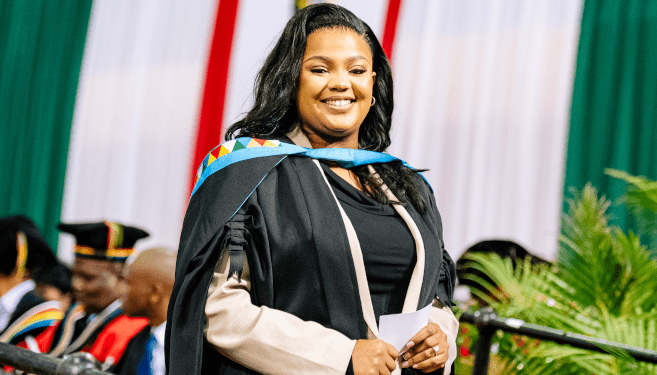
Music Foundation Programme Administrator at UKZN Ms Thandi Ndlovu graduated with a Master of Arts in isiZulu Studies.
‘This achievement has made me realise that I have so much potential. I doubted myself at times, but I have found new strength within that I love. This experience has taught me patience, perseverance and to never give up,’ she said.
The study, titled: “The Use of IsiZulu Mother Tongue as the Medium of Teaching and Learning in the Access Programmes at UKZN”, investigated the role played by the mother tongue in education and the strategies employed to implementing the University’s isiZulu-English bilingual policy.
‘English-speaking learners who are taught in their mother tongue have a higher pass rate than isiZulu students who are taught in English. Being taught in one’s mother tongue thus makes it easier to grasp concepts. With this in mind, I investigate how isiZulu learners feel about being taught in English, especially since they come from disadvantaged schools where they are taught English in isiZulu.’
‘My first objective was to explore students’ and educators’ attitudes towards the use of IsiZulu-English bilingualism as a medium of instruction and learning at UKZN,’ explained Ndlovu. Three major themes emerged, namely, language as a problem, as a resource and as a right.
Some students believed the initiative would help them grasp concepts more easily and that it would improve the pass rate at UKZN. However, others believed that it would not make any difference, while another group was of the view that it would cause confusion.
Ndlovu’s second objective was to investigate the academic benefits and challenges of implementing isiZulu-English bilingual education. ‘UKZN uses several strategies to ensure the implementation and use of isiZulu, mainly via its University Language Planning and Development Office.’
Many students appreciated being able to use their home language in the classroom and in exams and assignments. However, some highlighted the lack of lecturers competent to implement isiZulu as a language of teaching and learning. The lack of resources to support this initiative was cited as a further challenge.
Ndlovu remarked that most African students in universities are not fully competent in either their mother tongue or the language of instruction. While linguistic competence in English is important, this should not overshadow the importance of proficiency and competence in the mother tongue.
The third objective was to investigate different strategies used by various Extended Curriculum Programmes to ensure that isiZulu-English bilingualism as a medium of instruction and learning yields the envisaged outcomes.
‘My research showed that a number of strategies can be used such as terminology development, bilingual lecturers and translanguaging. Students are also divided into small tutorial groups, in which they are able to use isiZulu-English bilingualism; they are able to speak isiZulu with their tutors, code switch and code mix, which enables them to understand what they are being taught,’ said Ndlovu.
Reflecting on her master’s journey, Ndlovu said, ‘I am thankful to my supervisor Dr Gugulethu B Mazibuko. for always believing and seeing potential in me. This journey was not always smooth sailing, but I understand that she never wanted to compromise the quality and ethics. My fiancé and my sisters were also a constant source of encouragement and inspiration.’
Motivated by this achievement, she plans to register for a PhD.
Words: Jennene Naidu
Photograph: Sethu Dlamini