Bridging Faith and Advocacy in the Fight Against GBV
‘When people think of gender-based violence (GBV), they do not normally think there can be a connection with religion. I wanted to highlight this connection. As a survivor of GBV, I wanted people to know that they can turn to their religious community for help.’
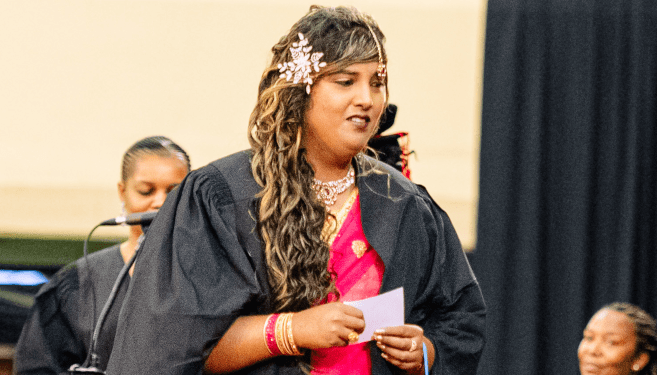
This personal experience motivated Gender and Religion graduate Ms Meriska Shriduth’s master’s research titled, “Silent No More Religion Engaging with GBV in South Africa: A Case Study on the ‘We Will Speak Out SA’ Coalition”.
‘The coalition was chosen because it weaves religion into its efforts to combat GBV, advocating for the rights of survivors within religious communities,’ said Shriduth. ‘Historically, religious institutions have avoided addressing GBV, considering it a taboo subject. However, the coalition actively works to change this by engaging religious leaders and communities, providing critical support to survivors.
She noted that patriarchy still goes hand in hand with religion and that readings of spiritual texts are still very literal with no room for interpretation.
Shriduth highlighted that one of the coalition’s key contributions is creating safe spaces for survivors within religious institutions, a vital aspect often missing in faith communities. ‘For example, when I asked to speak about GBV in my church, the pastor said it was not something we discussed. However, many survivors are looking for their religious community to be a place of refuge and support, and that is what the coalition aims to provide,’ she explained.
The coalition’s efforts align with the National Strategic Plan’s six pillars, offering programmes that train religious leaders on how to effectively address GBV. ‘Through these programmes, religious leaders are better equipped to support survivors. The coalition also provides clear referral pathways, ensuring that survivors can access the specialised care they need,’ said Shriduth.
‘Survivors of GBV within religious communities have responded well to the coalition’s efforts and many are now receiving the care that they need. The coalition also creates clear referral pathways for survivors so that people that need specific attention are referred to the appropriate place.’
Supervisor Ms Beverly Vencatsamy lauded the research as both timely and impactful, ‘Grounded in intersectional feminism, the study highlights gaps in current approaches and offers actionable strategies for improvement. By challenging longstanding norms within religious institutions, the findings have the potential to inspire meaningful change in how these communities support survivors. Her graduation is a significant achievement that contributes to the ongoing fight against GBV in South Africa, and we are proud of her work.’
Shriduth thanked her parents and supervisor for their support. She added that much remains to be done:
‘This battle cannot be won on its own. Social justice movements need the help of religious communities which they are not getting at the moment. Religious communities need to stand up and say, it is now time to talk about GBV.’
Words: Rakshika Sibran
Photograph: Sethu Dlamini