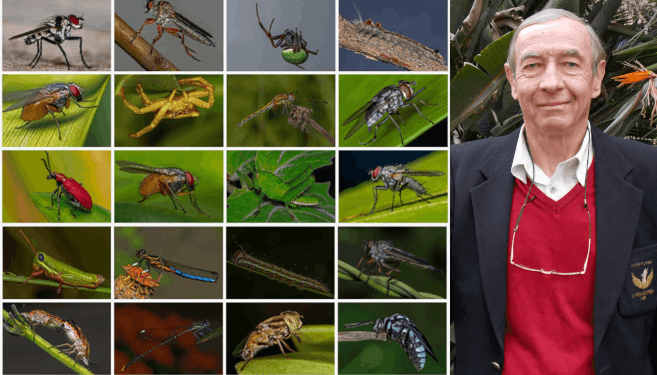
The University of KwaZulu-Natal’s (UKZN) Emeritus Professor Rob Hart has been awarded a Fellowship of the Photographic Society of South Africa (PSSA) for a panel of 25 images featuring insects and spiders that reflect his lifetime of work in zoology and ecology.
The technically challenging nature of macro photography and the high standards of assessment make receiving the Fellowship all the more gratifying for Hart, and it is his background in biology and ecology that enabled him to perceive invertebrates’ remarkable and varied survival strategies. He is one of only 96 members currently holding a PSSA Fellowship, with only a handful of these awarded for macro photography, and Hart is the first from the Maritzburg Camera Club to achieve this recognition, which he calls “a cherished milestone”.
A PSSA judge noted that, “Macro photography is probably one of the most difficult fields of photography in which to succeed in an honour’s application. The standard for macro photography is very high, setting a very high bar for success.”
Hart has received several accolades over his decades-long career, including the prestigious Southern African Society of Aquatic Scientists (SASAqS) Gold Medal in 2017 in recognition of his contributions to aquatic sciences.
Hart, originally from what was then Northern Rhodesia, grew up in sandy teak forests and wide-open grass plains alongside the Luanginga River, which flooded seasonally. The untouched natural environment and his parents’ encouragement nurtured his love for the wide range of animals and insects he could observe. He developed basic taxidermy skills, enabling him to contribute bird specimens to the Rhodes Livingstone Museum, where Mr Constantine Walter Benson became a mentor to the budding scientist. As a schoolboy, Hart was granted special permission to collect bird specimens in an exclusive hunting preserve of Barotseland’s Paramount Chief Lewanika – the Liuwa Plains reserve. Partly through this, he achieved a notable academic milestone by publishing a joint paper and having two lark subspecies named after him.
Keen to photograph the diverse organisms around him, Hart’s enthusiasm was tempered by limited equipment until, during his studies towards a Bachelor of Science in Botany and Zoology at the then University of Natal, his 35mm Pentax camera allowed him to explore this interest while on a visit with eminent ornithologist Dr Gordon Mclean to a research site in the Kalahari Game Reserve, and Hart’s contributions to the University’s Wildlife Society included photographs of their outings. Gordon’s quip that Hart was only happy when he had captured a sighting on celloidin was a true reflection of his growing photographic obsession.
Initially keen on a career in ornithology or mammalogy, an opportunity to relocate to Rhodes University’s Institute for Freshwater Studies field station on the shore of Lake Sibaya with his new wife, where he would study plankton, led Hart to bypass a master’s degree to obtain his PhD in just four years. His work comprised the then only South African contribution to the International Biological Programme on Freshwater Productivity.
Studying the diverse microscopic plankton also developed Hart’s eye for minute organisms, and he made the most of the Lake’s photographic opportunities, contributing photographic illustrations for textbooks such as Inland Waters of Southern Africa: An Ecological Perspective (Allanson, Hart, O’Keefe & Robarts 1990), in which 17 of the 38 photos were his.
At Rhodes University, Hart held an endowed Chair of Postgraduate Limnology for five years, returning to the University of Natal, where his diverse lecturing portfolio gave him an ecological and biological eye for invertebrates, while his photography focused more on conventional wildlife subjects.
After retiring in 2007, Hart purchased an entry-level digital single-lens reflex (DSLR) camera and joined the Maritzburg Camera Club, enabling him to pursue photography more seriously, refining his skill during the Club’s outings and topic-based projects. He joined the PSSA in 2012 and was awarded an Associateship of the Society in 2014. Honing his skills in close-up or macro photography as his ability to visit wilderness areas grew increasingly constrained, he appreciated the biodiversity offered by even a modest suburban garden.
“‘Life’ is essentially underpinned by two evolutionary fundamentals: live to maturity, and leave offspring. For animals, living to maturity requires finding food of sufficient and suitable quality, avoiding death (by predation, parasitism and disease, or by environmental stressors like weather) and thereafter – breeding. Invertebrates provide an enormously wide variety of strategies in all these arenas. Awareness of these fundamentals gained through my learning and teaching experiences enhanced my ability to see and perceive the fascinating photographic prospects provided by invertebrate subjects,” said Hart.
Post-retirement, Hart’s research on the ecological impacts and management of eutrophication in reservoir lakes (South Africa’s main water source) led to a unique comparative study of long-term satellite data on chlorophyll levels in managed and control reservoirs, showing how ineffective the costly but fundamentally flawed ‘biomanipulation’ management strategy had been. He continues with various projects, including the analysis of painted reed frog thermoregulation during daytime ‘roosting’ site selection, a synthetic historical evaluation of limnological studies on Hartbeespoort Dam, and the assessment of the management implications of South African reservoir morphometry and bathymetry.
Words: Christine Cuénod
Photographs: Christine Cuénod and supplied