South Africa faces a critical skills shortage, particularly in the electrical and renewable energy trades. Technical and Vocational Education and Training (TVET) colleges are intended to serve as a pipeline for these skills.
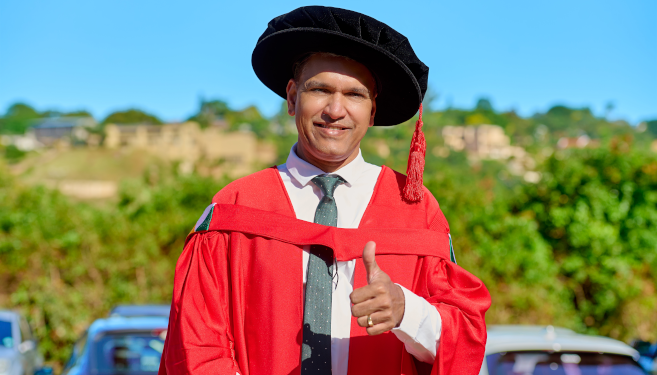
However, the quality of teaching within these institutions remains inconsistent and often under-resourced. Dr Mark Sanjeevy, an educational content developer and lecturer in the TVET sector, recently completed a PhD examining the use of Lesson Study as a professional development tool within TVET electrical education in South Africa.
The study titled, ‘Implementing Lesson Study to Influence the Teaching and Learning of Electrical Wiring Diagrams in a South African TVET College’, was supervised by Professor Wayne Hugo.
Lesson Study is a collaborative process in which educators jointly plan a lesson, observe its delivery, and then reflect on and refine it together. Sanjeevy’s research explored how this approach could improve teaching quality and learner outcomes in technical subjects. His study drew on theoretical frameworks such as Dual Coding Theory, Multimedia Learning Theory, and Cognitive Load Theory.
With a background in cognitive psychology, Sanjeevy has long been interested in how people learn in technical and vocational contexts. His experience in developing curriculum and teaching materials for electrical and electromobility programmes led him to question the effectiveness of current teaching practices. “Are we teaching these learners effectively? I wanted to investigate that rigorously rather than assume,” he explained.
He argues that Lesson Study offers a practical, low-cost, and evidence-based method for improving teaching from within institutions, without relying on expensive external interventions. If adopted more broadly, it has the potential to significantly enhance the quality of technical instruction and better prepare graduates for the workforce.
“The topic felt urgent because TVET colleges are central to the country’s skills development agenda, yet the quality of teaching practice in these colleges receives far too little research attention,” he said. “That gap needed to be addressed, and I wanted to contribute to that effort.”
According to Sanjeevy, the study contributes both practical insights for TVET educators and a scholarly case for embedding structured reflective practice into the professional lives of technical teachers. At its core, the research emphasises teaching as a craft – one that can be continuously improved through critical reflection and collaboration.
Reflecting on his journey, he noted that some of the most rewarding moments came when theoretical frameworks helped explain real challenges he had observed in practice. “Seeing how Cognitive Load Theory could explain why certain instructional approaches in electrical workshops were failing learners – and then designing a response to that – was genuinely exciting,” he said.
He also found the Lesson Study process itself deeply enriching, particularly in observing teachers become more reflective and confident through collaborative engagement. The research not only sharpened his academic thinking but also directly improved his teaching and curriculum development.
However, the journey was not without challenges. Integrating multiple theoretical frameworks into a coherent argument and responding constructively to examiner feedback required significant intellectual rigour. In addition, accessing TVET institutions for research presented logistical and ethical complexities. “None of these obstacles was insurmountable, but each one demanded persistence and adaptability,” he reflected.
Offering advice to aspiring researchers, Sanjeevy emphasised the importance of passion and perseverance. “Choose a topic you genuinely care about, because there will be times when that belief is what sustains you. Do not be discouraged by examiner feedback – it is part of the process, not a judgment of your worth. A PhD is a marathon, not a sprint. Consistent, steady progress will take you further than short bursts followed by burnout.”
He credits his success to discipline, honest communication, and accepting that perfection is not always attainable.
He also acknowledged the unwavering support of his family, especially his wife, Ms Clementine Sanjeevy. “I am deeply grateful for their love, understanding, and sacrifice. Their belief in me, even during the most challenging periods, made this journey possible,” he said.
Sanjeevy is currently lecturing at the University of KwaZulu-Natal (UKZN) and Umgungundlovu TVET College, while also developing curriculum materials and authoring textbooks in his field.
Words: Sinoyolo Mahlasela
Photograph: Sethu Dlamini