Adolescent girls know what sexual consent is.
They can define it and describe what it should look like in relationships based on respect and equality. However, new doctoral research shows that knowing what consent means does not always translate into the ability to act on it.
In her study, ‘Adolescent Girls’ Understanding of Sexual Consent within Dating Relationships in the Context of Gender-Based Violence in a Rural KwaZulu-Natal Community’, Dr Jennifer Vallen uncovers a stark gap: adolescent girls possess a clear, often sophisticated understanding of sexual consent – yet the conditions of their lives make it difficult, and sometimes dangerous, to exercise it.
A senior educator with more than two decades of teaching experience, Vallen serves as Head of Division at Austerville Primary School on the outskirts of Durban.
“Beyond my professional role, I am a mother of two daughters, and it is this intersection of roles – educator, leader, researcher, and parent – that informs both my professional practice and my scholarly interests.’
That intersection shaped her research focus, with her engagement emerging from a convergence of deeply personal and professional positionalities, as she witnessed first-hand how patriarchal norms shape the lives of girls across generations.
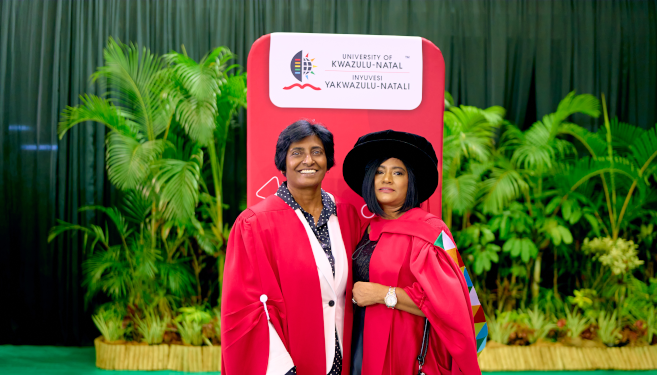
Conducted under the supervision of Professor Saras Reddy, Vallen worked with 10 participants, allowing learners to express themselves through drawings.
“Given the sensitivity of sexuality as a topic, verbal engagement alone would likely have inhibited meaningful participation. Participatory visual methods ultimately yielded richer, more authentic data,” Vallen said.
What emerged was not confusion but clarity with the study’s findings suggesting that these girls demonstrate a fairly sophisticated understanding of sexual consent. Yet that understanding exists alongside constraint.
Vallen explained: “The disjuncture was most visible when participants were asked to describe sexual consent in two distinct contexts. In ideal dating relationships, they articulated consent clearly. However, when asked to consider consent in the context of gender-based violence, a range of barriers emerged.”
These barriers include unequal gender norms, relationship power inequity, male sexual aggression, coercion and dating violence – realities that shape what girls are able to do with what they know.
One participant captured this tension: “I say no. Listen to me.” Yet, as Vallen points out, asserting that boundary may carry consequences.
“A girl asserting such a boundary may face physical violence from her partner,” she added.
Contrary to common assumptions, the issue is not a lack of understanding.
According to Vallen, the challenge is more about a pervasive reluctance, particularly among parents, to engage in open conversations about sexuality. She contends that in many rural South African communities, sexual consent remains a taboo subject.
Ultimately, structural inequalities further limit girls’ agency.
“Several interconnected structural inequalities constrain adolescent girls’ capacity to exercise sexual agency, pointing to poverty, economic dependency and cultural silencing. Knowledge alone is insufficient to enable safe action.”
And yet, what stood out most was not limitation but insight.
“What surprised me most was their capacity to reimagine transformed institutional responses. Participants envisioned more open family dialogue, stronger school-based consent education that includes boys and more supportive community institutions. This level of critical institutional awareness was deeply encouraging,” she reflected.
For Vallen, the implications are clear. Meaningful empowerment requires systemic, multi-level intervention. She argues that schools, families, faith communities, health services and law enforcement must operate in co-ordinated partnership.
Accordingly, she believes that boys must be centrally included in consent education, alongside empowering parents and educators to have honest conversations. At its core, the study challenges a persistent misconception – that girls need to be taught what they already know.
Expressing gratitude to all those who contributed, in diverse ways, to the completion of her study, Vallen said, “What remains is the harder work: dismantling the conditions that prevent that knowledge from being lived.”
Vallen reflected on the crucial role of her supervisor in the final stages of her doctoral journey, saying “My PhD journey was tumultuous in all spheres. I thought completion would be a miracle. My miracle came in the final run to the finish in Professor Reddy – a kind, humble and dedicated supervisor who bravely took on a troubled student at the tail end of my study. Her dedication brought out qualities I never thought I possessed. You are honoured, Prof. It is never about how or where you start, but a strong finish that wins the race.”
Words: Rakshika Sibran
Photograph: Sethu Dlamini