The building blocks of mathematics – counting, patterning and problem-solving – are already alive in children’s play. Yet they are often left outside the classroom door.
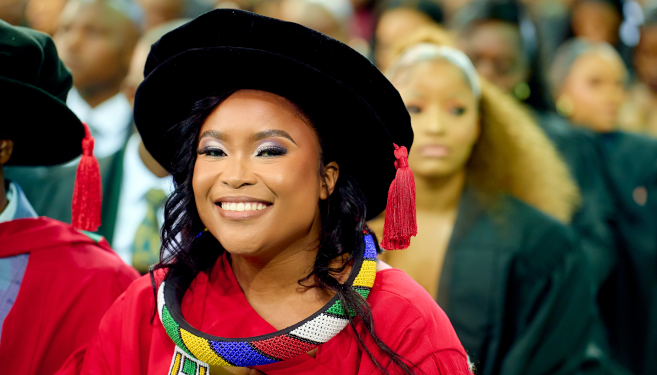
In her PhD study, ‘Exploring the Integration of Indigenous Games as Tools for Teaching Mathematics in Grade R’, Dr Busisiwe Ndhlovu, a lecturer in Early Childhood Education, challenges this disconnect.
Supervised by Professor Simon Khoza, her research reveals that indigenous games are far more than cultural artefacts – they are powerful, underused vehicles for mathematical learning. Yet, despite their promise, systemic barriers continue to keep them on the margins of formal education.
Before entering academia, she spent four years teaching in the Foundation Phase and later served as an Acting Head of Department, overseeing teaching and learning from Grade R to Grade 3. That role, she reflected, offered a very honest view of what Grade R teachers face on the ground – the pressures, the gaps and the untapped potential.
Ndhlovu’s interest was shaped by a recurring observation: children who were deeply engaged during culturally rooted play often disengaged during formal mathematics lessons.
“The mathematical thinking evident in their play was sophisticated, yet the formal curriculum seemed almost designed to ignore it.”
This disjuncture, she said, led her to interrogate why teaching approaches remain culturally foreign to many of our learners when their own cultural heritage is mathematically rich.
At the heart of her research is a firm stance: the problem is not in the children’s capacity, but in the curriculum’s failure to recognise and build on what children already know.
Moments from her fieldwork make this argument tangible. She recalls a young girl who consistently struggled to count aloud during formal lessons – a pattern serious enough to raise concerns about developmental delay. But when the class began playing kgati – a traditional rope-skipping game – the child began “counting aloud confidently alongside other kids.”
For Ndhlovu, the significance is clear: “The child had the ability all along. What she needed was the right environment to express it.”
Such moments challenge long-held assumptions about mathematics as abstract and difficult. Ndhlovu argues that this perception is historically produced, rooted in the imposition of Western teaching methods that often bear little relation to children’s lived realities. In contrast, indigenous games embed mathematical concepts in familiar, embodied practices. When children play diketo, for instance, they are counting, grouping, and comparing quantities without even realising it.
The result, she observed, was a shift in classroom dynamics: increased participation, peer interaction, and confidence in reasoning.
What surprised her most was not the presence of basic numeracy, but the depth of mathematical thinking embedded in these practices. Games like umrabaraba involve strategic planning, pattern recognition and spatial reasoning – concepts typically introduced much later in schooling. Similarly, activities such as beadwork and basket weaving engage children in geometry, symmetry and proportion long before formal instruction.
“The idea that African communities do not have strong mathematical traditions is simply not true. That idea came from colonialism, not from reality,” she explained.
Despite this, Ndhlovu found that teachers often face structural and psychological barriers to integrating such approaches. Strict adherence to CAPS (Curriculum and Assessment Policy Statement), overcrowded classrooms and limited resources all play a role. More deeply, many teachers have been trained to equate ‘real teaching’ with formal and structured instruction, making play-based approaches feel illegitimate.
“This is not the teachers’ fault, it is the result of years of training that did not value African ways of knowing,” emphasised Ndhlovu.
When encouraged to draw on indigenous knowledge, many teachers respond with recognition and relief, reconnecting with practices from their own childhoods. Yet resistance also emerged, particularly among younger educators who view digital technologies as the future of education. Ndhlovu does not dismiss this perspective but reframes the debate, adding that the Fourth Industrial Revolution and indigenous games are not in competition with each other. For young children, she argues, learning is inherently physical, social and cultural, something no screen can fully replicate.
Her findings speak directly to broader questions of identity and belonging in education. When children encounter their own languages, games and cultural references in the classroom, “they feel like they belong there.” Without this, many begin to internalise the idea that mathematics, and schooling more broadly, is not meant for them.
If there is one change she would prioritise, it lies in teacher education. More than three decades into democracy, she argues, indigenous knowledge remains marginal in many training programmes.
“If every Foundation Phase graduate left university with a solid understanding of how indigenous knowledge systems connect to mathematics, our Foundation Phase would look very different.”
Words: Rakshika Sibran
Photograph: Sethu Dlamini