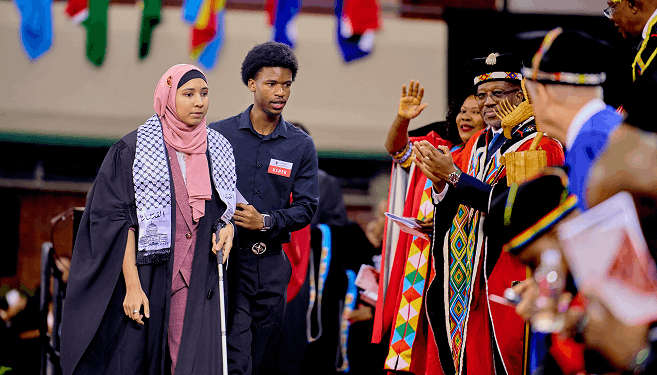
For Ms Azraa Ebrahim, academic excellence is not simply measured in distinctions, but defined by resilience, a commitment to representation, and a determination to reshape the academic conversations that have long excluded voices like hers.
In 2021 she emerged as a top achiever among learners from special needs schools, achieving one of the highest marks nationally. Ebrahim has since demonstrated a sustained academic excellence, graduating cum laude with a Bachelor of Social Science and now adding a summa cum laude Bachelor of Arts Honours degree in Religion and Social Transformation.
Born with Congenital Bilateral Optic Nerve Atrophy, a rare degenerative eye condition that has left her with minimal residual vision, Ebrahim has navigated Higher Education with intellectual courage and an unwavering sense of purpose. Since her undergraduate success, her growth has been as much personal as it has been academic. “What began as an uncomfortable spotlight gradually became something I embraced,” she reflects, recalling the media attention that followed her earlier achievements. “It gave me a platform to foreground the lived experience of being blind.”
Her honours year proved to be the most demanding and formative chapter of that growth yet. Researching women-led khutbah (sermons) in relation to gender justice within the South African context, Ebrahim drew inspiration for her research from her own experience of delivering the female khutbah at the TIP (Taking Islam to the People) Family Eidgah in 2024. Through analysing four sermons, her research demonstrated that women-led khutbahs function as powerful sites of resistance, epistemic reconstruction, and theological innovation.
Beyond the classroom, Ebrahim has presented at national conferences, travelled independently, and was honoured as guest of honour at her former high school’s Senior Prizegiving. Despite ongoing challenges around accessibility and inclusion, she has transformed her achievements into a platform for change. “My role is uniquely situated in that I embody the very research I am conducting,” she says.
At the heart of her academic drive lies a deeper mission. “Growing up, I seldom encountered stories of Muslim women with disabilities excelling academically,” she explains. Rather than discouraging her, that absence became motivation. Today, she is not only contributing to scholarship but reshaping it while bringing a lived, embodied perspective to conversations on disability, gender, and religion.
Grounded throughout by her family, faith, and the mentorship of her supervisor, Dr Cherry Muslim, whose guidance and commitment transcends the conventional duties of a supervisor in ways Ebrahim finds herself genuinely at a loss to put into words – she remains focused on her long-term goal of pursuing a PhD, entering academia, and advancing research in disability studies within Islam. For her, representation is about more than visibility. “We want to be included, not just accommodated,” she emphasises.
Ebrahim credits her parents and family as her pillars of strength, noting that they raised her no differently from any other child. “They never allowed my blindness to become a ceiling. Their belief in me before I believed in myself, shaped who I am today,” she said. Beyond her family and supervisor, Ebrahim is filled with gratitude for the support she has received from her friends, the lecturers and staff of the Discipline of Theology and Religion and everyone who assisted her along the way.
Now a master’s student in Religion and Social Transformation, Ebrahim carries the momentum of her honours year into research that examines how disability is discussed within Islamic digital spaces, and how that discourse perpetuates epistemic injustice towards Muslim women with disabilities.
Her message to others, particularly students living with disabilities, is both powerful and deeply personal: “Let your strengths define your capabilities. I experienced true success when I stopped seeing my blindness as a barrier and instead transformed it into a weapon.”
In rewriting her own story, Ebrahim is opening doors for many more to follow.
Photograph: Sethu Dlamini