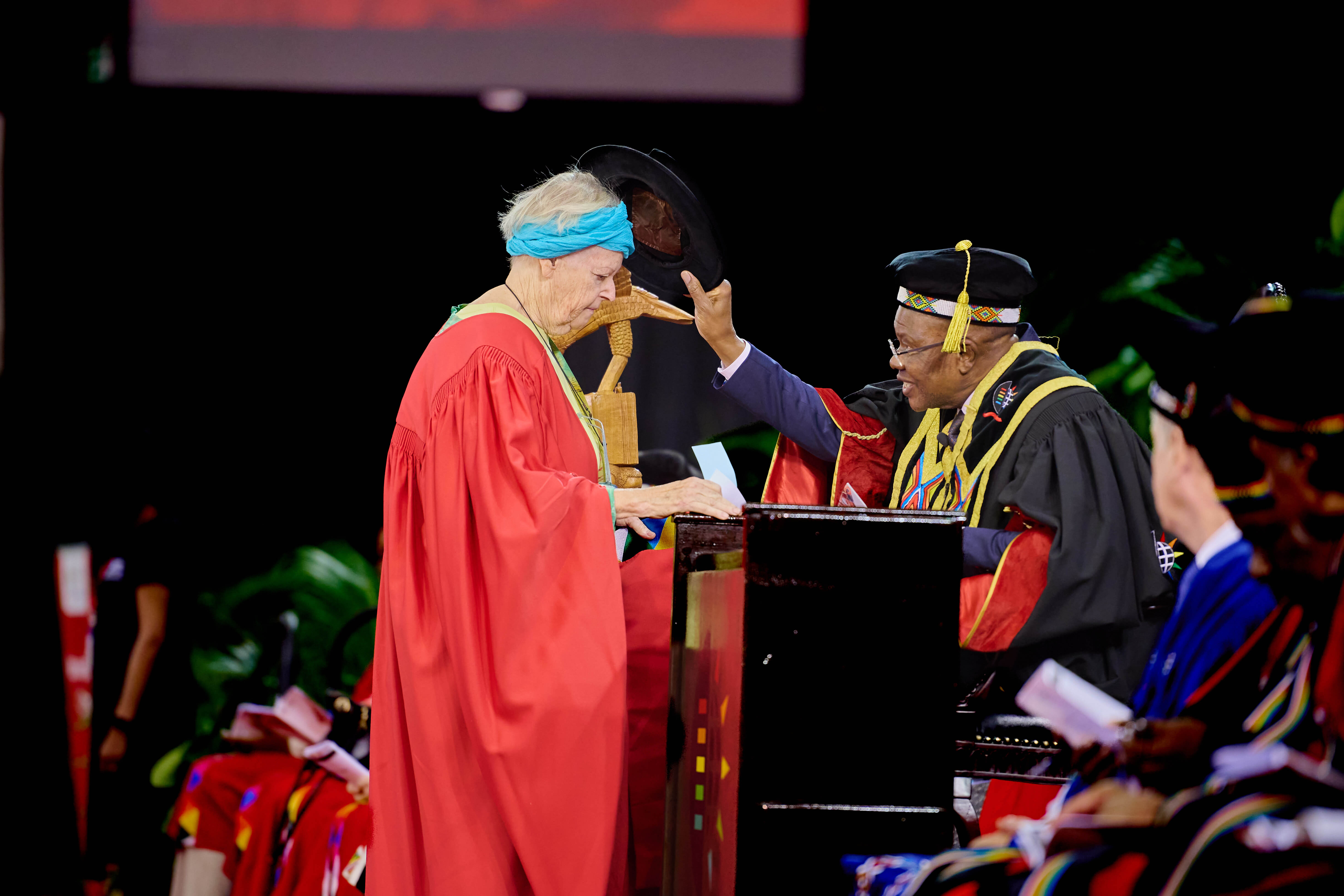
At 76 years old, doctoral graduate Dr Denise Ingrid Adams is the oldest graduate at this year’s UKZN autumn graduation, which kicked off on Monday morning.
Her achievement marks a remarkable academic milestone for Adams, whose study was shaped by creativity and a lifelong connection to Durban’s natural environment.
Her PhD, supervised by Kathy Patrick and Louise Gillian Hall, used creative practice-led research to explore the changing condition and ecological importance of the uMngeni Beachwood Mangrove Nature Reserve.
Drawing on more than three decades of living alongside this landscape, her work translated environmental observation into visual forms that deepen understanding of one of Durban’s most important ecosystems.
After more than 36 years living near the estuary, Adams developed a close relationship with the mangroves that would eventually shape the direction of her doctoral research.
“These mangroves are situated close to where I have lived for 36 years,” she said. “Earlier, there was scant pollution and no threat of a housing complex in the floodplain. Today, these have become harsh realities.”
Her research combined environmental observation with artistic experimentation, resulting in a series of three-dimensional cloak forms that translated ecological insight into visual expression. This approach allowed her to uncover perspectives that may not have emerged through conventional academic methods alone.
“My experiences in the estuary, together with creative experiments and sourced literature, provided unexpected insights of the current realities,” Adams explained. “I translated these into artworks culminating in a series of three-dimensional cloaks. I would not have discovered these insights had I relied on literature alone.”
Through sustained engagement with the estuary environment, Adams documented the remarkable resilience of mangrove ecosystems. She observed their capacity to store carbon, stabilise shorelines through complex root systems, and regenerate through buoyant seed pods that enable natural expansion. She also identified the ecological contribution of plants often dismissed as weeds.
“The discovery of weeds and their value in the ecosystem as pollinators, enriching the soil and as pioneers in damaged land was particularly important,” she said.
Her study highlights the broader environmental significance of the Beachwood mangrove system for Durban and surrounding communities.
The estuary supports diverse forms of life, including insects, birds, reptiles, crustaceans and fish nurseries, while also serving as an important educational resource.
“This valuable ecosystem supports varied life forms,” Adams said. “The loss of associated life in this estuary would be a loss for the greater area of Durban, including the educational opportunities that the estuary provides for scholars, students and citizens.”
One of the most demanding aspects of the project involved finding ways to translate environmental realities into artworks that communicated meaning without becoming didactic. Early attempts in two-dimensional painting did not achieve the intended effect, prompting a shift in creative direction.
“After a year of unsuccessful two-dimensional hanging paintings, I realised that I needed to reshape my creative practice in conjunction with environmental research,” she reflected. “Experiences in the estuary, meditating, sketching, collecting discards, photographing, printing, taking notes and comparing my findings with literature ultimately offered the means of overcoming the challenges.”
Adams credits the support of the Humanities College and colleagues at the Centre for Visual Arts (CVA) at UKZN with helping her refine both her research approach and artistic process.
“The Zoom sessions held by the Humanities College assisted me in developing research methods,” she said. “Weekly crit sessions with post-grad students and lecturers at the CVA were inspiring and constructive.”
Her work is already contributing to environmental education and awareness. Her research workbooks are currently being used when school groups visit the Durban Botanic Gardens and the Beachwood Mangrove Nature Reserve, while Ezemvelo KZN Wildlife has indicated interest in displaying some of her artworks.
“It is possible that artists who experienced my exhibition, or who saw photographs on the internet, may consider alternative ways of communicating environmental themes,” she said.
As she graduates with her doctorate, Adams’s work stands as an example of how creative research can deepen public understanding of fragile ecosystems while encouraging new ways of engaging with environmental conservation.
Author: NdabaOnline
Photographer: Sethu Dlamini