
Justice for Sale, Justice Under Threat: The Dual Crisis Facing South Africa’s Criminal Justice System
- Posted by ukzn-admin
- Categories News
- Date July 1, 2026
South Africa’s criminal justice system is increasingly being pulled apart by two powerful and converging forces: violence from the outside and corruption from within. These pressures do not operate in isolation. They intersect, reinforce one another, and ultimately threaten the ability of the system to function as envisioned by the Constitution – a system in which justice is administered ‘without fear, favour or prejudice’.
Recent events surrounding a high-profile extortion case in Mpumalanga illustrate just how fragile that ideal has become.
The Sibanyoni Matter: When a Case Collapses Under Pressure
At the centre of the controversy is Mpumalanga taxi boss Madoda Johannes ‘Joe Ferrari’ Sibanyoni, who appeared in the Kwaggafontein Magistrates’ Court alongside his co-accused – Bafana Oupa Sindane, Mvimbi Daniel Masilela, and Philemon Msiza.
They face serious charges of extortion and money laundering, with the State alleging that between 2022 and 2025, the group extracted more than R2 million in ‘protection fees’ from a businessman, threatening to shut down his operations if he refused to comply.
This is not an ordinary criminal matter. The case sits within the broader context of alleged organised criminal activity linked to the taxi industry, an environment long associated with violence, coercion, and informal enforcement structures.
But what unfolded in court in May 2026 has come to symbolise something far deeper about the state of the justice system.
On 18 May 2026, during a bail hearing, State prosecutor Mr Mkhuseli Ntaba failed to appear in court despite a clear judicial directive. The presiding officer, Chief Magistrate Tuletu Tonjeni, responded decisively:
- she found Ntaba in contempt of court;
- issued a warrant for his arrest; and
- struck the case off the roll, effectively releasing the accused for the time being.
What initially appeared to be prosecutorial misconduct quickly became more complex. The National Prosecuting Authority (NPA) later confirmed that Ntaba had raised concerns about his safety, indicating that he had received threats linked to the case. Some accounts suggest he had been warned he could be killed en route to court, prompting his withdrawal.
The aftermath has been chaotic:
- Ntaba was suspended and subjected to disciplinary proceedings;
- the NPA has sought to appeal the contempt order;
- and a formal complaint has been lodged against the magistrate; and
- the accused have attempted to block the re-enrolment of the case
In a matter of days, a serious organised crime prosecution became entangled in institutional conflict, procedural breakdown, and allegations of intimidation.
A Broader Pattern: Violence in the Justice System
The Ntaba episode is not an anomaly. It reflects a broader and deeply worrying trend.
In July 2025, regional court prosecutor Tracy Brown was shot dead outside her home in Gqeberha in what authorities described as an assassination-style killing. Just months earlier, another prosecutor, Elona Sombulula, was murdered in Mthatha. The NPA has confirmed that multiple prosecutors have been killed in a relatively short period, highlighting the very real risks faced by those pursuing serious criminal cases.
But prosecutors are not the only ones under threat.
Across the system:
- witnesses are intimidated into silence;
- victims are pressured to withdraw cases;
- whistleblowers face retaliation; and
- investigating officers are discouraged from pursuing sensitive leads.
Sometimes these pressures are overt – threats, violence, and assassination. Often, they are subtle – a warning, a visit, a reminder of consequences. Either way, the effect is the same: participation in the justice system becomes dangerous.
Corruption: The Quieter, Equally Corrosive Force
Running parallel to intimidation is a second, less visible but equally destructive force: corruption.
Recent cases reveal that the system is vulnerable not only to coercion, but also to inducement:
- a Pretoria prosecutor was charged after allegedly accepting a bribe to ensure that a case was not enrolled in court;
- another prosecutor was accused of soliciting a significant payment in exchange for declining to prosecute; and
- a former NPA prosecutor has been sentenced to imprisonment for corruption and money laundering.
More troubling are instances of organised corruption within the courts themselves. At the Palm Ridge Magistrate’s Court, a syndicate involving prosecutors, police, and attorneys allegedly manipulated cases to extract money from accused persons.
Yet corruption is not confined to officials.
Within communities:
- victims may be paid to withdraw complaints;
- witnesses may be bribed to recant testimony; and
- cases may be informally ‘settled’ before reaching court.
These practices blur the line between formal justice and informal negotiation. Over time, they contribute to a dangerous perception: that justice is not determined by law, but by leverage.
Fear and Favour: Two Sides of the Same Breakdown
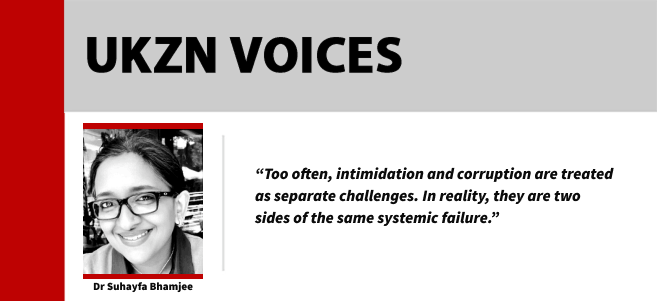
Too often, intimidation and corruption are treated as separate challenges. In reality, they are two sides of the same systemic failure.
- Intimidation exerts pressure through fear
- Corruption exerts pressure through favour.
Both distort decision-making. Both undermine independence. Both lead to the same outcome: the derailment of justice.
The constitutional standard becomes difficult to sustain:
- ‘Without fear’ is undermined by threats and violence;
- ‘Without favour’ is undermined by bribery and inducement; and
- ‘Without prejudice’ is weakened by institutional instability and selective enforcement.
When these forces converge, the system does not necessarily collapse – but it begins to bend, sometimes in ways that are invisible until it is too late.
The Human Impact: Victims, Families, and Communities
At the centre of this crisis are not institutions, but people.
For victims and their families, the decision to report a crime is fraught:
- Will they be protected?
- Will the accused retaliate?
- Will the case go anywhere?
For communities, particularly those affected by organised crime, repeated failures of the justice system can produce disillusionment and disengagement. Reporting becomes futile. Silence becomes rational.
For community leaders, navigating these dynamics becomes deeply complex. They may be drawn into mediating disputes informally, sometimes reinforcing parallel systems of accountability that sit uneasily alongside the law.
Even within the justice system, the effects are profound. Police, prosecutors, and magistrates operate under increasing strain. In such environments, the line between resilience and compromise can become dangerously thin.
A System Under Pressure – From All Directions
What the Sibanyoni matter ultimately reveals is not simply a failure of one actor, but the fragility of the system as a whole.
Pressure comes from every direction:
- from outside, through intimidation, violence, and organised criminal networks;
- from within, through corruption, misconduct, and institutional conflict;
- from below, through community-level practices that normalise negotiation and withdrawal; and
- from above, through governance and co-ordination failures.
This is what makes the current moment so significant. The concern is not only that cases fail. It is that they fail in ways that expose systemic vulnerability.
Reimagining the Response
The instinctive response is often to look for targeted solutions: better witness protection, tighter disciplinary processes, improved security.
These are necessary. But they are not enough.
What is required is a whole-of-system response:
- protection must extend beyond prosecutors to include witnesses, victims, and investigators;
- anti-corruption measures must address all actors in the justice chain, not only the most visible ones;
- communities must be engaged as partners in accountability, not passive observers; and
- institutional relationships must be strengthened to avoid public conflict that erodes confidence.
Above all, there must be recognition that fear and favour are not isolated problems – they are systemic pressures.
Conclusion: Defending the Promise of Justice
South Africa’s justice system is not uniformly broken. Cases are still prosecuted. Convictions are still secured. Many officials continue to serve with integrity under difficult conditions.
But the warning signs are unmistakable.
When prosecutors fear for their lives, when witnesses are silenced or bought, when cases collapse due to internal conflict, and when communities lose faith in formal processes, the system does not simply weaken – it becomes vulnerable to capture.
The constitutional promise of justice ‘without fear, favour or prejudice’ is not self-executing. It must be actively protected – not only in principle, but in practice, and across every level of the system.
The Sibanyoni matter is a reminder that the threats to justice are no longer coming from a single source. They are coming from all angles, in multiple forms, and with increasing sophistication.
The challenge now is whether the system can withstand that pressure – or whether, slowly and unevenly, it begins to yield.
In the News: Related Developments
- Corruption Watch “Addressing Judicial Corruption in South Africa” (2024)
- Daily Maverick “Prosecutor faces arrest after taxi boss Joe ‘Ferrari’ Sibanyoni escapes extortion charges” (18 May 2026)
- GroundNews “Sibanyoni case kicked out of court, warrant issued for arrest of no-show prosecutor” (18 May 2026)
- News24 “Joe ‘Ferrari’ Sibanyoni extortion case to be re-enrolled” (27 May 2026)
- The Citizen “Taxi boss Joe ‘Ferrari’ Sibanyoni’s extortion case struck off the roll” (18 May 2026)
- IOL / Daily News “NPA files complaint against magistrate over Sibanyoni case” (26 May 2026)
- The Citizen “Minister calls for added security after prosecutor murdered” (2025)
- Cape Flats / News Report “Arrest made in murder of prosecutor Tracy Brown” (2025)
- NPA Media Statement “NPA condemns threats against prosecutor in Malema case” (2026)
- The Citizen “Pretoria prosecutor faces corruption charges over bribe” (2025)
- News24 “Randburg prosecutor faces corruption charges” (2026)
- The Star “Bribery and corruption syndicate linked to Palm Ridge Magistrate’s Court” (2024)
Dr Suhayfa Bhamjee is the Discipline Head of Public Law in the School of Law at UKZN.
*The views and opinions expressed in this article are those of the author and do not necessarily reflect the official policy or position of the University of KwaZulu-Natal.

Previous post


