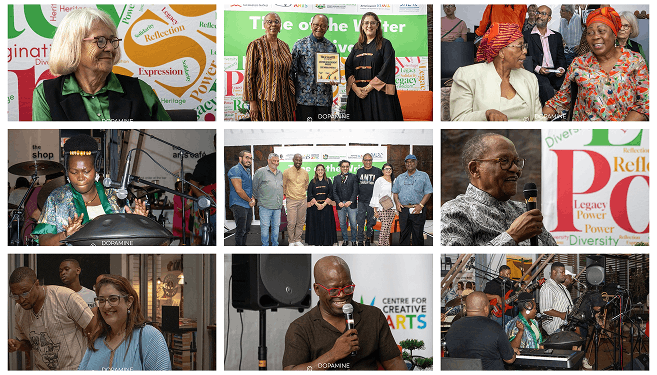
The 29th edition of the Time of the Writer festival once again brought together South Africa’s top authors, publishers, and international guests who used the platform to celebrate the best literature South Africa has to offer.
Presented by the Centre for Creative Arts (CCA) at the University of KwaZulu-Natal (UKZN), this year’s festival ran from 23 to 28 March under the theme: ‘Ink-stitutional Power’.
Spread across six days, the programme featured leading and emerging writers – not just from South Africa but also Norway, Ivory Coast, Ukraine and Palestine – in a hybrid format of online and live events
Discussions ranged from hidden histories and language to mental health, colonial power, activism and the craft of writing itself.
Director of the CCA Dr Ismail Mahomed honoured those who built the festival over nearly three decades, calling it a legacy “that we guard preciously and one that we are incredibly proud of”.
At a time when arts funding remains uncertain, he warned that reduced support for cultural platforms should concern everyone who values public dialogue.
“It is about power. It is about silencing voices that matter,” Mahomed said, stressing the need for the event to remain “a festival of conversations and a festival of dialogue”.
He highlighted UKZN’s role in sustaining the CCA and strengthening its connection with communities beyond the campus. Over the past five years, he said, the University has worked to position the Centre as a bridge between the academic environment and the broader public.
Ms Shafinaaz Hassim, the curator of Time of the Writer echoed Mahomed and said the 2026 theme, Ink-stitutional Power, captured the dire importance of continuing the legacy to write in the face of ongoing persecution.
“We must use our words as a vehicle to challenge institutional power, to shift policy and consciousness and to smash stereotypes for a better world… The power of the pen, the echo of words is our ultimate weapon of choice. Now more than ever, we need to celebrate those who have made a legacy of writing truth to power, of bringing leadership through their literature, and in order to encourage heightened literary voices that will carry us through these times of war and peril,” she said.
The opening discussion, hosted by celebrated author Mr Fred Khumalo, saw acclaimed authors, Dr Antjie Krog and Professor Njabulo Ndebele in a conversation that reflected on storytelling, language and the responsibilities of writers today.
Krog touched on her latest book, Blood’s Inner Rhyme, an autobiographical work that explores her complex relationship with her mother through her decline and death.
This book, she explained, reflected changes in reading habits and the emergence of new hybrid forms that move between fiction and non-fiction.
Rather than seeing this shift as a loss, she described it as a response to the complexity of contemporary life. “A new genre has developed, that is a mixture of both. Life has become so complicated, it has become so dramatic, so foreign and layered that the linear name of non-fiction cannot do justice to the complexity of our lives.”
Krog encouraged writers to take their own experiences seriously as material and to approach their work with courage.
“When you write it must be like jumping down that waterfall, you must not know whether you’re going to survive when you land. That big a risk it must be. Everyone can write safely… rather it must be a risk so insane that it can destroy you”.
Ndebele turned his attention to the relationship between place, story and community. He spoke about his forthcoming book due for publication in September 2026, which explores how a small community in Mdantsane in the Eastern Cape produced an extraordinary number of boxing champions.
“Why is it that a place like that produces a quality of boxing that is unmatched, nowhere else in the world?” he asked, pointing to the importance of understanding how local histories shape national narratives.
His reflections also touched on how young people encounter literature and how language and curriculum shape the development of readers across South Africa’s diverse communities.
By the closing sessions, the tone of the festival had shifted from opening night reflection to a shared sense of momentum. What remained clear was the value of sustained literary exchange in a city recognised as a UNESCO City of Literature, and the importance of partnerships that make such work possible.
As the final conversations drew to a close, the 29th Time of the Writer festival affirmed its place as a space where writers and readers meet to question, listen and imagine new ways of telling South African stories.
The 30th edition of the Time of the Writer festival takes place from 16 – 21 March, 2027.
Words: Lee Rondganger
Photographs: Supplied