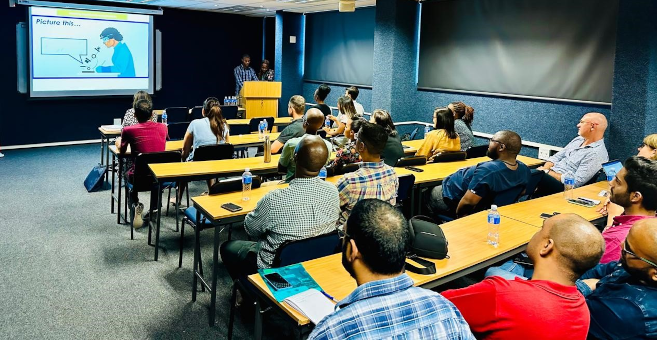
Inaugural International Hybrid Seminar on Keratitis at UKZN
The sensitivity of the eye and the critical need for timeous and accurate diagnosis of eye diseases came under the spotlight when UKZN’s Discipline of Ophthalmology held its first international hybrid seminar on keratitis.
In short, keratitis is the inflammation of the cornea (clear, dome-shaped tissue that covers the pupil and iris).
Ophthalmology deals with the diagnosis and treatment of eye disorders. At UKZN, this discipline is led by ophthalmologist and glaucoma specialist, Dr Nombuso Mathe, Ophthalmology Acting Head and Harvard Medical School’s Moorfields Eye Hospital alumna.
The seminar called upon local and international ophthalmologists to share their expertise on how to diagnose and treat keratitis using the greatest of precision to avoid damaging the eye and circumventing blindness.
UKZN Medical School alumnus, Dr Shaheer Ballim, said it was important for ophthalmologists to look out for clues in patient history when suspecting keratitis. These include trauma, contact lenses, ocular medications, self-medications, home remedies, ocular co-morbidities, procedures, duration of symptoms, smoking and diabetes. He said pain, duration, contact lenses, steroids, trauma or surgery, position (central or peripheral), morphology, associated ocular disease, and scrape were high-yield clues that would lead to the most accurate diagnosis.
Also a UKZN Medical School alumnus and recently recognised as a Global Health Icon at the 2023 Zenith Global Health Awards in London, esteemed pathologist microbiology lecturer at Nelson Mandela University’s Medical School in the Eastern Cape, Dr Ntokozo Mzimela’s presentation showcased the need for interprofessionalism between health experts in managing conditions such as keratitis.
Microbiologists play a critical role from sample collection and handling to eye-pack for keratitis diagnosis, advising on available diagnostic methods, elaborating on challenges in lab diagnosis, and promoting antimicrobial stewardship (a systematic approach to educate and support healthcare professionals to follow evidence-based guidelines for prescribing and administering antimicrobials) as alluded by Ballim, because patients and their conditions react differently to treatment.
Stimulating case studies were presented by international experts, Dr Fasika Woreta who is currently an Associate Professor in the Department of Ophthalmology; Eugene de Juan, Professor of Ophthalmic Education at the Johns Hopkins University School of Medicine; as well as Professor Swati Tomar from India.
Mathe said such seminars were important, not just for sharing best practices around delicate ocular procedures, but also for registrar training, as well as the promotion of inter-professional collaboration.
Words: Lunga Innocent Memela
Photograph: Supplied