Tackling Workplace Bullying in Higher Education Institutions
Workplace bullying is a significant issue in Higher Education Institutions (HEIs) worldwide.
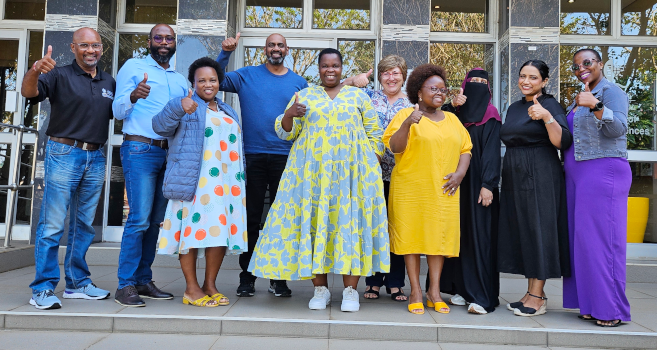
Research has shown that the highest incidence of bullying occurs within the health sciences field. In response, the College of Health Sciences (CHS) hosted four workshops for its leaders and managers titled: Managing Bullying in Higher Education Institutions, facilitated by Ms Brightness Mangolothi.
Mangolothi is the Director at HER-SA, a Higher Education women’s leadership development and advocacy non-governmental organisation (NGO). She is a former lecturer and Head of Department at the Nelson Mandela University and has lectured and supervised postgraduate students at public and private institutions of higher learning. She is also co-editor of a book titled, Women’s Empowerment for a Sustainable Future: Transcultural and Positive Psychology Perspectives. Her recent doctoral study paper is on Workplace Bullying and its Implications for Gender Transformation in the South African Higher Education Sector. Mangolothi has served on various boards and in leadership roles in and outside of academia. She has also presented on workplace bullying globally working with a range of universities and serves on an international committee focusing on workplace bullying.
Workplace bullying is defined as situations where an employee repeatedly and over a prolonged time period is exposed to harassing behaviour from one or more colleagues (including subordinates and leaders) and where the targeted person is unable to defend him/herself against this systematic mistreatment. (Einarsen et.al. 2011).
Mangolothi said there are various layers of bullying in HEIs which can be horizontal, vertical or cross-level. Bullies, who can also be targets, can include supervisors, colleagues, subordinates, students, trade unions, external stakeholders, and institutional systems. Being a complex and multi-faceted issue, it is important for leaders to create a psychologically safe workspace that is welcoming, collegial, respectful, where communication is open and transparent and the organisation has a clear mission statement with all employees being committed to it.
Bullying can take the form of discrimination such as race, age, and gender and can also include cyberbullying, sexual harassment, corruption, mobbing against an individual, spreading rumours and gossip, as well as assault. Reasonable management practices, such as assigning tasks, providing feedback or enforcing workplace policies are not considered as bullying. Mangolothi however cautioned, ‘Line managers should be mindful of their approach and avoid abusive or discriminatory behaviour. We need to humanise our work spaces. People want to be heard and seen.’
Mangolothi advised anyone who has been a target of workplace bullying to alert their supervisor, adding that should the supervisor be behind the bullying, they must refer the matter higher up. She urged victims to keep notes, obtain copies of harassing paper trails, expect the bully to deny the allegation, and most importantly, get support from friends and family.
‘If you are accused of bullying, stay calm and professional. Reflect on your actions, listen to the concerns raised, and seek to understand them. Ask for clarification if needed, apologise when appropriate, co-operate with investigations, and document your perspective,’ she said.
Most importantly, she urged all staff to act as constructive bystanders, one that addresses workplace bullying behaviour and actively seeks to improve the situation for both the bully and the target.
Professor Nceba Gqaleni, Head of Traditional Medicine at UKZN, said, ‘I learnt a lot from the workshop and my eyes are now open to the nuances of bullying in the workplace and I have been empowered to handle it.’
Ms Sithembile Khuzwayo, who manages staff in the Human Resources and Finance portfolio in the School of Clinical Medicine, said, ‘Thank you so much for organising such an informative workshop. It really opened my eyes about how I respond to being bullied and also being conscious of being a bully. Thank you Brightness for your honesty and advice on how to deal with the various situations we face.’
Words: MaryAnn Francis
Photograph: Supplied