
History Education’s Role in Instilling Citizenship Loyalties in Teachers and Learners
- Posted by ukzn-admin
- Categories News
- Date December 10, 2025
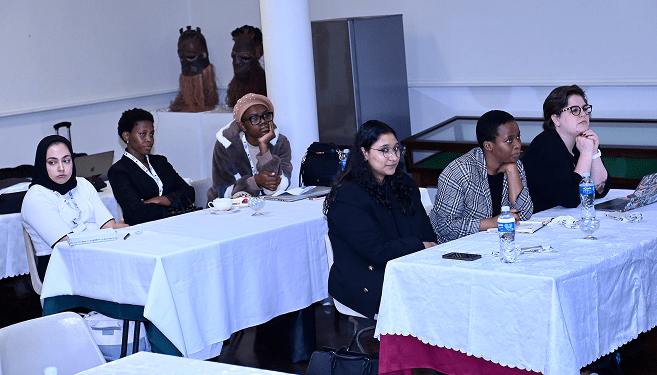
‘Navigating Loyalties in Intercultural History and Citizenship Education: Historical and Contemporary Perspectives’, was the title of a TranCit national workshop held at the Killie Campbell Africana Library in Durban.
Hosted by UKZN and the VID Specialised University in Norway, the focus was on essential themes in history education relevant to instilling citizenship loyalties, skills and values in teachers and learners.
The workshop provided an opportunity for UKZN postgraduate students to share their research and engage in discussions of how history teaching can foster critical engagement, social justice and civic responsibility.
Presentations focused on South Africa, the curriculum, the teacher, the learner, and the history textbook in the context of citizenship, transloyalties and shifting identities.
A key theme that emerged for history researchers and educators within a South African context was the shift from ‘thin’ citizenship to ‘thick’ citizenship conceptualisation. ‘Thin’ citizenship is characterised by passive participation, while ‘thick’ citizenship involves active engagement, critical thinking, and a commitment to democratic values.
Discussions focused on how this concept and shift in thinking about citizenship can help learners at primary, secondary and tertiary institutions to move beyond multiculturalism, which emphasises coexistence, toward interculturalism, which promotes meaningful interactions in a diverse society like South Africa. This change has the potential to foster more inclusive and empathetic communities.
UKZN’s Professor Kalpana Hiralal said citizenship education and decolonial studies were closely linked in South Africa. Participants heard that the ongoing impact of colonialism and apartheid continues to influence educational content and teaching methods, making it essential to include diverse heritages, voices, and viewpoints into history lessons.
The workshop highlighted how interdisciplinary studies – history, architecture, sociology, culture and heritage, and education among others – could provide a platform for asking tough questions about whose history is emphasised, whose identities are prioritised, and which stories are left out. History benefits from a wide range of sources, including oral histories, archives, museums, and multimedia materials. “These resources enrich the curriculum and make history more interactive and engaging,” said Hiralal.
The workshop heard further that museums, in particular, play a vital role in shaping national identity and promoting heritage. “Their inclusion in history education helps learners connect personal and collective narratives and understand how institutions influence loyalties and identities,” said Hiralal.
She said this was particularly vital in the South African context given that the histories of marginalised communities were yet to be fully explored. In addition, considering South Africa’s turbulent political history, conversations focused on how history as a discipline could be promoted and taught in schools, the challenges envisaged, and how class and economic disparities can be overcome.
She said there was a call for a broader understanding of South African socio-economic and political realities and how they shaped the teaching and learning environments in both urban and rural schools. “With participants including researchers and practitioners, the link between educational policy in history and citizenship education and its implementation in schools took centre stage. The concept of transloyalties was also deliberated within the South African context.
The workshop learned that promoting identity through history involved recognising the multiple loyalties learners and teachers brought to the classroom. The loyalties were layered and extended across local, regional, national, and global levels. Understanding that loyalty could be directed toward a community, a country, a continent, or even a global cause; these layers often coexist, overlap, and sometimes conflict (transloyalties). Hence understanding loyalties in South African schools was not just about politics, it was about identity, memory, justice, and belonging.
Research presentations also revealed the challenges of teaching history at schools. Early-career history teachers felt compelled to replicate the methods they experienced as students, often focusing on rote learning and factual recall. This results in learners losing interest in the subject altogether. The workshop encouraged educators to embrace history as a discipline that invites inquiry, dialogue and reflection.
According to Hiralal, history should be interactive, not passive; it should challenge students to think critically about the world around them and their place within it. “Presentations of tertiary history courses and their relevance to South African universities reveal how teachers, academics and students are navigating complex civic identities, and history education should reflect that reality.”
There were also discussions on reflexivity in South African schools – how teachers and academics should be reflexive, understanding and acknowledging their biases, but not allowing these biases to influence history lessons and citizenship education. Teachers needed to be mindful of their language, recognising that they did not teach in a vacuum.
“Classrooms can become spaces where difficult conversations lead to growth and understanding and be safe spaces to confront South Africa’s painful past through critical and empathetic engagement.”
Words: NdabaOnline
Photograph: Albert Hirasen

You may also like

Staff and Students Don Black and Purple in Continued Fight Against GBV

Book on Sex and Sexuality Co-Compiled by UKZN Academic
