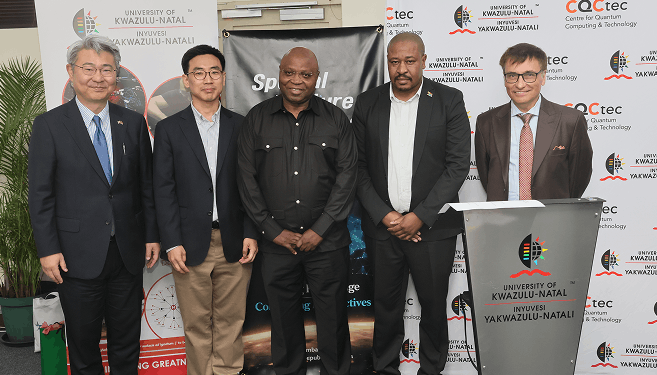
The University of KwaZulu-Natal’s (UKZN) Centre for Quantum Computing and Technology (CQCTec) co-hosted a public lecture with the Embassy of the Republic of Korea in Pretoria and the Department of Science, Technology and Innovation, focusing on the growing importance of quantum technology for industries worldwide.
The lecture, titled ‘From Quantum Science to Quantum Industry: Building Scalable Technologies for the Next Computing Era’, was presented by Professor Donggyu Kim of the Korea Advanced Institute of Science and Technology (KAIST) and OQT Inc., South Korea.
Held as part of UKZN’s ongoing efforts to strengthen South Africa’s role in emerging quantum technologies, the event attracted academics, students, researchers and industry stakeholders eager to learn more about advances in quantum computing and the challenges involved in transforming frontier science into practical industrial applications.
Kim presented an overview of the rapid evolution of quantum technologies and explained how the field had entered a critical phase where scientific breakthroughs needed to be translated into scalable, programmable and useful systems capable of meeting growing global computational and energy demands.
During his lecture, Kim explored developments in quantum imaging, quantum sensing and neutral-atom quantum computing, highlighting how quantum entanglement and interference offered computational resources beyond the capabilities of conventional computing architectures.
Focusing on neutral-atom quantum computing platforms, he outlined several key challenges facing the field, including programmability, scalability, limited control degrees of freedom and the future of quantum measurement architectures.
Kim explained that solving these challenges would require tightly integrated advances across physics, engineering and computation.
He argued that the future success of large-scale quantum systems would depend on interdisciplinary collaboration capable of linking cutting-edge scientific discovery with industrial implementation.
Kim is an assistant professor of physics at KAIST and a leading researcher in quantum science and technology, specialising in neutral-atom quantum computing and information physics at the intersection of atoms, photons and artificial intelligence.
He earned his PhD from the Massachusetts Institute of Technology (MIT) and previously held major research roles at Harvard University and QuEra Computing, where he was a founding team member involved in the development of a 256-qubit neutral-atom quantum computer.
In addition to his academic work, Kim serves as Chief Executive Officer of OQT Inc., where he focuses on translating quantum advantage into real-world industrial applications, including the development of software-defined quantum data centres.
Professor Thomas Konrad, Director of CQCTec, said the lecture reflected UKZN and the Centre’s commitment to advancing quantum technology research and contributing to the development of a quantum technology industry in Africa.
“One of the objectives of the Centre, which is part of the South African Quantum Technology Initiative, is to contribute to the formation of a quantum technology industry in Durban and South Africa through research and development,” said Konrad.
“We anticipated with great curiosity the talk by Professor Donggyu Kim on the key challenges involved in linking frontier research to industry in quantum computing and other quantum technologies, which requires interdisciplinary solutions from physics, engineering and computer science,” he added.
The event also highlighted the importance of international collaboration in developing future technologies and strengthening South Africa’s participation in the rapidly expanding global quantum economy.
Students attending the lecture were exposed to current developments at the forefront of quantum research and gained insight into the ways quantum computing could transform industries ranging from healthcare and finance to communications and artificial intelligence.
The public lecture formed part of broader efforts by UKZN and its partners to stimulate dialogue, research collaboration and innovation in advanced technologies that are expected to shape the next era of computing and industrial development.
Words: Sally Frost
Photograph: Sethu Dlamini