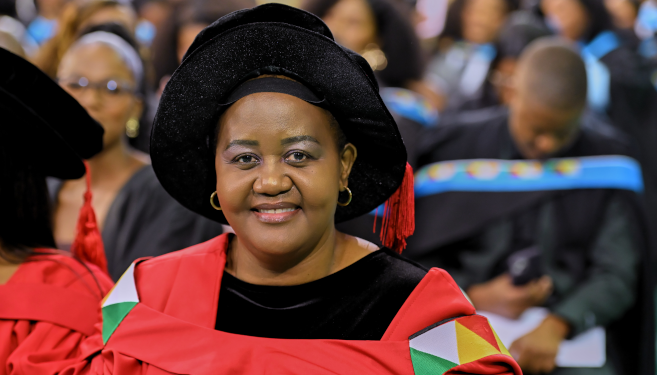
Dr Olivia Mgeyane-Zondi’s doctoral study, ‘The Policy-Practice Interface of Principalship in South Africa: A Study of Public Primary School Principals’ has determined that while policy is often found in files, circulars, and compliance checklists, it is far less visible in the lived reality of classrooms.
Mgeyane-Zondi, a teacher and mother of two, traces her journey from Umlazi’s A Section, where she was raised by a single parent, to earning a PhD in Educational Leadership and Management Policy.
Supervised by Professor Vitallis Chikoko, her study questioned why South Africa, with a “very rich” policy framework on school principalship, continues to struggle with educational outcomes. Drawing on the Department of Basic Education’s policy on school principalship, which outlines eight key areas of responsibility, she noted the sheer scale of expectation placed on school leaders. The role, she argued, is “complex and multi-faceted,” with demands that are often unrealistic for a single individual to carry daily.
What emerged from her study is what she terms a “dissonance” between policy and practice – not an abstract gap, but one that is deeply human and, at times, deeply strained. In some schools, relationships within leadership teams are marked by conflict and mistrust. One principal described a deputy principal as being “after her position,” while another spoke of a management team as “hungry for positions and not work.” She found that these are not isolated tensions but recurring patterns that disrupt cohesion and decision-making.
The consequences are felt most sharply in instructional leadership – the core expectation that school principals should drive teaching and learning. Instead, Mgeyane-Zondi found what she describes as a “poverty of practice” in this area.
Teachers are often demotivated, absenteeism is high, and in some cases, learners are unable to read or write at expected levels, a reality one principal described as “an embarrassment.” Compounding this is a system where, as she noted, some individuals in senior positions have never taught in schools before, yet are responsible for shaping policy.
The study also points to structural disconnections. While school principals are expected to ensure the recruitment of quality staff, many felt excluded from the process. This, she argues, contributes to improper staffing, where educators may teach subjects outside their expertise. At the same time, resource inequalities persist where some schools ‘have’ while others ‘do not have’, reinforcing broader patterns of inequality that extend beyond the school gate.
Positively, Mgeyane-Zondi was able to document instances where school principals quietly bridge the gap between policy ideals and school practices. One principal has a practice of arriving first and leaving last each day, maintaining a visible presence across the school. Other principals cultivate collaboration through fruitful engagements with staff and motivate learners through initiatives like Awards Day. In these accounts, she found that leadership is less about compliance and more about presence, consistency, and care.
Still, she believes that these efforts operate against a backdrop of limited preparation for principalship, asserting that there is “no thorough preparation” for these roles, particularly in leadership and management. As a result, she established that while principals are aware of policy requirements, their ability to enact them is often undermined by poor management of time and a lack of leadership.
Central to her recommendations is the need for formal training in leadership and management for both principals and their School Management Teams. According to Mgeyane-Zondi, professional development is not optional, but foundational to improving learner outcomes: without it, the system risks remaining compliance-driven rather than transformative.
Mgeyane-Zondi cautions that failure to address these gaps could have wider consequences, including the collapse of the education system as a whole and increased economic hardship. In this sense, her study speaks not only to education policy but to broader national priorities, from quality education to social and economic stability.
Her doctoral milestone carries a quiet pride, marking a journey she once only dreamed of.
“The love I had for school made me opt for a tertiary institution after matric. The degree has been conferred, and I am now called a Doctor.”
Words: Rakshika Sibran
Photograph: Sethu Dlamini