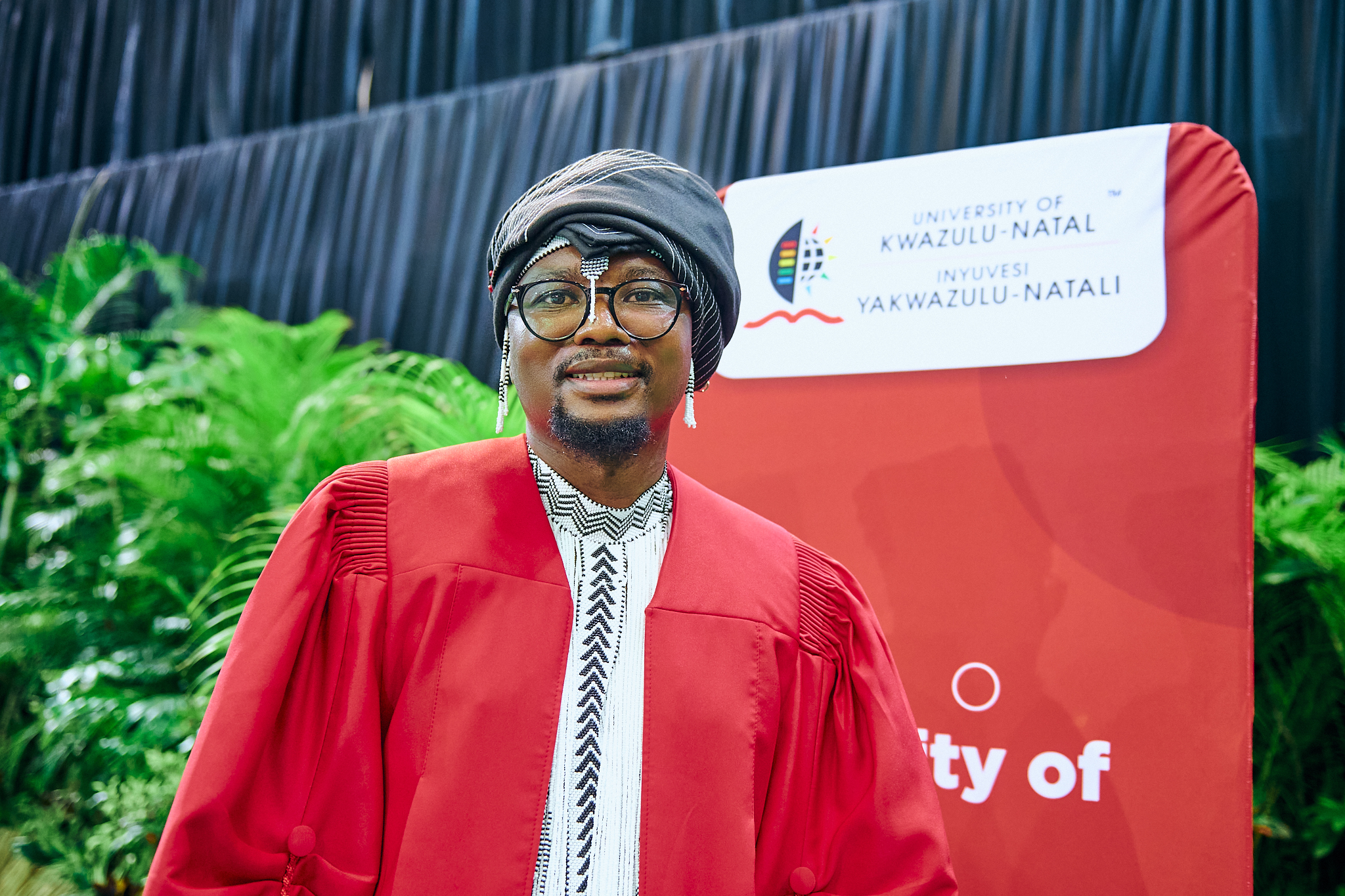
Mr Lusanda Ncisana left school after Grade 9. Two years later, after his initiation, he returned with a renewed sense of purpose to continue with his education. This month, he will graduate from the University of KwaZulu-Natal (UKZN) with a PhD in Crop Science.
Raised in Ngangelizwe Township in Mthatha, Eastern Cape, Ncisana describes the journey as one of “active hope” – refusing to let his circumstances define what was possible.
The experience taught him important lessons about discipline, responsibility, respect, humility, and serving others. He completed his secondary education, worked for two years, and then enrolled for a Bachelor of Science degree at the University of Fort Hare. “Education was never simply about obtaining a qualification; it was about creating opportunities where none seemed to exist,” said Ncisana.
His university journey soon tested his determination. After successfully completing his first year and earning distinctions in several modules, he was unable to register for his second year due to challenges with funding from the National Student Financial Aid Scheme (NSFAS).
Rather than returning home, Ncisana continued attending classes while searching for a solution. He eventually approached the Office of the Premier in the Eastern Cape, where a secretary explained the process for applying for financial assistance. He followed the guidance, secured funding, and registered.
“That experience reinforced a lesson that continues to guide me today: solutions become more meaningful when they are shared with others,” he said.
Further challenges followed, including the loss of his mother, whose belief in him had been a major source of strength. During his doctoral studies, the COVID-19 pandemic disrupted his research plans, while other academic and career challenges tested his resilience.
Throughout these difficulties, books became an important source of guidance.
“Reading became my way of finding answers, developing new perspectives, and solving problems,” said Ncisana.
This approach developed into what he calls active hope – the belief that progress requires action. “Passive hope waits for circumstances to improve, while active hope takes action, seeks knowledge, adapts to change, and believes that tomorrow can be better because of what we do today,” he explained.
His passion for science and environmental stewardship began at school. At Nxeko Mtirara Senior Primary School, his Natural Sciences teacher, Ma’am Ndesi, recognised his curiosity and selected him for an SABC science outreach programme, where he demonstrated the importance of conserving and using water wisely. At Zimele Junior Secondary School, Ma’am Mgquba regularly selected him to accompany Grade 7 learners to environmental awareness programmes organised by the King Sabata Dalindyebo Municipality.
Those early experiences would eventually connect with his doctoral research at UKZN.
His PhD research was supervised by Dr Ntuthuko Mkhize and Professor Tafadzwa Mabhaudhi. Titled “Responses of Selected Forage Brassica (Raphanus sativus) Genotypes to Water Stress”, it focused on improving agricultural sustainability in South Africa, a country increasingly affected by water scarcity. His findings demonstrated that newly developed forage radish genotypes could maintain comparable yields while using substantially less irrigation water, contributing practical knowledge towards climate-smart and water-efficient agriculture.
Ncisana is now a university lecturer at the University of Limpopo, where he is committed to advancing knowledge through research, teaching, and mentoring the next generation of scientists.
“My work extends beyond publishing research; it is about using science to solve real-world problems and empowering students to realise that their circumstances do not define their potential,” he said.
Reflecting on his journey from Ngangelizwe Township to academia, Ncisana believes education remains a powerful tool for breaking the cycle of poverty and creating lasting change.
“Success is rarely determined by the absence of obstacles. Rather, it is shaped by the decisions we make when confronted with them,” he said.
He hopes his story will inspire young people, particularly those from disadvantaged communities, to embrace active hope.
“Their future is defined not by where they begin, but by the choices they make each day,” said Ncisana.
Words: Hlengiwe Khwela
Photo: Sethu Dlamini