
Commitments to Truth-Telling, Ethical Leadership and the Protection of Democratic Spaces
- Posted by ukzn-admin
- Categories News
- Date September 18, 2026
South Africa’s debate on undocumented migration has become one of the defining ethical and political questions confronting the country’s constitutional democracy. While governments possess the sovereign authority to regulate borders and enforce immigration laws, democracies are ultimately judged by how they exercise that authority.
The 2026 Professor Fatima Meer Memorial Lecture, delivered by Ms Barbara Hogan under the theme ‘Commitments to Truth-Telling, Ethical Leadership and the Protection of Democratic Spaces’, provides an important opportunity to reflect on migration through the interconnected lenses of Meer’s philosophic humanism, sociology, constitutional democracy and ethical leadership. Rather than approaching migration solely as a security or policing issue, it is argued that migration must be understood as a historical feature of human civilisation, a structural characteristic of global capitalism and a constitutional challenge requiring both effective governance and unwavering respect for human dignity.
Migration as a Defining Feature of Human Civilisation
Migration is one of the defining characteristics of human civilisation. From the earliest human communities to the modern global economy, people have moved in search of safety, livelihood, knowledge, family, trade, faith and freedom. Long before migration became the subject of immigration legislation or political contestation, it was a fundamental expression of human survival and social development. Meer’s philosophic humanist perspective therefore begins with a simple but profound proposition: before a migrant is categorised as documented or undocumented, legal or illegal, skilled or unskilled, citizen or foreign national, the migrant is first and foremost a human being. The ethical question confronting modern democracies is not whether states possess the sovereign authority to regulate migration – they unquestionably do – but whether such regulation can occur without abandoning the principles of human dignity on which democratic societies claim to rest. This question lies at the heart of South Africa’s contemporary migration debate.
Democracy, Ethical Leadership and the Fatima Meer Legacy
The 2026 Professor Fatima Meer Memorial Lecture, to be delivered by former Cabinet Minister Ms Barbara Hogan, on the theme, ‘Commitments to Truth-Telling, Ethical Leadership and the Protection of Democratic Spaces’, could not be more timely. Both Meer and Hogan dedicated their lives to defending justice through principled public service, often at considerable personal cost. Their lives remind us that democracy is neither self-sustaining nor self-correcting. It survives only when citizens and leaders alike are prepared to defend truth, uphold ethical leadership and protect the humanity of those rendered politically vulnerable.
Sovereignty and Humanity: The Constitutional Challenge
One of the defining tests of any democracy is not how it treats the powerful, but how it treats those with the least power. Few contemporary issues illustrate this more sharply than the treatment of undocumented migrants. South Africa has every sovereign right and, indeed, every constitutional responsibility to secure its borders, regulate migration and enforce immigration legislation. No democratic state can function without lawful border management or credible immigration systems. Citizens are entitled to expect government to maintain public safety, uphold the rule of law and administer migration policies transparently and consistently. Yet ethical leadership requires more than enforcement. It demands that the law itself be administered with fairness, proportionality and respect for human dignity.
A Sociological Understanding of Migration in Southern Africa
Sociologically, migration cannot be understood simply as a question of border control. South Africa’s migration patterns are deeply embedded within the historical development of capitalism, colonial state formation, regional inequalities and apartheid’s migrant labour system. Southern Africa was built on human movement. The mining industry depended on migrant labour recruited across national boundaries. Agriculture, domestic work, construction, transport and manufacturing similarly relied on labour mobility. Refugees fleeing wars, students pursuing education, professionals transferring skills and informal cross-border traders have all contributed to the regions social and economic development. Migration is therefore not an external disruption imposed on South Africa. It constitutes one of the historical foundations on which South African society has been constructed.
Migration, Global Capitalism and Human Development
Human history offers the same lesson. Every civilisation has been shaped by migration. Ancient trade routes connected Africa, Asia, Europe and the Middle East through continuous human movement. Empires expanded through migration. Religious traditions spread through migration. Scientific knowledge travelled through migration. Industrialisation depended on migration. Contemporary globalisation, celebrated for its interconnectedness, rests on unprecedented flows of capital, technology, information and people. Modern economies simultaneously encourage the unrestricted movement of finance, investment, digital technologies and multinational corporations while increasingly seeking to restrict the movement of labour. This contradiction lies at the heart of contemporary global capitalism. Opposition to migration therefore often reflects a profound misunderstanding of the very economic system on which modern societies depend. Capitalism has always required mobility. Investors seek opportunities across borders. Corporations relocate production to maximise efficiency. Supply chains span continents. Universities recruit international students. Hospitals recruit foreign medical professionals. Technology firms rely on global talent. Agricultural sectors depend on seasonal migrant workers. Care economies increasingly rely on migrant labour. To welcome the free movement of capital while rejecting the movement of human beings represents not only an ethical inconsistency but an economic contradiction. Capital has no intrinsic value without labour. Human mobility has been as essential to global development as financial mobility.
International, African and South African Legal Frameworks
International law recognises precisely this balance between sovereignty and humanity. The United Nations Global Compact for Safe, Orderly and Regular Migration acknowledges that migration is a multidimensional global phenomenon requiring international cooperation, effective governance and respect for human rights. While affirming that states retain sovereign authority over their borders, it simultaneously insists that migrants remain bearers of fundamental human dignity regardless of their legal status. The African Union Migration Policy Framework for Africa (2018-2030) approaches migration not merely as a security challenge but as a developmental opportunity, linking labour mobility, regional integration, diaspora engagement, border governance and human security within a comprehensive continental framework. South Africa’s constitutional order reflects these principles.
The Constitution deliberately protects ‘everyone’ within the Republic rather than citizens alone. The South African Human Rights Commission has consistently affirmed that fundamental human rights derive from personhood rather than nationality. At the same time, the 2024 White Paper on Citizenship, Immigration and Refugee Protection seeks to strengthen border management, modernise immigration administration and improve migration governance while maintaining South Africa’s constitutional and international humanitarian obligations. The legal position is therefore neither open borders nor indiscriminate exclusion.
It is the simultaneous pursuit of effective migration management and unwavering respect for constitutional rights. Unfortunately, public discourse frequently abandons this constitutional balance. When undocumented migration becomes synonymous with criminality, an entire population is reduced to a stereotype. Fear displaces evidence. Anger substitutes for analysis. Migrants become convenient symbols onto whom societies project frustrations generated by entirely different structural problems. South Africa’s unemployment crisis, deep inequality, poverty, deteriorating public services, corruption and violent crime did not begin with migration, nor will they disappear through mass deportations. These crises originated in long-standing structural weaknesses involving governance failures, uneven economic development, institutional decline, corruption and persistent socio-economic exclusion. Migrants neither created these conditions nor possess the capacity to resolve them.
Scapegoating, Structural Inequality and the Politics of Fear
History repeatedly demonstrates that societies experiencing economic insecurity often search for visible scapegoats rather than confronting structural causes. Throughout history, migrants, minorities and refugees have frequently become targets of political mobilisation during periods of uncertainty. Yet democracies weaken whenever complex structural problems are simplified into hostility towards vulnerable populations. Responsible political leadership requires precisely the opposite, the courage to distinguish evidence from prejudice and governance from populism.
Remembering Africa’s Contribution to South Africa’s Liberation
The African dimension of this debate deserves particular reflection. South Africa’s liberation was never achieved by South Africans alone. When apartheid sought to isolate the liberation movement, the African continent refused to abandon South Africa. Nigeria mobilised significant diplomatic and financial support for the anti-apartheid struggle. Ethiopia provided military training to liberation fighters long before democratic transition appeared possible. Zambia, Tanzania, Angola, Mozambique, Zimbabwe, Botswana and Lesotho opened their borders to political exiles, hosted liberation movements, sheltered refugees and endured military incursions, economic destabilisation and political retaliation because they believed that South Africa’s freedom was inseparable from Africa’s freedom. Their solidarity was neither symbolic nor inexpensive. It involved profound sacrifice undertaken in the service of justice. Remembering this history does not weaken the contemporary case for effective immigration enforcement. On the contrary, it strengthens it by reminding South Africans that sovereign authority should always be exercised with historical memory, constitutional responsibility and African solidarity. Border management and human dignity are not mutually exclusive principles. They are complementary obligations within a mature constitutional democracy.
Truth-Telling and the Responsibilities of Public Intellectuals
These are precisely the values that energised Meer’s life’s work. She understood that scholarship carries moral responsibilities, extending beyond universities. Knowledge, she insisted, should expose injustice, amplify marginalised voices and illuminate uncomfortable truths. Universities exist not simply to produce graduates but to cultivate democratic citizenship. Public intellectuals bear obligations not merely to knowledge but to society itself. Hogan’s own public life reflects the same ethical tradition. Both women accepted detention, banning orders, political persecution and personal sacrifice because they believed that integrity must never become subordinate to political convenience. South Africa today faces profound democratic challenges extending far beyond migration. Corruption, declining institutional capacity, unemployment, social fragmentation, weakening public trust and growing inequality collectively threaten democratic legitimacy. Constitutions cannot defend themselves. Courts cannot preserve democracy in isolation.
Laws cannot substitute for conscience. Democracy ultimately depends on ethical leadership, active citizenship and institutions prepared to defend truth even when truth proves politically inconvenient. Truth-telling therefore requires intellectual honesty about migration itself. It requires acknowledging that South Africa must regulate migration effectively while rejecting the false choice between sovereignty and compassion. It requires recognising that migrants contribute significantly to destination societies through labour, entrepreneurship, taxation, consumption, innovation, skills transfer, cultural diversity and demographic renewal. International evidence consistently demonstrates that well-managed migration benefits countries of origin, destination societies and migrants themselves. Human mobility has always expanded economic opportunity, strengthened knowledge exchange and enriched social development. To imagine that societies flourish through isolation, rather than interaction, contradicts both history and contemporary economic realities.
Towards Ethical Migration Governance
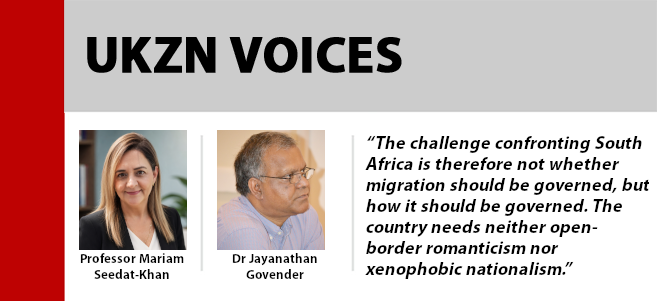
The challenge confronting South Africa is therefore not whether migration should be governed, but how it should be governed. The country needs neither open-border romanticism nor xenophobic nationalism. It requires ethical migration governance that is lawful, efficient, development-oriented, regionally cooperative and firmly grounded in constitutional human rights. It requires border systems that are credible, immigration institutions that are effective and public discourse that distinguishes structural socio-economic failures from the presence of vulnerable migrants. Ultimately, the migration debate is a test of democratic maturity. The measure of South Africa’s constitutional democracy will not be whether it enforces immigration laws, that is both necessary and legitimate, but whether it can do so without sacrificing the humanity on which its constitutional order rests. The enduring legacies of Meer and Hogan remind us that ethical leadership is measured not by political popularity but by moral integrity. Not by the willingness to exploit public fear, but by the courage to defend justice when it is least convenient. Their lives call on South Africans to reject the politics of scapegoating, embrace the discipline of truth-telling and build a society capable of protecting both its sovereignty and its humanity. In the final analysis, democracy is strongest not when it excludes the vulnerable, but when it demonstrates that the rule of law and the dignity of every human being can coexist within a single constitutional vision.
The contemporary migration debate is ultimately far more than a discussion about borders. It is a test of South Africa’s constitutional character and democratic maturity. Every society possesses the sovereign right to regulate migration and secure its borders, yet the legitimacy of that authority depends on whether it is exercised with fairness, legality and respect for the inherent dignity of every human being. Migration has shaped the development of every civilisation, contributed to the growth of modern capitalism and played a central role in the making of South Africa. To reduce migrants to the source of complex structural problems such as unemployment, inequality, corruption and institutional decline is both sociologically unsound and historically inaccurate. The enduring legacies of Meer and Hogan remind us that truth-telling, ethical leadership and public courage remain indispensable to democratic life. South Africa therefore requires neither open-border idealism nor xenophobic nationalism, but a principled migration framework that combines effective governance, constitutional fidelity, African solidarity and philosophic humanism. Only by protecting both sovereignty and humanity can the country remain faithful to the democratic values on which its constitutional order was founded.
The annual Professor Fatima Meer lecture takes place at the Howard College Theatre on 29 August 2026 from 14h00 to 16h00. All are welcome. RSVP here
*Professor Mariam Seedat-Khan is a Clinical Sociologist in the Department of Sociology at the University of KwaZulu-Natal. She is Vice-President of the ISA Research Committee on Clinical Sociology (RC46) and Certification Board Chair of the Association for Applied and Clinical Sociology (AACS). Her scholarship integrates decolonial, feminist and community-based approaches to social transformation. As Chair of the Fatima Meer Memorial Lecture Committee, she advances public scholarship rooted in equity, activism and care. Her research and advocacy bridge academia and civic engagement, emphasising justice-oriented sustainability and inclusive social change.
*Dr Jayanathan Govender is a member of the academic staff in the School of Sciences, Department of Sociology at the University of KwaZulu-Natal. His scholarship is informed by an interdisciplinary and intersectional Southern Sociological praxis, bringing together diverse theoretical traditions to address questions of social justice, public policy and democratic transformation. He has published extensively in peer-reviewed journals, scholarly books, and edited volumes. His most recent co-edited volume, Sociology of Inequality in BRICS Countries (2025), published jointly by Frontpage and Palgrave Macmillan, advances comparative Sociological analyses of inequality across the BRICS nations and contributes to the growing body of scholarship emerging from the Global South.
*The views and opinions expressed in this article are those of the authors and do not necessarily reflect the official policy or position of the University of KwaZulu-Natal.

You may also like

From Viral Voice to Varsity Graduate: Paradise Mdlalose Takes a Bow

