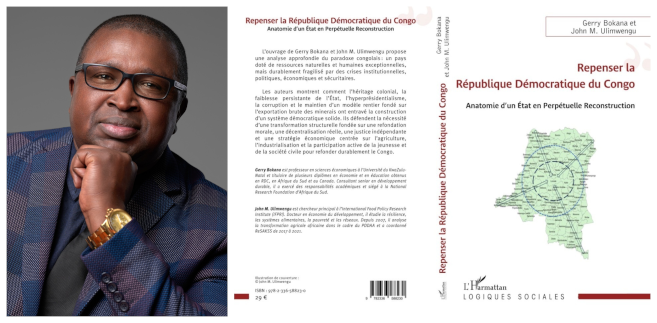
University of KwaZulu-Natal (UKZN) academic Professor Gerry Bokana and colleague Dr John M Ulimwengu have authored a book titled: Rethinking the Democratic Republic of Congo: Anatomy of a State in Perpetual Reconstruction.
The work engages a central question frequently raised within Congolese academic and policy circles: “Why does the Democratic Republic of the Congo (DRC), endowed with extraordinary mineral wealth and strategic assets, remain trapped in a condition of recurrent institutional fragility and economic underperformance?”
In the following short synopsis Bokana details a variety of interesting aspects in the book:
“Our analysis is framed by a dual premise: concern and hope. “First, concern about a country of immense and extraordinary mineral wealth and strategic assets that has nonetheless been persistently weakened by political instability, institutional fragility, governance failures, and recurrent national security crises.
“Second, hope because despite repeated economic shocks, protracted conflicts and structural constraints, we contend that the DRC is neither condemned to failure nor irrevocably bound by its historical trajectory,” he added.
From an economics perspective, the book situates the DRC experience within broader theoretical debates on state capacity, the political economy of sustainable development, and the ‘resource curse’. “We critically examine how colonial extractive institutions shaped a production structure oriented toward primary commodity exports rather than diversified, productivity-enhancing growth. We then assess post-independence governance from 1960 to the present, identifying persistent structural weaknesses: excessive centralisation of authority, weak regulatory and judicial institutions, systemic corruption, limited fiscal and budgetary capacity, and the marginalisation of citizens from effective participation in economic decision-making.
“Using macroeconomic indicators: GDP per capita trends, savings and investment ratios, trade composition, foreign direct investment (FDI) flows, and aid dependence, we demonstrate how structural reliance on raw mineral exports, combined with low levels of productive investment and limited industrial transformation, have constrained sustainable and inclusive growth,” he said.
The book also addresses the political economy of conflict, particularly in eastern DRC. Armed conflicts are examined not only as humanitarian crises but as manifestations of weakened state authority, contested control over natural resources, and regional geopolitical dynamics, including interference by neighbouring states such as Rwanda and Uganda. Institutional fragility and governance deficits continue to undermine both security and sustainable development outcomes.
However, the work is not intended as a catalogue of failures. It advances a normative and policy-oriented framework for reconstruction, grounded in economic reasoning and institutional reform.
They argue that sustainable transformation requires:
- Credible, accountable, and rules-based institutions
- Good governance oriented toward the provision of public goods and the protection of property rights
- Economic diversification beyond primary commodity exports
- Substantial investment in human capital formation
- Effective decentralisation supported by meaningful fiscal and budgetary autonomy
“In this sense, the reconstruction of the DRC cannot rely on external interventions alone. It requires endogenous institutional reform, informed citizens, responsible leadership, and coherent long-term public policy design.”
The book is intended to contribute to a broader academic and policy debate, engaging decision-makers, researchers, faculty members, students, civil society actors, and members of the diaspora. “We view it as a platform to stimulate rigorous national dialogue on institutional reform, economic transformation, and intergenerational responsibility,” they said.
The publication is dedicated to Congolese youth, those who critically question prevailing narratives yet remain committed to the possibility of a DRC governed by reason, justice, and strategic vision.
A digital preview is currently available through our e-reader platform: https://liseuse.harmattan.fr/9782336588230
As a collegial and academically oriented suggestion for the 2026 calendar year, they encourage all colleagues to adopt the following professional resolution: to strengthen their proficiency in French and to engage critically with the book.
“We would be honoured if colleagues engage with the work and, where appropriate, incorporate it into discussions, seminars or research conversations related to economics, sustainable development, political economy and African state formation.”
* Bokana is a Research Fellow in the Discipline of Economics at the School of Commerce in UKZN’s College of Law and Management Studies, while Ulimwengu is a Senior Research Fellow in the Development Strategies and Governance Unit of the International Food Policy Research Institute (IFPRI).
To access the book, click here.
Words: NdabaOnline
Images: Supplied