
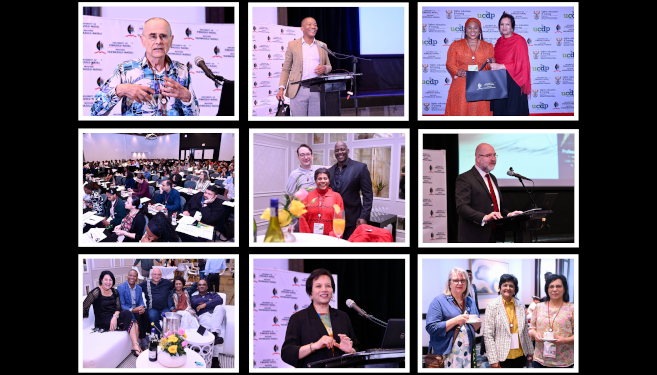
Conference Positions Students at the Centre of Artificial Intelligence Learning
- Posted by ukzn-admin
- Categories News
- Date November 6, 2025
‘Student Success in the Age of Artificial Intelligence (AI): When Human Potential Meets AI in the Learning Revolution’, was the theme of the Innovations in the Science of Teaching and Learning Conference (ISTOL).
The three-day event, hosted by UKZN’s Teaching and Learning Office (UTLO), was attended by national and international scientists, researchers, scholars, and teaching and learning practitioners.
In his opening remarks, Deputy Vice-Chancellor of Teaching and Learning at UKZN, Professor Thabo Msibi, reflected on the responsibility of educators in empowering students to be both employable and entrepreneurial, and to be citizens that could adapt, innovate and lead with integrity.
Msibi noted how the conference had shifted from being focused on the scholarship of teaching and learning, to the science of teaching and learning, an evolution that includes all forms of science so as to better understand how students live, how educators teach and how Higher Education can be used to equip both staff and students for the future.
Commenting on UKZN’s own pivotal transition with the launch of Project Renewal which had seen the consolidation of 19 Schools into nine, Msibi said: “We are reimagining our curriculum through a very ambitious module rationalisation process and positioning ourselves to deliver sound and forward -looking online programming. At the heart of all of these efforts is a simple but profound commitment, to centre the students and their learning. In doing so, we are not forgetting about the vital role of teachers, because teaching and learning together define the soul of the University,” he said.
Interim Director of the UTLO Professor Nyna Amin defined AI learning as the systematic inquiry into acquiring new neural pathways.
Drawing on Aesop’s Fables – stories that have been told for centuries to illuminate human behaviour – Amin connected their timeless lessons to patterns emerging in the current educational climate and the ongoing digital transformation.
She said: “AI must be embraced for growth to take place. While it requires deep learning, time, consolidation, reflection, and integration must also be prioritised. Learning should focus on building neural pathways rather than merely consuming information. Emotional intelligence, ethical thinking, and contextual wisdom are essential for remaining authentically human while collaborating with artificial intelligence. Moreover, what we choose to measure in assessments should reflect what truly matters, not simply what is easiest to test.”
In his keynote address Professor Donrich Thaldar of UKZN’s School of Law used calligraphy to encourage the use of AI. Thaldar said people were the verifiers of information, using AI to validate text. He highlighted the benefits of using both artisanal and technology aspects to merge the two worlds and dismantle the avoidance, bans and fear associated with the use of AI.
Professor Janel White-Taylor of Arizona State University in the United States shared how she has imparted knowledge with the use of AI bots enabling her students to interact with material longer and learn more. White-Taylor said it was important for AI to be integrated at every level of a university and for a dedicated team to be assembled for those systems to be entrenched in teaching and learning.
Director of the Global Quality Assurance Association based in Accra, Dr Violet Makuku, spoke on the correlation between student enrolment and institutions embracing AI, while Dr Andre van Zyl of the North West University warned in his presentation about the incorrect use of AI, urging participants to always be conscious of the responsibility attached to having “access to great power”.
Professor Lesley le Grange of Stellenbosch University highlighted the link between epistemological access and student success in a post-plagiarism world; while Professor Melissa Warr of the University of New Mexico reflected on how AI could be used as a mirror to bring about inclusion in terms of identity, ideas, languages, religion and culture for minority groups.
The conference included panel discussions on the economy of micro-credentialling and as well as whether age mattered in the era of AI from a Higher Education perspective.
In breakaway rooms the following topics were discussed: AI in Education; Student Support and Success; Equity, Inclusion and Justice; Discipline-specific Education; Curriculum Transformation, and Wellbeing, Ethics and Society.
An Innovation Room hosted discussions on themes such as AI in Action, Immersive Learning, and Co-creating the Future of Education with participants getting an opportunity to engage in gamification and virtual reality.
Winners of the ‘I Matter’ student competition – Mr Sinakhokonke Ximba, Mr Siyabonga Khumalo and Ms Avanee Gajadhar – recited thrilling renditions of their poetry; while participants were treated to a fun Sophiatown themed cocktail evening.
In his closing remarks, interim CEO of UKZN’s Extended Learning Unit, Dr Crispin Hemson, focused on a future where AI incorporated and embraced the use of indigenous languages. Noting the paucity of African history on AI platforms he encouraged users to pose questions for machine learning to take place.
Hemson thanked the UTLO for hosting an incredible conference filled with knowledgeable insights gained from participants around the world.
Words: Hlengiwe Khwela
Photographs: Albert Hirasen

You may also like

UKZN Students’ Association Donates New Shoes to Primary School

UKZN Hosts Launch of Transformative Career Enhancement Code Series
