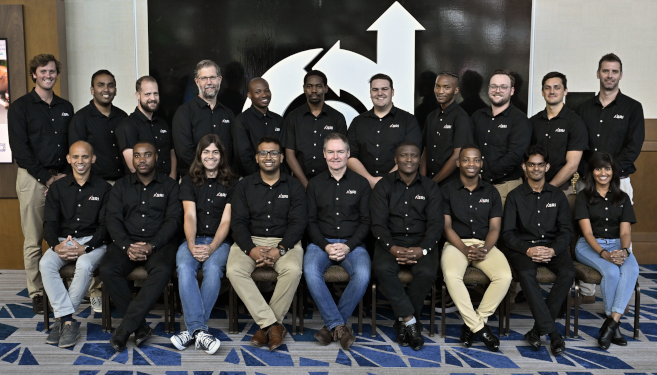
ASRI’s Rocket Engineers Take to the Global Stage
A team of students and staff from the Aerospace Systems Research Institute (ASRI) within UKZN’s School of Engineering participated in the 2024 SciTech aerospace conference hosted by the American Institute of Aeronautics and Astronautics (AIAA). South Africa’s Department of Science and Innovation supported the trip.
SciTech showcases the latest global developments in aerospace engineering. The event, which ran from 8 to 12 January in Orlando, Florida, is one of the largest international aerospace conferences. It attracted more than 6 000 delegates from 48 countries, including around 2 000 students from the world’s top universities. In addition to academic presentations, AIAA hosts an exhibition of major aerospace companies such as SpaceX, Boeing, Lockheed Martin and NASA to enable networking and knowledge transfer with young professionals.
This year, SciTech hosted 2 500 technical presentations covering a range of cutting-edge topics from liquid propulsion cryogenics, to machine learning in combustion, applied surrogate modelling, and hypersonics, aerodynamics and green engineering.
The ASRI team delivered 15 papers, detailing the institute’s space propulsion research in hybrid, liquid and gelled propellant categories. These were positively received, resulted in the forging of many valuable contacts and laid the foundation for new research collaborations with entities such as the University of Glasgow and the German Aerospace Center (DLR).
The 20-strong ASRI’s team included postgraduate students, engineers, and senior engineers. Among other topics, its technical presentations focused on ASRI’s SAFFIRE liquid rocket engine ablative thrust chamber development, the development of an injector test rig to characterise the behaviour and spray patterns of gelled rocket propellants, flight testing of the Phoenix 1C and 1D hybrid rockets, an ASRI-developed rocket propellant pump code, testing and numerical optimisation of pumps using surrogate modelling, and the numerical and experimental analysis of slosh reduction in propellant tanks using different baffle configurations.
Copies of ASRI’s 2024 SciTech conference publications are available on the institute’s website at https://aerospace.ukzn.ac.za/publications.
SciTech 2024 provided ASRI and UKZN with invaluable international exposure. The younger researchers gained confidence-boosting experience in presenting to international audiences and the opportunity to rub shoulders with global leaders in the aerospace field. The conference also provided ASRI with a platform to highlight the quality of aerospace research in South Africa.
During the trip, the ASRI engineers visited the nearby NASA Kennedy Space Center and toured the facilities. The team viewed astonishing space hardware including various early space-age rockets and propulsion units such as the Saturn V engines that took the Apollo astronauts to the moon. In the Kennedy Space Center (KSC) Gateway Center, they observed a SpaceX Falcon 9 booster as well as replicas of Blue Origin’s New Shepard crew capsule, a Boeing Starliner simulator and flight-flown Orion EF1-1 and SpaceX Cargo Dragon COTS-2 capsules.
A highlight of the trip was the opportunity to witness two live launches of SpaceX Falcon rockets from Cape Canaveral. These Starlink missions placed internet satellites into low-Earth orbit. One of the launches occurred at night, providing a particularly impressive display. The team returned to South Africa invigorated by their experiences and eager to continue their work, which focuses on developing satellite launch capability for South Africa and the African continent.
Words: Vedanth Reddy
Photograph: Supplied