A father’s absence does not always announce itself loudly; it shows up later in how young men learn to handle pressure, silence and expectation.
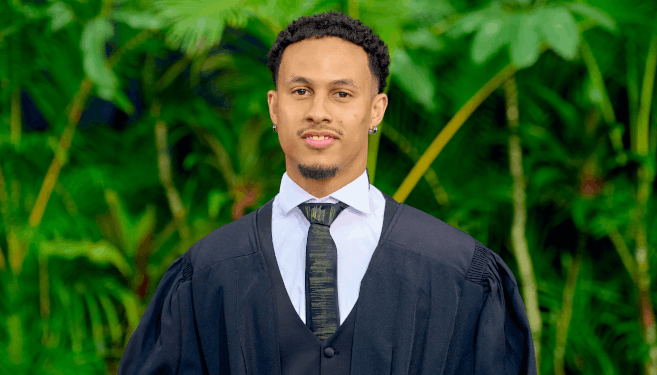
For Mr Jaden Thurston, this reality became the starting point of his Master of Education research titled: ‘Male University Students in Absent-Father Households: Masculine Performances and Resilience’.
Thurston approaches the topic with a balance of academic clarity and lived understanding. “I not only lived in a household where a father was absent, but also began to notice how prevalent this experience was around me.”
Supervised by Professor Shakila Singh, his research draws on this dual position – personal experience and academic inquiry – to look beyond absence itself and into what it produces over time, how young men adapt and how they come to understand what it means to ‘be a man’ without a consistent paternal figure.
A consistent thread across his findings is self-reliance. Participants repeatedly describe learning early on to depend on themselves.
“In essence, the participants are aware of the circumstances that they have lived through; however, because of this, they ensure that they are not dependent on anybody other than themselves.’
He explained that this independence shapes how the students approach university demands, personal challenges and emotional pressure. Self-discipline, self-regulation, and self-dependence appear throughout their accounts as ways of coping rather than abstract ideals.
One recurring theme is the weight of rigid ideas about masculinity, often expressed through phrases such as “men don’t cry”. For some participants, these ideas were explicitly taught. For others, they were absorbed quietly through environment, expectation and observation.
Thurston noted that even when participants did not directly speak about pressure to conform, many still described behaviour shaped by it, especially in how they managed emotion and vulnerability.
One account stood out during interviews. A participant described how his older sister played a central role in his upbringing. “She has guided him into manhood and ultimately taught him things that he believed he should have been taught by a father,” he recounts.
“It is not often that you hear males openly speak about how the guidance of a female can shape their male identities. That was quite powerful for me.”
In such moments, masculinity appears less fixed than assumed, less something inherited from one source and more something built through whoever is present enough to shape it.
Across the broader study, university life becomes a space where these identities are continuously tested. Academic pressure is not separate from personal history; for many participants, it intensifies it. Success is often framed as proof of control, discipline and direction in the absence of paternal structure.
Alongside this, students describe different ways of coping. Some lean on sport and informal social spaces as outlets for stress. Others describe withdrawal, with time alone used for reflection, planning or emotional reset. Practices such as journalling and vision-boarding emerge as quiet but deliberate tools for stability and focus.
At an emotional level, however, certain gaps remain visible. Several participants link father absence to difficulty navigating relationships, particularly with women, noting that they had not been guided in these areas while growing up. Others describe an internal pressure to avoid vulnerability, even in moments where it is needed.
Thurston describes them as ongoing negotiations between expectation and experience, silence and expression, independence and connection. Many participants also express a desire to “be better than their fathers,” whether in presence, responsibility or emotional availability in future families. This reveals a forward-looking form of identity-making, shaped as much by what was absent as by what was present.
His hope is that the research contributes to wider conversations still unfolding in South African contexts.
“I hope that a study like mine could be expanded upon and provide male university students and other young males with a platform where they feel more free to share their experiences.”
Words: Rakshika Sibran
Photograph: Sethu Dlamini