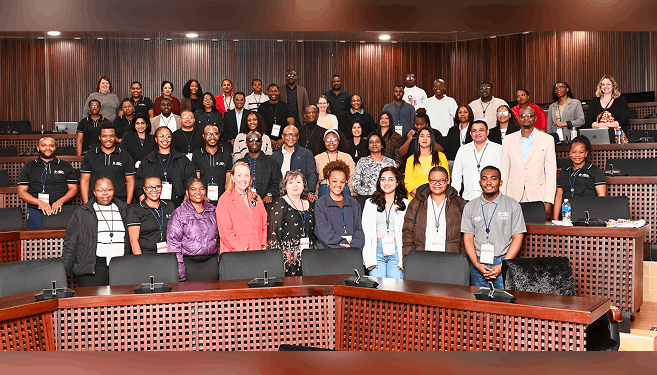
The University of KwaZulu-Natal’s (UKZN) University Teaching and Learning Office (UTLO) hosted the Third Instructional and Learning Design Symposium, bringing together academics, instructional designers, professional services staff, students and colleagues from the Durban University of Technology (DUT), Mangosuthu University of Technology (MUT) and the University of Zululand (UNIZULU) to explore the future of digitally enabled teaching and learning.
Held under the theme ‘Advancing Digital Curriculum Transformation through Evidence-Led Design’, the symposium examined how digital curriculum transformation can be designed, implemented, evaluated and continuously improved through evidence-informed teaching and learning practices.
Welcoming delegates on behalf of the Deputy Vice-Chancellor: Teaching and Learning, Professor Thabo Msibi, UTLO Interim Director Professor Nyna Amin, challenged Higher Education Institutions to remain focused on their educational purpose amid the rapid pace of technological change.
Drawing on the fable of ‘The Man, His Son and the Donkey’, Amin cautioned against adopting educational technologies simply because they are new or widely promoted. “A university that changes direction at every shout from the roadside soon finds itself in the position of the man and his son,” she said. “It ends up carrying its technologies instead of being carried by them.”
She warned that when institutions become distracted by trends, “students accumulate logins rather than learning”, adding that the real casualty is the student learning experience itself, the foundational purpose that all our tools were meant to serve.”
Amin explained that the symposium was established to ensure that digital transformation remains purposeful and evidence-driven.
“Evidence-led design is the discipline that allows us to decide which voices deserve our attention and which deserve a polite nod as we walk on,” she said.
Delivering the keynote address, ‘Whose Evidence? Rethinking What Counts in Digital Curriculum Transformation’, Senior Lecturer and Educational Technology Specialist at Rhodes University’s Centre for Higher Education Research, Teaching and Learning (CHERTL), Dr Nicola Pallitt, challenged delegates to broaden their understanding of what constitutes evidence in digital learning.
“Evidence-led curriculum design should move beyond platform analytics and performance metrics to include students’ learning experiences and voices,” she argued.
Drawing on Ubuntu philosophy and principles of epistemic justice, as well as trauma-informed, decolonial and humanising pedagogies, Pallitt encouraged institutions to design learning experiences that are responsive to the realities of African Higher Education contexts.
She emphasised that meaningful digital curriculum transformation requires educators to ask not only whether technologies improve performance, but also whose experiences are recognised, whose knowledge counts and whose voices are heard in curriculum design.
Academic presentations showcased innovative teaching practices developed through collaborations between lecturers and instructional designers, while student presenters reflected on how digital transformation has influenced their own learning experiences.
A panel discussion, ‘Advancing Digital Curriculum Transformation: Cross-Institutional Perspectives on Evidence, Progress and Future Directions’, featured representatives from UKZN, DUT, MUT and UNIZULU, highlighting the value of collaboration in strengthening evidence-led teaching and learning across the sector.
The symposium concluded with the presentation of the Digital Curriculum Transformation Portfolio Awards, recognising academics whose sustained innovation and evidence-based practice have made a significant contribution to teaching and learning. Award recipients, Professor Nishani Harinarain and Professor Veena Singaram together with Dr Rayishnee Pillay (collaborated on one project) received institutional prizes of R10 000 and certificates in recognition of their achievements.
In his closing remarks, Mr Mukondeleli Mulaudzi, an instructional designer, reminded delegates that digital curriculum transformation is not a destination but a continuous journey of learning, innovation and improvement. Reflecting on the symposium’s theme, ‘Advancing Digital Curriculum Transformation through Evidence-Led Design’, he encouraged academics and support staff to ensure that technology serves learning and that evidence informs meaningful curriculum decisions.
Mulaudzi concluded by challenging delegates to build systems that support both student success and institutional growth. He urged the University community to continue fostering collaboration, innovation and evidence-informed practice beyond the symposium, ensuring that curricula, teaching and technology work together to cultivate graduates equipped to meet future challenges.
Words: Lungile Ngubelanga
Photograph: Albert Hirasen