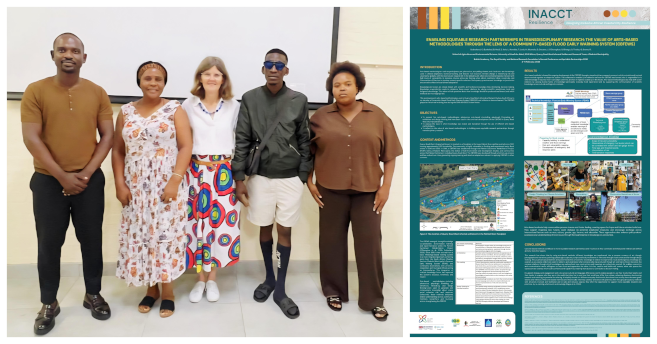
As part of the CLARE-funded (Climate Adaptation and Resilience) Designing Inclusive African Coastal City Resilience (INACCT Resilience) project, and in collaboration with research programmes including SHEFS-SA (Sustainable and Healthy Food Systems – South Africa) and EPIC Durban (Educational Partnership for Innovation in Communities), a team from the University of KwaZulu-Natal (UKZN), led by Professor Cathy Sutherland, attended an event at the CSIR (Council for Scientific and Industrial Research) in Pretoria, which hosted the British Academy, The Royal Society and the National Research Foundation’s 2nd Equitable Partnerships Conference.
The team included Ms Sibongile Buthelezi and Mr Nkosinathi Mncwabe, (EPIC Durban Co-ordinator), representing UKZN and eThekwini Municipality through the Durban Research Action Partnership (DRAP) as well as Ms Zandile Ntuli and Mr Luyanda Xolo, two community-based researchers from Quarry Road West informal settlement.
The Conference on Equitable Partnerships is an ongoing initiative focused on fostering more equitable and just research collaborations. Key themes included principles for equitable partnerships and knowledge production, capacity building, policy engagement and strengthening stakeholder partnerships.
Buthelezi said that the conference was highly engaging, with speakers sharing their knowledge and lived experiences of building equitable research partnerships and enhancing research quality.
“The discussions were honest and constructive. The conference did not shy away from addressing the challenges of conducting research in the Global South, but approached these in a fair and solutions-oriented manner,” said Buthelezi.
Mncwabe said the conference challenged perceptions of power within research collaborations, adding, “It encouraged participants to reflect on their own agency and responsibility in shaping equitable partnerships. Barriers were openly discussed, but so too were practical solutions.”
The team presented a poster titled: ‘Enabling Equitable Research Partnerships in Transdisciplinary Research: The Value of Arts-Based Methodologies through the Lens of a Community-Based Flood Early Warning System (CBFEWS)’.
“The content and presentation of the poster reflected the co-production of knowledge between academia, communities and municipalities, which is central to transdisciplinary research in Durban,” said Sutherland.
The poster showcased how arts-based methods, including the innovative use of playdough as a participatory tool, enabled community members, municipal officials and researchers to co-design elements of a flood early warning system. The methodology created accessible spaces for dialogue, knowledge integration and shared problem-solving.
The presentation received the Best Original Poster Award, based on a ‘people’s vote’ and adjudication by conference organisers. Ms Ruth Cooper, Senior Policy Advisor at The Royal Society and one of the judges, said the poster stood out for its originality.
“The poster was novel in the way it used arts-based methods to integrate knowledge into a technical process of early warning,” said Cooper.
Dr Hayley Leck, Ms Jo Douwes, Ms Carina Mason from Local Governments for Sustainability (ICLEI), Dr Sean O’Donoghue, Mr Geoff Tooley, Mr Smiso Bhengu and Mr Russell Stow (eThekwini Municipality), contributed to the knowledge and design of the poster.
For the team, including the community members who participated in the playdough methodology, the award was a shared achievement.
“Winning the poster award was an exciting moment for all of us. It affirmed that our partnership model, grounded in mutual respect and co-production, is both meaningful and impactful,” said Buthelezi.
Attendees expressed strong interest in the poster, noting that it provided compelling evidence of how equitable partnerships between researchers, communities and local government can strengthen both research processes and outcomes.
The recognition aligns closely with UKZN’s 2023–2032 Strategic Plan, particularly its goal of building on strong regional relationships and existing capabilities to co-create, understand and apply world-class research across social, economic, health, environmental and cultural agendas.
“INACCT, SHEFS-SA and EPIC Durban exemplify this commitment by positioning communities not as research subjects, but as co-researchers and knowledge holders. Through collaboration with municipal partners and interdisciplinary research teams, the projects advance contextually grounded solutions to complex urban challenges such as climate risk and flooding. The award not only celebrates a successful poster presentation, but underscores the value of equitable, inclusive and transdisciplinary partnerships in shaping resilient African coastal cities, and in strengthening the quality, relevance and impact of research emerging from UKZN,” added Sutherland.
Words: NdabaOnline
Images: Supplied