
UKZN Scientists Receive L’Oréal – UNESCO For Women in Science National Awards
- Posted by ukzn-admin
- Categories News
- Date November 3, 2023
UKZN Scientists Receive L’Oréal – UNESCO For Women in Science National Awards
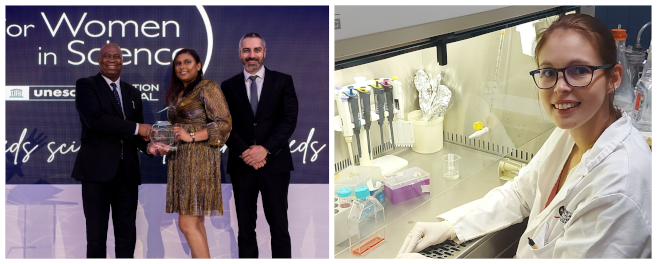
Postdoctoral researchers in biochemistry and health sciences Drs Alexandre Delport and Nireshni Mitchev are among the seven female scientists who were honoured with a L’Oréal-UNESCO For Women in Science (FWIS) South Africa National Young Talents Programme Award at the 2023 awards ceremony.
They are joined by two post-doctoral and three doctoral Laureates: postdoctoral researchers, Drs Mapula Razwinani from the Durban University of Technology and Gugu Kubheka from the University of Pretoria, and doctoral candidates Ms Sapokazi Timakwe from the Cape Peninsula University of Technology, Ms Alexandra Howard from the University of the Free State, and Ms Anna Chrysostomou from the University of Johannesburg.
Over a period of 25 years, the international Fondation L’Oréal – UNESCO FWIS programme has supported 250 female scientists on the cusp of their careers through 52 regional and national programmes that aim to remedy imbalanced female representation in research and the sciences – where women represent only 33.3% of researchers globally according to UNESCO – by assisting talented female scientists through each step of the scientific research system. Five Laureates have gone on to win Nobel Prizes.
The South African national programme is in its fifth year and provides funding – PhD grants of R 80 000 and postdoctoral grants of R160 000 – to women scientists to support their research.
In a country where, according to a 2021 Global Gender Report cited by L’Oréal South Africa Country manager Mr Serge Sacre, less than 13% of women choose to study Science, Technology, Engineering and Mathematics (STEM), representation at every level of the scientific supply chain is vital.
L’Oréal has prioritised investment in the sciences and promotion of gender equality in these fields.
‘At L’Oréal, we envision a world where girls are encouraged to study science and are enabled to do so, where female students stay the course in pursuing their postgraduate studies, and where scientists are judged purely on the merit of their discoveries and the potential of their work to change the world,’ said Sacre, who congratulated the L’Oréal – UNESCO For Women in Science recipients of 2023.
‘I was absolutely thrilled that our project was selected for this prestigious award,’ said Delport.
‘The award ceremony was breath-taking and the L’Oréal – UNESCO FWIS organising committee really made us feel that we were the top young women scientists in South Africa. I am excited and proud to be an ambassador for all women in science and fly our flag high and would like to thank all those who have contributed to my scientific career and UKZN for all the support towards our research,’ she said.
Delport, who completed her studies from undergraduate to PhD level on UKZN’s Pietermaritzburg campus, was drawn to the field of biochemistry during her undergraduate studies and pursued a master’s degree on African trypanosomiasis or sleeping sickness.
An internship in the laboratory of Professor Raymond Hewer piqued her interest in drug discovery and her PhD research involved the design and evaluation of compounds that remove amyloid precursor protein (APP). Upregulation of APP has been implicated in several diseases including early onset Alzheimer’s disease, Down Syndrome, cancers, and obesity, and removal of the protein represents a novel strategy to combat these diseases.
During her PhD studies, Delport visited the Technical University of Kaiserslautern in Germany, funded by the National Research Foundation (NRF)-German Academic Exchange Service (DAAD) In-Country Scholarship, and spent time in the laboratory of an expert in neurodegenerative disease and biochemistry, Professor Stefan Kins. Her PhD research resulted in Delport receiving the 2020 Research Excellence Award for Next Generation Researchers from the National Research Foundation (NRF).
She continued to a postdoctoral fellowship under Hewer’s supervision, building on her PhD work by optimising their APP-removing compounds. She has undertaken the first pilot preclinical study to assess these compounds as a possible treatment for obesity. Delport’s proposal to use APP-removing compounds to combat obesity in women, the predominant obese population in South Africa, won her the FWIS award.
Her research also has a patent pending and has attracted provisional seed funding from the Technology Innovation Agency and interest from local pharmaceutical companies. She continues to work on producing the necessary preclinical data to allow for further development of these compounds as a potential new drug candidate to treat obesity. The team hopes the drug candidate will meet efficacy and safety requirements to begin clinical trials within the next three years.
Last year, Delport was one of only 11 South African scientists selected to travel to Germany for the annual Lindau Nobel Laureate Meeting focused on the field of chemistry, following nomination by the Academy of Science of South Africa (ASSAf). She was also recently awarded the South African Medical Research Council Self-Initiated Research Early Career Research Grant which includes three years’ funding to conduct her research and advance her career as an independent researcher. She has published seven journal articles in international journals, two as the corresponding author.
Delport, who enjoys the laboratory aspect of her field, is aiming for a career in research and academia.
Mitchev is pursuing research on diagnostic innovation projects, focusing on sexually transmitted infections (STIs) and other infectious diseases. She was inspired to pursue this avenue of research after years of research on STIs highlighted the prolific associated adverse reproductive health sequelae which could be prevented with early diagnosis and treatment and is working under the supervision of tuberculosis and HIV expert Professor Veron Ramsuran.
‘We can make a difference in women’s health through innovation and translational research,’ she said.
Mitchev was drawn to the L’Oréal-UNESCO FWIS programme because of its specific focus on the contributions of women leading research in their respective fields.
‘For me, it acknowledges the fact that women wear multiple hats; we have families and additional roles. This funding is flexible and caters for many factors to assist female scientists to grow,’ said Mitchev.
‘I also look up to the L’Oréal-UNESCO alumni and am proud to now be associated with this amazing initiative. I am honoured that the importance of my research and the impact it will have on women’s health has been recognised. This award is a reminder that I am making a difference and motivation to keep persevering,’ she said.
Recognising the impact this award will have on her research and her professional development and network, Mitchev is also motivated by the boost it provides to women in science, who she says have always been in the field but not adequately acknowledged. She believes supporting diverse perspectives in science can result in more meaningful solutions and provide role models to the next generation of scientists.
Mitchev hopes to one day lead a research team focusing on STIs.
Words: Christine Cuénod
Photographs: Supplied

You may also like


