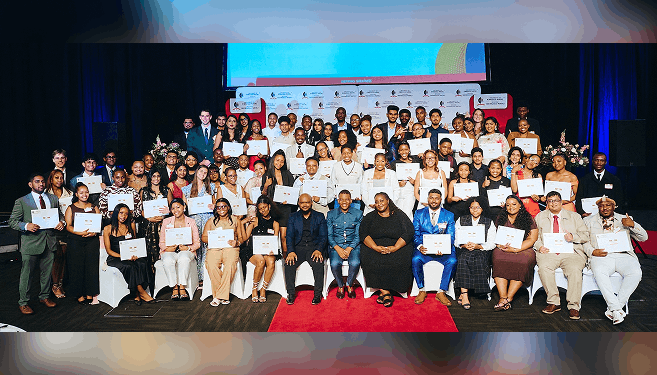
The University of KwaZulu-Natal (UKZN) hosted its prestigious Scholarship Awards Ceremony on Wednesday, 2 September 2026, at the Inkosi Albert Luthuli International Convention Centre (Durban ICC), celebrating outstanding student achievement.
The University recognised 84 students for excellence in academics, community engagement and leadership, while seven were recognised for sporting achievements at provincial or national level.
The merit-based awards celebrate students whose talent is matched by a consistent pursuit of academic excellence, highlighting the diverse ways in which UKZN students are making an impact within and beyond the University.
Delivering the welcome address, UKZN Scholarships Committee Chairperson and Deputy Vice-Chancellor: Teaching and Learning, Professor Thabo Msibi, said the ceremony showcased all-round student accomplishment.
He noted that the ceremony takes place at a defining moment in UKZN’s history, following the consolidation of its academic structures from 19 Schools to 10 as part of the University’s institutional renewal agenda, Project Renewal, and Strategic Plan 2023–2032. He also expressed appreciation to the University’s external partners and trustees for their continued support and investment in UKZN students.
Delivering the keynote address, Dr Judy Dlamini, UKZN alumna and Mbekani Group Founder and Executive Chairperson, challenged students to view their awards as an investment in their future potential. “This scholarship is not a reward for the past, it is an investment into the future,” she said.
Emphasising that leadership is about ethics rather than titles, Dlamini urged students to take responsibility for their impact on society. She added that success is rarely achieved alone, pointing out how first-generation graduates can uplift entire families and communities. “We are communal individuals. None of us succeeds alone,” she said, encouraging students to remember the parents, grandparents, teachers, mentors, friends and scholarship partners who supported their journeys.
Turning her attention to the country’s history of youth activism, Dlamini noted that South Africa just celebrated 50 years since the youth of 1976 stood up against an unjust education system. “They were change leaders. Today, you are the new change leaders,” she said. She challenged students not to wait for opportunities to be created for them, but to become active participants in shaping their own futures and contributing to the transformation of society. “Do what you can, with what you have, where you are. Become an agent for the change you want to see and the change we so desperately need,” she urged.
Providing a powerful personal account of the transformative impact of education was UKZN alumna and former Emma Smith Overseas Scholarship recipient, Ms Thobile Sibiya.
Sibiya, who hails from Mshalane, a small village in Paulpietersburg in northern KwaZulu-Natal, reflected on attending Sidubelo Primary School and Abaqulusi High School, both Quintile 1 schools. She travelled between two and three hours on foot each day to attend high school. Her determination saw her graduate cum laude from UKZN following her undergraduate studies in Early Childhood Development. She subsequently completed an Honours in Educational Psychology, graduating summa cum laude, before pursuing a master’s degree at the University of Nottingham, United Kingdom, through the Emma Smith Overseas Scholarship. “I did not want more than my village; I wanted more for my village,” she said.
She expressed her gratitude to the Emma Smith Overseas Scholarship and UKZN for investing in her potential, as well as to those who administer scholarships and make life-changing opportunities possible. “Your work is not paperwork. It is the quiet machinery of transformation,” she said.
Reflecting on the significance of receiving the scholarship, she said it gave her agency and the opportunity to make choices about her future.
While studying abroad, Sibiya also shared her Zulu heritage with members of her church community, teaching them traditional Zulu songs. For her, this demonstrated the reciprocal nature of education.
Addressing the current scholarship recipients, Sibiya urged them to recognise the responsibility that accompanies opportunity. “A scholarship is not a reward for where you have been. It is an investment in where you are going and in those whom you will bring with you,” she said.
The ceremony highlighted that academic excellence is not an end in itself, but a foundation for purposeful leadership, ethical decision-making and service to others.
Words: Lungile Ngubelanga
Photograph: Sethu Dlamini