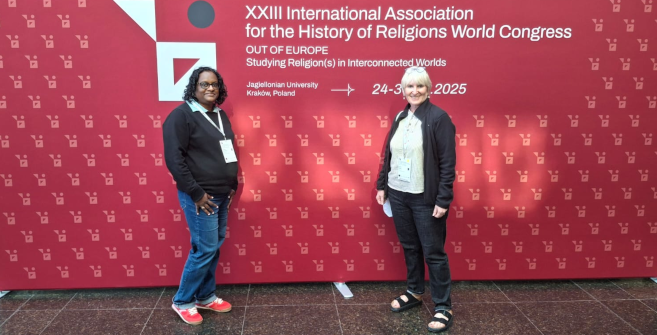
University of KwaZulu-Natal (UKZN) Religion scholars Dr Beverly Vencatsamy and Dr Cherry Muslim, from the School of Arts, attended the XXIII International Association for the History of Religion (IAHR) World Congress in Krakow, Poland.
Held at Jagellonian University in Krakow, the second oldest university in Europe, the week-long congress featured scientific discussions, intellectual exchanges, and collegial interactions among scholars from around the world. Organisers aimed to foster a vibrant atmosphere and advance the global study of religion(s). Centred on the theme ‘Out of Europe: Studying Religion(s) in Interconnected Worlds’ the congress explored the creative tensions between the discipline’s European roots and its global evolution, while offering reflections on both its past and future trajectories.
Vencatsamy and Muslim presented papers engaging with the congress theme of religions in interconnected worlds, hoping to retrace the discipline’s development and explore new directions. Vencatsamy also represented the Association for the Study of Religion in Southern Africa (ASRSA), where she currently serves as General Secretary.
Muslim’s presentation titled: ‘From Apparent Imposter to Affirmed Expert: Navigating Positionality in Islamic Studies Scholarship’ was an autoethnographic exploration of the complex, fluid positionalities of an atypical Muslim academic within the South African Higher Education context. She unpacked the dynamic negotiations of identity, expertise and scholarly legitimacy that characterise her academic experience in Islamic Studies and the teaching of religion.
“Ultimately, my research offers a nuanced examination of scholarly positioning in religious studies, arguing that identity is not a fixed category but a dynamic, contextual negotiation. By revealing the complex interplay between personal experience, community expectations, and academic practice, my study contributes to broader conversations about reflexivity, expertise, and the performative nature of academic identity,” said Muslim.
Vencatsamy’s paper, titled: ‘Decolonising Religious Studies: Challenging the World Religions Paradigm in the South African Educational Context’, critically examined the World Religions Paradigm (WRP) which perpetuates a restrictive, Eurocentric approach that systematically marginalises non-Christian, non-Western, and non-White religious perspectives. Using South Africa’s complex religious landscape as a lens, she illustrated the urgent need for epistemological transformation in religious studies.
Building on the critical momentum of the #MustFall movements (2015-2016), Vencatsamy’s research interrogates how colonial intellectual frameworks continue to shape knowledge production and pedagogy in religious studies. Her paper demonstrates how the WRP fails to capture the diverse religious practices and epistemologies of marginalised communities.
Reflecting on the congress, Vencatsamy said, “While it was encouraging to see the breadth of research being shared, it also highlighted how much work remains in advancing critical and decolonial perspectives within the study of religion.”
Vencatsamy added, “Participating in the congress was an invaluable opportunity for me, not only to share ideas, but also to engage directly with scholars whose work has significantly shaped my own research journey.”
Words: Jennene Naidu
Photograph: Supplied