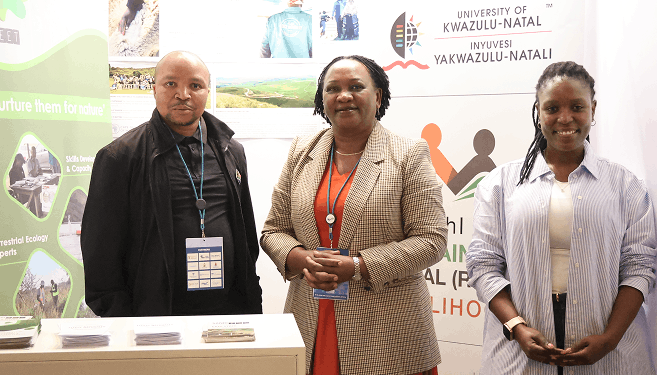
The University of KwaZulu-Natal’s (UKZN) Department of Science, Technology and Innovation (DSTI)/National Research Foundation (NRF) South African Research Chairs Initiative (SARChI) Chair in Sustainable Rural Livelihoods showcased UKZN’s leadership in sustainability research and community-engaged scholarship at the 2026 Sustainability Research and Innovation (SRI) Congress held in Cape Town from 23 to 26 June 2026.
Professor Betty Mubangizi, SARChI Chair in Sustainable Rural Livelihoods, convened and chaired an international panel titled: ‘From Source to Sea: Collaborative Governance, Learning and Scaling in the Umzimvubu Catchment’. The session brought together researchers, government officials and civil society organisations to demonstrate how long-term partnerships are supporting climate resilience, ecosystem restoration and sustainable rural livelihoods in one of South Africa’s most important river catchments.
The panel showcased the work of the Umzimvubu Catchment Partnership (UCP), a multi-stakeholder platform that has become a model for collaborative governance, bringing together communities, municipalities, researchers, conservation organisations and government agencies to co-design and implement sustainable solutions for the catchment.
Presentations by Ms Fezile Matandela, a UKZN student and co-chair of the UCP; Ms Danisile Mavimbela of the South African National Biodiversity Institute (SANBI); Rev/Dr Alice Barlow-Zambodla of Conservation South Africa (CSA); and Mr Lumko Mboyi of the Conservation Exposure Education and Training (CEET), also co-chair of the UCP, illustrated how partnership-based approaches are strengthening landscape restoration, climate adaptation, water resource management, citizen science, spatial planning and monitoring across the catchment.
Representing Alfred Nzo District Municipality, Mr Zola Mbuyana demonstrated how lessons emerging from the partnership are increasingly informing municipal planning, environmental management and climate adaptation.
In her opening address, Mubangizi highlighted the importance of place-based research in addressing complex sustainability challenges. She noted that the interconnected nature of climate change, biodiversity loss, water insecurity and rural poverty requires collaborative governance approaches that bridge disciplinary, institutional and sectoral boundaries.
“The Umzimvubu Catchment has become more than a research site,” said Mubangizi. “It is a living laboratory where researchers, practitioners, government and communities are jointly producing knowledge while testing innovative approaches to sustainable rural development. The lessons emerging from this partnership have significance far beyond the catchment itself.”
A central theme of the session was that sustainable landscape management depends not only on sound science but also on strong institutions, trusted relationships and long-term partnerships capable of translating knowledge into collective action. The discussions demonstrated how the Source-to-Sea approach provides an effective framework for integrating ecological restoration, livelihood enhancement and collaborative governance across entire landscapes.
The session attracted strong interest from delegates representing universities, government agencies, international organisations and civil society, generating valuable discussion on how the Umzimvubu experience can inform sustainability transitions in other rural landscapes across Africa and beyond.
The successful session reflects UKZN’s continued commitment to transdisciplinary research, stakeholder engagement and knowledge co-production through the DSTI/NRF SARChI Chair in Sustainable Rural Livelihoods. It also reinforces the University’s growing international profile in advancing collaborative approaches to environmental governance, climate resilience and sustainable rural development.
Words: NdabaOnline
Photograph: Supplied