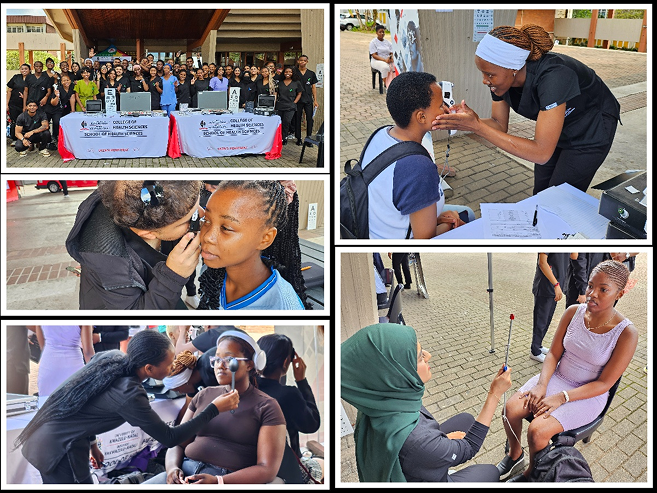
The University of KwaZulu-Natal’s (UKZN) Discipline of Optometry recently hosted an awareness event commemorate World Glaucoma Day on the Westville campus, where students were encouraged to take charge of their eye health through free glaucoma screening.
Senior Optometry students conducted a range of vision and eye pressure assessments to help detect early warning signs of glaucoma among fellow UKZN students. The initiative aimed to increase awareness of the condition and emphasise the importance of routine eye examinations in preventing avoidable vision loss.
Head of Discipline, Dr Naimah Ebrahim Khan, highlighted the seriousness of the condition and the importance of early detection. “Glaucoma is a group of eye diseases that damage the optic nerve, often linked to increased pressure inside the eye, and it is one of the leading causes of irreversible blindness worldwide,” she said. “Often called the ‘silent thief of sight’, glaucoma develops slowly and usually without pain or obvious warning signs. Many people are unaware they have the condition until permanent vision loss has already occurred.”
She explained that early screening remains one of the most effective ways to protect vision. “Regular comprehensive eye examinations can detect glaucoma long before symptoms appear, allowing treatment to begin at an early stage. This is especially important for individuals at higher risk, including those over the age of 40, people with a family history of glaucoma, and individuals of African or Asian descent.”
Dr Nombuso Mathe, Head of UKZN’s Discipline of Ophthalmology, also contributed to raising public awareness of glaucoma. She said: “As a glaucoma specialist, the hardest part of the conversation is explaining that the vision already lost cannot be restored.
Patients are often shocked and distressed, struggling to understand how their sight could deteriorate so severely without warning. This is the quiet cruelty of glaucoma. Unlike cataracts, where vision loss can often be reversed with surgery, glaucoma causes permanent loss of visual function. Each year, World Glaucoma Week reminds us of this reality. The 2026 theme, ‘Uniting for a Glaucoma-Free World’, calls on clinicians, researchers, health systems and communities to work together to prevent avoidable blindness. Yet while this vision is inspiring, it also forces us to confront an uncomfortable truth: the path to a glaucoma-free world is not the same everywhere.”
The screening initiative held on the Westville campus also provided valuable clinical experience for the Optometry students who conducted the tests. Fourth-year Optometry student Mr Nihal Singh said the experience highlighted both the curiosity of students and the importance of eye health education.
“I’ve realised that our students are incredibly inquisitive – they truly personify the phrase ‘fear nothing and question everything,’” he said. Singh recalled a screening where he detected a large cup-to-disc ratio, a potential indicator of increased eye pressure. Although he explained it gently to avoid alarming the patient, the student later researched the condition and returned with numerous questions.
“This experience shows just how interesting optometry can be when people understand its impact,” he said. “It also highlights how important it is to be aware of your eye health status. Routine eye examinations every 1.5 to 2 years could help people identify potential problems early.”
Third-year student Ms Taliah Arjun said her training at UKZN has equipped her with the confidence to recognise and manage suspected glaucoma cases. “As I begin to see more patients, I have become increasingly aware of the hallmarks of glaucoma and what to expect clinically,” she said. “Although glaucoma is often misdiagnosed or overlooked, the awareness and in-depth education we receive at UKZN gives us the confidence to identify potential cases and manage or refer them appropriately.”
Fourth-year student Mr Thabiso Chili described the experience of screening fellow students as both rewarding and educational. “It has been a delightful experience, especially when testing fellow students that I know personally,” he said. “It allows me to follow up with them and answer their questions about their eye health even outside clinic hours, which helps build long-term relationships with our patients.”
He also encouraged students to adopt healthier visual habits, particularly in a digital age where prolonged screen use is common.
“University students often spend long hours on digital devices, which can strain the eyes,” he explained. “Simple habits such as holding devices at an appropriate distance, maintaining full blinks, and following the 20-20-20 rule – looking at something 20 feet away for 20 seconds every 20 minutes – can help reduce visual stress.”
The awareness event not only helped identify potential eye health concerns among students but also reinforced the importance of regular eye examinations and preventative care.
Words: MaryAnn Francis
Photographs: Supplied